
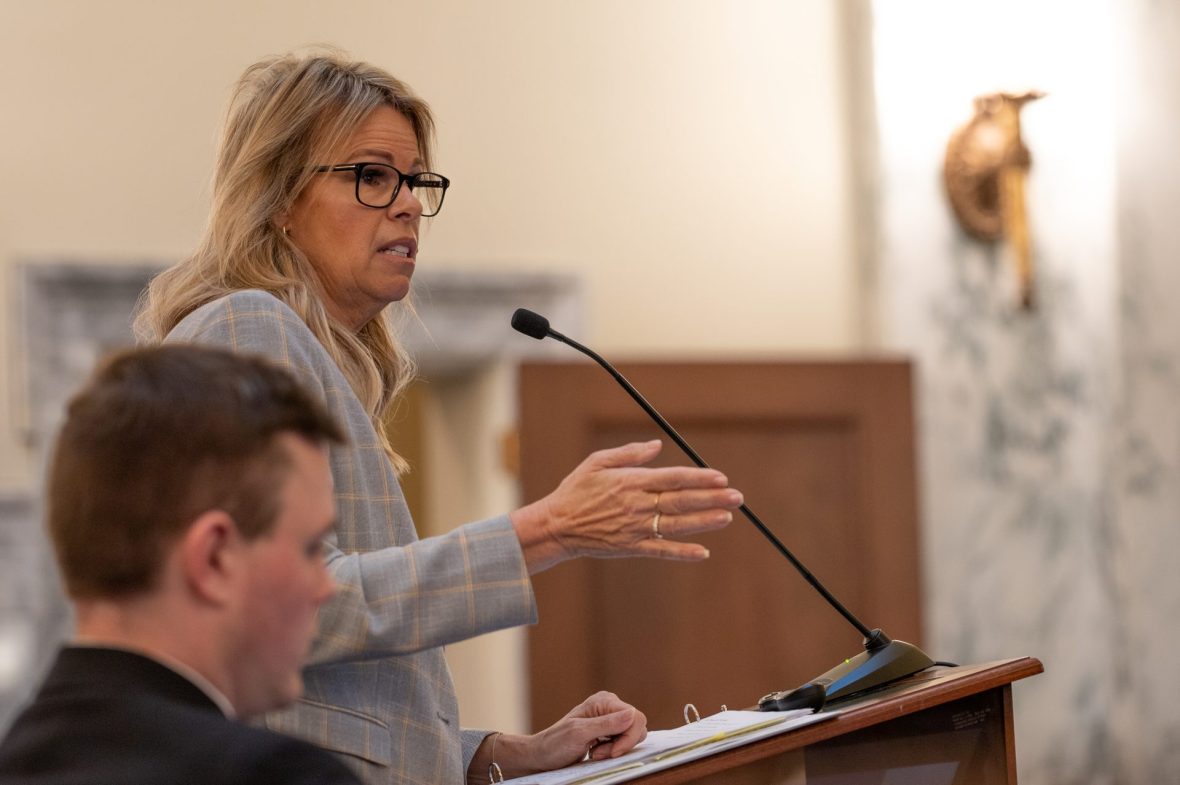
Debbie Critchfield’s top priority from the 2026 legislative session — a new special education account — faces a significant funding decrease.
Instead, the state superintendent wants to put money into one of her longstanding goals: a sweeping K-12 funding formula rewrite.
Critchfield Tuesday submitted her 2027-28 budget request, Step One in a process that will play out during next winter’s legislative session. The governor will present budget recommendations on Jan. 11, the first day of the session. From there, the budget-writing Joint Finance-Appropriations Committee and legislators will approve an array of spending bills for the next fiscal year, which begins July 1.
By the numbers
The 2027-28 K-12 budget request, at a glance:
- General fund (the portion of the state budget covered largely by sales, income and corporate taxes): $2,950,775,700.
- Increase, general funds: $127,554,900, or 4.5%.
- All funds (including federal and dedicated funds): $3,318,940,900.
- Increase, all funds: $125,077,800, or 3.9%.
Here’s what is (and isn’t) in Critchfield’s budget.
Special education. Critchfield is requesting $1.7 million for a “high-needs” special education program created earlier this year. The new program is designed to support special education students who need full-time staff help or expensive equipment and learning materials.
The $1.7 million request is down from the $5 million lawmakers approved this year.
The reason: Critchfield cobbled together this year’s $5 million from carryover money and interest from two in-house accounts. She is tapping into these same accounts for Year Two, but now, only $1.7 million is on hand.
The high-needs program will reimburse districts and charters for student costs exceeding $30,000. And because it’s a reimbursement program, it will be a while before Critchfield’s office starts spending this year’s $5 million — and has a sense of the demand.
“We don’t really have a lot of data at this point,” Critchfield chief of staff Greg Wilson said Monday.
In an EdNews interview in June, Critchfield said she expects the $5 million “to be gone in a minute.”
Discretionary dollars. Next year’s new request is in “operational” funding, sometimes called “discretionary” spending. Schools will receive $367.5 million in operational money this year, and they can use it for any purpose.
Critchfield is seeking a $22.8 million increase. And $20 million is “new” money — above the increase needed to cover an anticipated growth in “support units,” the measure used to distribute operational money.
The $20 million increase would help to offset inflation, after the state froze operational spending over the past couple of years, said Gideon Tolman, the CFO for Critchfield’s Idaho Department of Education.
The funding formula debate, rekindled. “We want to send a very strong signal that we want to make changes to the funding formula, but we’re having to make that signal four months before the legislative session,” Wilson said.
Critchfield has long wanted to revamp the K-12 funding formula — last rewritten in 1994. She would like to move toward a more student-based model, which earmarks additional dollars to support special education students, low-income students, English language learners and gifted and talented students. But any shift would create winners and losers, at least in the short run, and the $20 million in new money could provide cushion.
Education leaders and lawmakers have debated a funding formula rewrite for a decade. On Tuesday, Critchfield said change is overdue.
“We know that the fiscal environment we’re working in is still tight, but we also know that Idahoans expect state leaders to initiate work to update our public school funding formula,” she said in a news release.
No money for the benefits trust. About 100 districts and charters across Idaho are staring at an unexpected $13 million bill, to cover a shortfall in the Idaho School Benefit Trust.
Schools learned about the trust’s shortfall earlier this summer, after they set their budgets for the current spending year.
Critchfield did not carve out any money in her budget request to address the benefit trust shortfall.
An umbrella over the rainy-day fund? The 2026 Legislature approved a range of line items — including $30 million for salaries and benefits under the teacher salary “career ladder” and $23.2 million for transportation, among others. These current-year line items are safe. The question comes down to the funding source.
As it stands, the Legislature would tap into the Public Education Stabilization Fund, the state’s $231.3 million rainy-day account for K-12. Critchfield wants the Legislature to use better-than-expected state revenue collections to cover this $72.8 million, leaving the rainy-day account intact.
If the 2027 Legislature agrees, lawmakers would have to pass a supplemental spending bill. Lawmakers usually pass supplemental budgets early in the session.
But first, there’s an election …
Sept. 1 is the deadline for all state agency heads to submit their 2027-28 budget requests. Critchfield is no exception.
But before anything really happens with the budgets, Idaho voters will go to the polls on Nov. 3. Critchfield is seeking a second term. Gov. Brad Little is running for a third term. And legislative elections could shake up the makeup of Statehouse leadership, and committees like JFAC.