
After a year of deadlocked negotiations with the teachers’ union, the Blaine County school board voted Tuesday to impose the district’s latest contract offer and close the bargaining process without a ratified master agreement.
The decision comes after the Blaine County Education Association (BCEA) asked the school board to come back to the bargaining table for a fourth time following more than 50 hours of negotiations and mediation over the last year. Union members this month rejected the terms of a tentative agreement between the district and the union’s bargaining team.
Rather than reopen negotiations with the new school year already underway, trustees unanimously voted Tuesday to move forward with the tentative agreement, which includes an additional $1.2 million toward teacher pay and benefits.
“The board was just feeling a lot of pressure from an operational standpoint to get something in place,” school board chairwoman Lara Stone told Idaho Education News.

The $1.2 million increase includes raises for teachers who advanced on the district’s salary schedule through experience. It also includes increases for health coverage along with one-time, $1,195.65 bonuses and three additional sick days this year.
Brenda Southwick, a teacher at Wood River Middle School and the president of the BCEA, told EdNews that the union is still “figuring out the implications” of the school board’s decision. It’s unusual — but probably legal — for districts to impose contract terms without a ratified agreement.
The Idaho Mountain Express first reported on the stalemate between district leaders and union members in Blaine County.
Teachers struggle with cost of living
The impasse centered on ongoing raises that could cover the costs to live in an area known for its opulent resort towns like Sun Valley, Ketchum and Hailey.
While Blaine County teachers are the highest paid in the state, earning $97,423 annually, on average, they say it’s not enough amid increasing housing, food and healthcare costs.
“They want a long-term solution to the incredibly high cost of living and housing in this area,” Southwick said.
Southwick said housing was the biggest concern in a March survey of BCEA members. Teachers described long commutes from faraway communities that are more affordable. Some teachers who live near work said they can only rent a room or they “couch-surf,” she said.
An average rental in Blaine County costs $3,101 per month, and an average home costs $1.1 million, according to Zillow. Rent is 74% higher than the statewide average. Home costs are 128% higher than the rest of the state.
But it’s not just housing. The cost of food for a family with two adults and two children is $17,268 per year in Blaine County, according to MIT’s Living Wage Calculator. That’s 27% higher than the rest of the state.
Maritt Wolfrom, a social studies teacher at Wood River High School, told the school board this month that she recently removed family members from her healthcare plan. “I can no longer afford to insure my family,” she said.
District leaders, on the other hand, said there wasn’t enough money to meet the union’s demands as enrollment declines, operational costs increase and state funding for public schools is stagnant.
Earlier this year, the Blaine County school board voted to cut funding for 16 positions after enrollment dipped 8.2% in five years. Next year, the district could face a projected shortfall of up to $2 million, and that deficit could quadruple when a $7.7 million supplemental levy expires in 2028, Stone said.
Trustees and Superintendent Jim Foudy have said in recent months that ongoing raises for teachers could lead to additional layoffs and larger class sizes.
“We’re just in a really tight spot,” Stone told EdNews. “It’s miserable.”
Union rejects tentative agreement
District leaders and the BCEA’s bargaining team reached a tentative deal before the school year started. It included the bonuses, additional sick days and raises based on experience.
But union members thought it relied too heavily on one-time investments, Southwick said. In a ratification vote the week before Labor Day, they rejected the tentative agreement — the first time BCEA members rejected a tentative master agreement since 2017 — and asked the district to reopen negotiations.
Before the school board considered coming back to the bargaining table, however, trustees wanted more information “to better understand the outcome of the ratification process and what issues remain unresolved,” Stone wrote in a Sept. 10 letter to the union’s bargaining team. They asked for:
- The aggregate results of the ratification vote
- Specific provisions that led union members to vote against the deal
- Solutions that could provide a path forward
In a joint response Tuesday, union negotiators restated their members’ cost-of-living concerns and desire for “a sustained, long-term commitment to employees.” But they declined to share the ratification vote totals or specific terms that could secure a deal. Idaho law prevents “us from offering specific bargaining proposals outside of the negotiations process,” the letter said.
“What we can provide is a clear understanding of the concerns that need to be addressed and our belief that there are multiple potential paths to resolving them,” the letter said. “Those possibilities are best explored at the bargaining table, where both teams can ask questions, consider alternatives, evaluate financial implications, and work collaboratively toward a solution.”
BCEA bylaws require a simple majority to ratify an agreement, Southwick told EdNews. But she didn’t say how close the vote was. “Regardless of the numbers, the result is still that we didn’t meet the 50% plus one to be able to ratify the contract,” she said.
Trustees decline to reopen negotiations
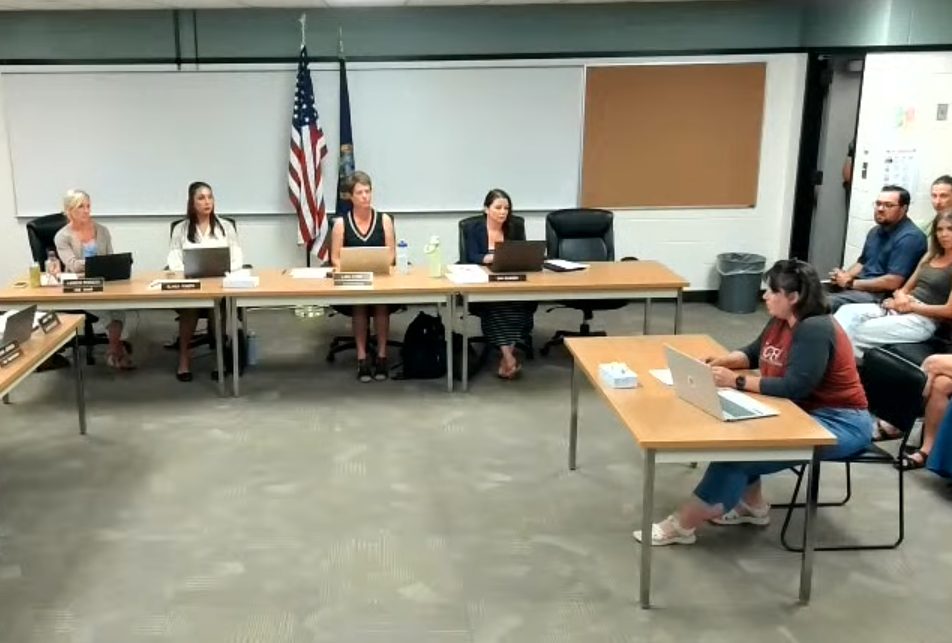
Later on Tuesday, after a closed-door discussion with the district’s legal counsel, the school board unanimously voted to move forward with the terms of the tentative agreement and reject the union’s request to reopen negotiations.
“I don’t believe we received any meaningful new information showing that another round of negotiations is going to produce a different result,” said trustee Tim Garza during the meeting.
Stone told EdNews Thursday that the school board will vote next month to implement the tentative master agreement as a “temporary policy.” Ideally, the union would vote again and approve it, she said, “so that we actually have a master agreement in place rather than a policy.”
In the meantime, negotiations for next year’s contract are expected to start in the coming weeks — likely with a different bargaining team.
“I think it’d be best for everybody if we had some change, just because it’s been so frustrating,” Stone said.