
Idaho school enrollment has fallen by more than 5,000 students since reaching a peak in 2022-23, despite continued population growth across the state.
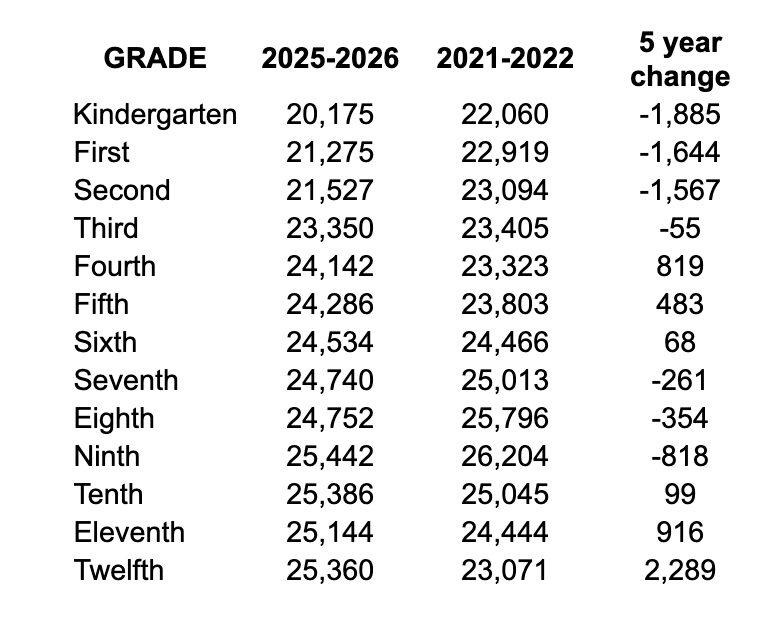
The decline is concentrated among elementary students, while enrollment continues to grow in middle and high schools.
The shifting demographics impact K-12 funding and have contributed to school staffing adjustments, budget tightening and long-term plan changes.
But Idaho’s enrollment story looks different depending on where families live and the choices available to them. Declines are more pronounced in some communities, while Idaho’s charter schools continue to grow and some traditional districts are buoying enrollment through online offerings.
Here’s a closer look at the numbers and trends driving the changes.
The big picture: Idaho is growing but enrollment is not
Over the last five years, the state’s population increased from around 1.9 million residents to just over 2 million, according to U.S. Census Bureau data. Yet K-12 enrollment has fallen by 5,104 students since reaching a peak of 315,254 in fall 2022. Enrollment stood at 310,150 this fall.
The decline has been concentrated in the lower grades, with K-3 enrollment falling by 5,151 students since 2021-22, according to Idaho Department of Education data.
Here’s a closer look at the numbers by grade:
The decrease is due in part to declining birth rates, which fell from over 16 per 1,000 residents in 2007 to under 12 per 1,000 residents in 2024, according to U.S. census data.
Most of Idaho’s growth has come from people without school-aged children moving to the state, said Idaho Department of Labor Economist Lisa Grigg.
According to Grigg, just 8% of Idaho’s population growth from 2020 to 2025 is attributed to school-aged children.
Enrollment changes accompany budget challenges
State funding for schools is calculated largely using average daily attendance. Declining enrollment does not always mean a funding loss, but fewer students attending school can reduce the attendance counts that drive state funding.
Overall, average daily attendance and statewide K-12 funding disbursements have increased in recent years. And lawmakers kept state K-12 funding for this school year largely flat.
But when attendance does decline at a district or charter, it can lose funding while many fixed costs remain.
Many school leaders say that’s the challenge with the state’s enrollment-based model. Attendance-based funding reduces state revenue when more students are absent amid declining enrollment, but costs for things like busing and food services remain — and increase with inflation.
Many school leaders say switching to an enrollment-based model would help schools stabilize funding.
About 291,494 students attended school per day last school year, compared to the 309,254 students enrolled in public schools. That’s a gap of 17,760 students — or roughly $172.2 million if the state funded each of those students at about the same per-student rate.
Idaho’s attendance-based funding formula is both complex and outdated, Idaho officials say. An effort to rewrite the more than 30-year-old formula is again in the works by state officials.
The state offers some protection under the attendance-based model. Thirty-eight districts ended fiscal year 2026 in “protected” mode, meaning they can’t lose more than 3% from the prior year’s funding as attendance fluctuates from year to year.
Districts adjust as enrollment falls
The Boise School District has seen the largest enrollment decline in the state over the last five years, with a drop of more than 1,600 students.
To adjust, Boise is cutting 17 staffing positions ahead of the 2026-27 school year.
District spokesperson Dan Hollar said the reductions align staff levels with student needs: “The district’s approach is to align staffing with enrollment while preserving classroom instruction and essential student services whenever possible.”
The decline is partly demographic. In Boise’s attendance areas, births fell 14.5% between 2015 and 2024, creating smaller incoming classes.
Even though the district doesn’t track age-related data, Hollar said families are relocating to neighboring communities as a result of expensive housing.
Even within the district, enrollment trends vary by neighborhood. Dallas Harris Elementary School’s attendance area has 35 students per 100 homes, according to the district’s Facilities Master Planning. Meanwhile, families are moving away from Garfield Elementary’s boundary, which is producing just five to six students per 100 homes.
In North Idaho, the Post Falls School District is also adjusting staffing to combat enrollment declines. Last fall, the district had about 5,700 students enrolled, compared to 6,080 in 2021-22. Enrollment increased slightly last school year, but only by around 75 students.

“We budget directly based on student enrollment,” Deputy Superintendent Anna Wilson said.
Post Falls has managed staffing through attrition and not hiring for vacant positions. It had 308 full-time employees in 2022-23, compared with 292 this past school year.
Meanwhile, the Blaine County School District has seen an 8.2% enrollment decrease in the last five years.
Steep declines among younger students are fueling the trend. In May of 2025, 285 Blaine County seniors graduated. Last year, the district had just 160 kindergarteners.
Most children born in the area still attend Blaine County schools. Kindergarten enrollment is within 5% of the number of children born locally, suggesting the district is retaining most of its school-age population.
Still, the district is reducing staff through attrition and, in at least one case, a layoff last year.
Charters buck enrollment trends
The decline in district enrollments accompanies more school choices, including charter schools.
Twin Falls spokeswoman Eva Craner said three charter schools that have opened within the district’s boundaries since the pandemic have contributed to the district’s 6.8% enrollment decline in that timeframe.
Enrollment at each of those charters has increased in the last five years:
- Gem Prep Twin Falls: 149.7%
- Rise Charter: 130%
- Pinecrest Academy of Idaho: 94%
Idaho is seeing a similar statewide trend. In 2021, 31,578 students were enrolled in charter schools. That number skyrocketed to 42,978 in 2025 — a 36.1% increase.
Nine new charter schools have opened since 2023 with an additional six charter schools set to open this fall.
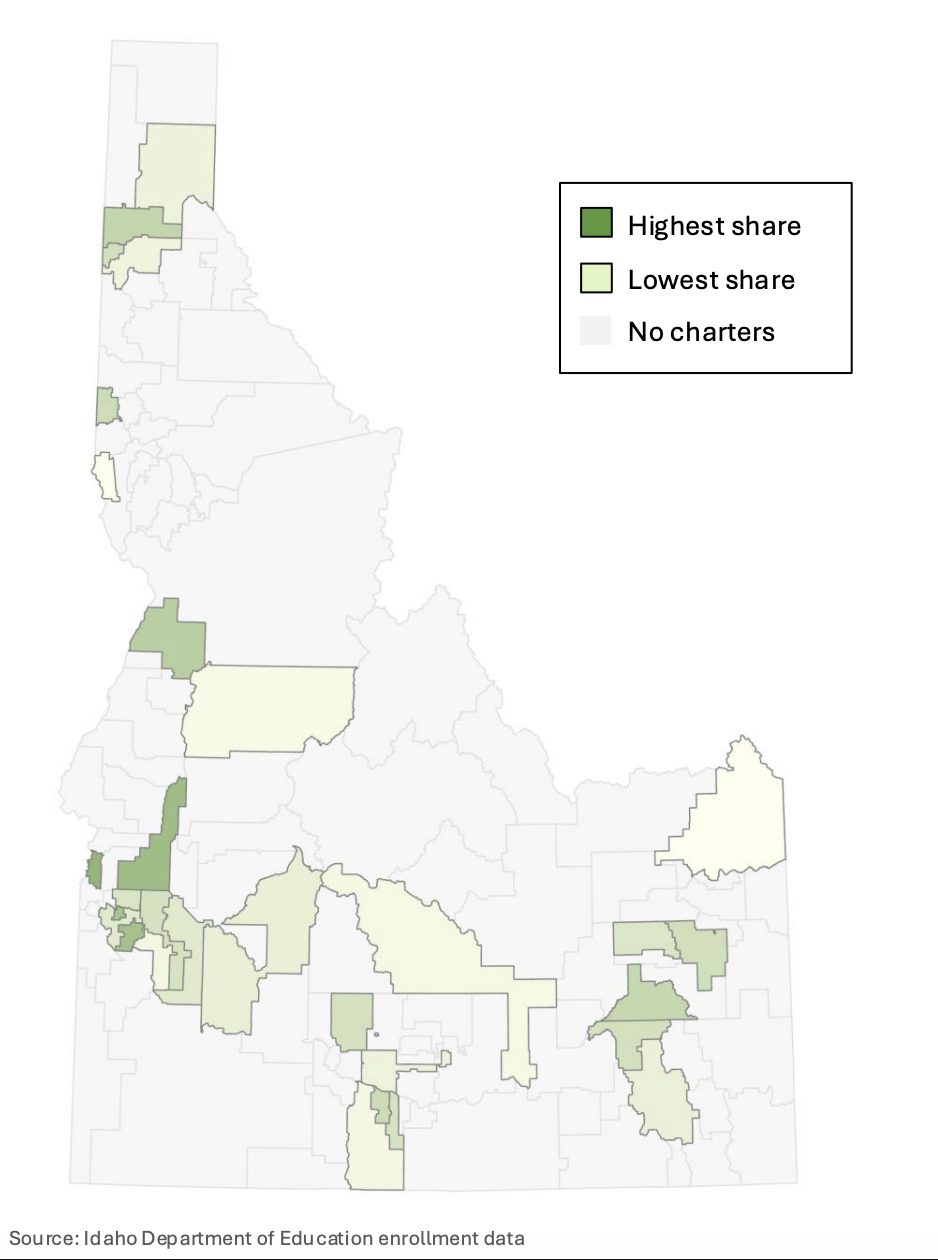
However, charter schools aren’t evenly distributed across the state. Less than half of Idaho’s counties have a charter school, according to a report published last month by Idaho charter support nonprofit BLUUM.
Charters had a significant impact on Twin Falls, but much of Idaho has no in-person charter access, limiting their effect on traditional districts in those areas.
Virtual programs see continued growth
While some districts are losing students, others have grown by attracting them through online programs, an area where demand continues to increase since the COVID-19 pandemic.
The Oneida School District’s Idaho Home Learning Academy (IHLA) has seen massive and controversial growth, with about 7,500 students enrolled.
Other Idaho districts saw the demand and opened their own programs.
Sugar-Salem has become the fastest growing district in the state since opening an online school four summers ago. Its enrollment has increased by more than 600 students since 2021.
Another rural eastern Idaho district, Snake River, is experiencing the same trend after launching its online program in 2020-21. The district’s enrollment increased by 593 students in the last five years — a jump of over 20%.
Both districts use Overture, an Idaho-based company to run their virtual schools.
School districts aren’t the only ones experiencing continued growth. Other exclusively virtual schools have seen vast enrollment increases over the last five years:
- Gem Prep Online — 32.8%
- Idaho Virtual High — 40.1%
- Isucceed Virtual High — 95.9%
Online schools have historically struggled with standardized tests. Click here to read more about them.
Disclosure: Idaho Education News and Bluum are both supported by grants from the J.A. and Kathryn Albertson Family Foundation.
EdNews data analyst Randy Schrader contributed information for this story.

