
UNDER WATCH
Sheriff’s office: Vallivue land deal still under investigation
Sean Dolan | 09/18/2026
The Canyon County Sheriff’s Office on Friday confirmed its investigation into the Vallivue School District’s 2024 land deal is still active.
Idaho EdNews broke the story on April 17.
“No updates at this time, investigation still active,” a detective with the criminal investigation division told EdNews Friday.
The district in 2024 bought 87 acres of farmland from Dave Christensen, the father of trustee Clay Christensen, for $5 million. The land, intended for the site of a school, was appraised at $2.87 million.
“I knew about what I wanted, and, you know, it was really the only way I probably would have sold it,” Dave Christensen told EdNews in April about his $5 million price tag for the land.
Idaho code requires trustees to have property appraised before a purchase and that appraisal “shall be used to establish the value of the real property.”
Superintendent Lisa Boyd at the time defended the purchase and said the district complied with statute.
Later that month, EdNews obtained records from several other Idaho school districts that showed Vallivue’s deal bucked the norm by millions.
Five different land purchases in districts from around the state came in under the appraised value — and in two deals landowners gifted chunks of property — according to public records EdNews examined in a spot check of transactions over the past two decades.
Vallivue trustees have declined to answer any questions about the land deal. Trustee Toni Brinegar, who was board chair at the time of the 2024 purchase, referred EdNews to their attorney.
Two trustees have since resigned, leaving the board with three members. Brinegar resigned in June, and Paul Tierney resigned in August.
Boyd said both trustees had planned to resign after their kids graduated from Vallivue schools.
The district is looking for interested residents to apply for the vacancies.
Prosecutor: No update on Lakeland open meeting complaint
Emma Epperly | 09/02/2026
The Kootenai County prosecutor’s office said last week there’s no update on a complaint that the Lakeland School Board again voted on an unnoticed agenda item.
EdNews filed the complaint last month after trustees voted on “Item E” following a July 29 executive session, a closed portion of a public meeting. The item was not listed as an action item, and no details were posted. Idaho Code 74-204(4) requires an agenda to identify an item as an “action item” when it requires a vote, providing notice to the public that action may be taken.
EdNews discovered through a public records request that the item was a settlement between the district and Old Republic Surety Company, which held the bond for a company that did faulty work on a sidewalk replacement project. The district received a $220,000 payment from Old Republic.

Mortensen Last week, EdNews visited prosecutor Stanley Mortensen’s office to ask about the complaint after multiple emails went unanswered. A person working the front desk said the prosecutor had received the emails, but there was no update.
It’s unclear if Mortensen has taken any action on the complaint. Under Idaho law, a county prosecutor can enforce the open meeting law against elected bodies in their county.
Lakeland trustees have faced questions about the open meeting law before. In June, trustees voted to extend Interim Superintendent Jake Massey’s contract without listing it as an action item on the agenda. After EdNews filed a complaint with the prosecutor, trustees self-cured by holding a noticed vote on July 17.
Lakeland trustees did not respond to questions following the Aug. 19 meeting.
Questions about Lakeland’s meeting practices surfaced again Aug. 19, when trustees voted on a handful of items following executive session. The items were listed as action items but contained far less information than is typical for an agenda.
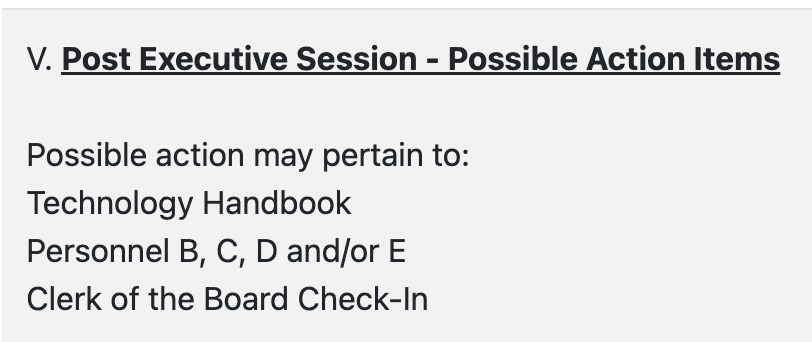
A screenshot of the post-executive session action items from Lakeland trustees’ Aug. 19, 2026, meeting. A recording of the meeting on YouTube shows trustees hired a curriculum director and took action on a facility director position. The Idaho Code cited for the executive session, 74-206 (1)(b), covers the evaluation, dismissal or disciplining of employees, among other personnel matters. It does not include the provision specifically allowing an executive session to consider hiring, 74-206 (1)(a).
Other districts routinely include a description of post-executive session action to alert the public to what the board is doing and allow for public comment.
For example, when hiring Marcus Meyers as superintendent in February, Kuna trustees listed detailed explanations of what would be discussed in executive session, along with Idaho codes. Post-executive session items were also descriptive.
At Lakeland’s Aug. 19 meeting, trustees also voted to release two employees from their contracts but provided little information on the agenda, other than citing “Personnel C&D.”
In contrast, Coeur d’Alene trustees entered executive session at their July 13 meeting, citing the same legal justification as Lakeland. However, the action item explains the issue more clearly.

A screenshot of the Coeur d’Alene schools board’s agenda from July 13, 2026. Boise State says it acted in ‘good faith’ in public records dispute
Kevin Richert | 08/31/2026
Boise State University is denying wrongdoing in a public records dispute with a conservative lobbying group.
Attorneys for Boise State say the university “acted in good faith” in responding to the Idaho Family Policy Center — even though the group received only two pages of university records, at a cost of $257.02.
The IFPC filed a lawsuit on July 24, stemming from a seven-month records dispute. The Christian lobbying group requested documents, data and correspondence related to a 2025 article authored by two Boise State researchers. The article said 35% of OB-GYNs left Idaho between 2022 and 2024, in the wake of the state’s near-total ban on abortion.
The IFPC authored one of Idaho’s anti-abortion laws.
The lawsuit alleges Boise State dragged out its response to the request for more than a month, withheld germane documents and charged for a costly legal review of the records that ultimately were released.
“By refusing multiple requests for these documents, and rebuffing efforts to solve this matter without litigation, BSU has frivolously pursued its refusal,” the IFPC said in its lawsuit.
In a response filed Tuesday, Boise State said it produced all documents that fell within the parameters of the request and did not delay its response. The university also defended the bill that it sent to the IFPC — which reflected 6.5 hours of staff review, including 3 hours of legal work.
Idaho’s public records law is based in a presumption of openness. In other words, documents are considered public records unless they are specifically exempt from disclosure.
The dispute between Boise State and the IFPC centers on two intertwined issues.
The timing. The law requires public entities to release records to Idaho residents within three working days — although agencies can and frequently do claim an extension that pushes the timetable to 10 working days.
In this case, IFPC policy analyst Grace Howat filed a records request on Dec. 10. Boise State responded on Dec. 23, within 10 working days. The university did not produce the records at this time, but instead sent an estimate — reflecting the potential cost of reviewing and producing the records. Boise State did not request payment at this time.
On Jan. 8, Boise State sent a $257.02 invoice. IFPC paid the bill that day.
Howat twice sent followup emails, asking about the status of the records request. “Am I able to receive the records I requested and paid for?” she wrote on Jan. 26.
The university provided the two-page response on Jan. 27 — more than 10 working days after IFPC paid the invoice.
But in Boise State’s response in court, attorneys defended the turnaround time.
“(Boise State) denies (IFPC’s) characterization that (Boise State) ‘sat on the request for over a month.’”
Carsten Peterson and Eric Stokes are representing Boise State in the case. They work for Hawley Troxell, a Boise-based firm prominent in education law.
The invoice. Public agencies are required to cover some cost of retrieving records — their first two hours of staff time and the first 100 pages of paper records.
Beyond that, agencies are allowed to bill their costs, but they aren’t required to do so.
Boise State says the $257.02 invoice covers 6.5 hours of staff review, above the two “free” hours of employee time.
IFPC is skeptical, noting that the two pages released by Boise State were unredacted.
In their response, Boise State’s attorneys say that staff had to review documents beyond the two pages that were released. “(Boise State) denies the inference that 6 1/2 hours responding to Ms. Howat’s request was excessive.”
What’s next? It’s unclear when the dispute may go to court.
Both sides are seeking their costs and attorney’s fees. IFPC is also seeking the $257.02 in question, or a cost to be determined at trial. The group also wants a court order requiring Boise State to “produce the records requested, or to show cause why it has not done so.”
In its filing, Boise State’s attorneys also argue that the burden of proof falls not on the university, but on IFPC.
Former superintendent challenges public-records request
Devin Bodkin | 08/27/2026
A former Idaho superintendent wanted some basic enrollment information from an online public charter school: How many students attended the school last school year, broken down by home district and grade?
No names. Just numbers.
After he asked for the information in an email chain shared with EdNews, a school employee told him that if he wanted to submit a formal public records request, he needed to use her business email and “state the reason for the request specifically.”
He pushed back.
“I don’t believe that you are allowed under Idaho Code to ask me my reason for the request,” he wrote. “You may want to check.”
He was right.
The Idaho Attorney General’s Public Records Law Manual says public agencies generally may not ask why someone wants public records (see Question 25). There are limited exceptions, including inquiries about whether requested information will be used as a mailing or telephone list.
The school is a public charter school authorized by the Idaho Public Charter School Commission.
This all comes with a simple reminder for public agencies: You generally don’t get to ask why someone wants a public record.
State Board misstates public records law
Devin Bodkin | 08/26/2026
The Idaho State Board of Education appears to have misinterpreted Idaho’s public records law, telling Idaho Education News that simply acknowledging a records request within three business days satisfied the law.
The request, from senior reporter Kevin Richert, seeks documents and communications related to Boise State University’s athletics department deficit, discussed at the State Board’s Aug. 13 meeting. After the board asked Richert to resubmit the request through a new online form, its public records office acknowledged receipt and invoked a 10-business-day extension.
Richert pointed out that Idaho law requires an agency to grant or deny a request within three business days — not simply acknowledge it — and asked whether the request had been granted and whether the records would be provided within the 10-day window.