
The Kootenai County prosecutor’s office said last week there’s no update on a complaint that the Lakeland School Board again voted on an unnoticed agenda item.
EdNews filed the complaint last month after trustees voted on “Item E” following a July 29 executive session, a closed portion of a public meeting. The item was not listed as an action item, and no details were posted. Idaho Code 74-204(4) requires an agenda to identify an item as an “action item” when it requires a vote, providing notice to the public that action may be taken.
EdNews discovered through a public records request that the item was a settlement between the district and Old Republic Surety Company, which held the bond for a company that did faulty work on a sidewalk replacement project. The district received a $220,000 payment from Old Republic.

Last week, EdNews visited prosecutor Stanley Mortensen’s office to ask about the complaint after multiple emails went unanswered. A person working the front desk said the prosecutor had received the emails, but there was no update.
It’s unclear if Mortensen has taken any action on the complaint. Under Idaho law, a county prosecutor can enforce the open meeting law against elected bodies in their county.
Lakeland trustees have faced questions about the open meeting law before. In June, trustees voted to extend Interim Superintendent Jake Massey’s contract without listing it as an action item on the agenda. After EdNews filed a complaint with the prosecutor, trustees self-cured by holding a noticed vote on July 17.
Lakeland trustees did not respond to questions following the Aug. 19 meeting.
Questions about Lakeland’s meeting practices surfaced again Aug. 19, when trustees voted on a handful of items following executive session. The items were listed as action items but contained far less information than is typical for an agenda.
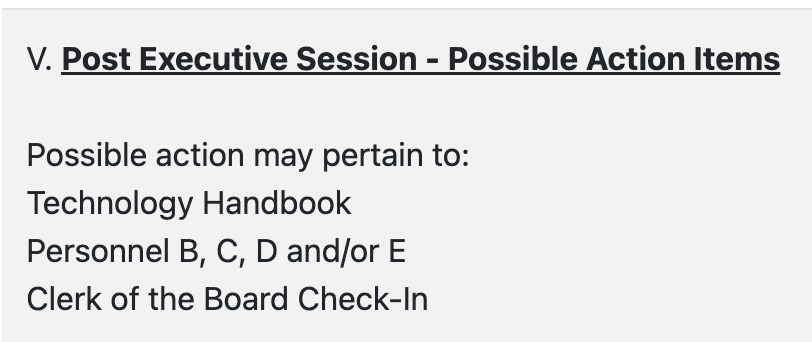
A recording of the meeting on YouTube shows trustees hired a curriculum director and took action on a facility director position. The Idaho Code cited for the executive session, 74-206 (1)(b), covers the evaluation, dismissal or disciplining of employees, among other personnel matters. It does not include the provision specifically allowing an executive session to consider hiring, 74-206 (1)(a).
Other districts routinely include a description of post-executive session action to alert the public to what the board is doing and allow for public comment.
For example, when hiring Marcus Meyers as superintendent in February, Kuna trustees listed detailed explanations of what would be discussed in executive session, along with Idaho codes. Post-executive session items were also descriptive.
At Lakeland’s Aug. 19 meeting, trustees also voted to release two employees from their contracts but provided little information on the agenda, other than citing “Personnel C&D.”
In contrast, Coeur d’Alene trustees entered executive session at their July 13 meeting, citing the same legal justification as Lakeland. However, the action item explains the issue more clearly.


