
By the time most Idaho students settle into their school day, high school sophomore Graeme Carlson has been at work — sorting potatoes or running a rake for a local farmer.
For the last two weeks, anyway.
Carlson’s Snake River School District is one of several in eastern Idaho where the school bell takes a back seat to harvest season. Students in these districts, including Firth and Sugar Salem, enjoy a two-week break from school.
When the spuds are ripe, the calendar makes room.
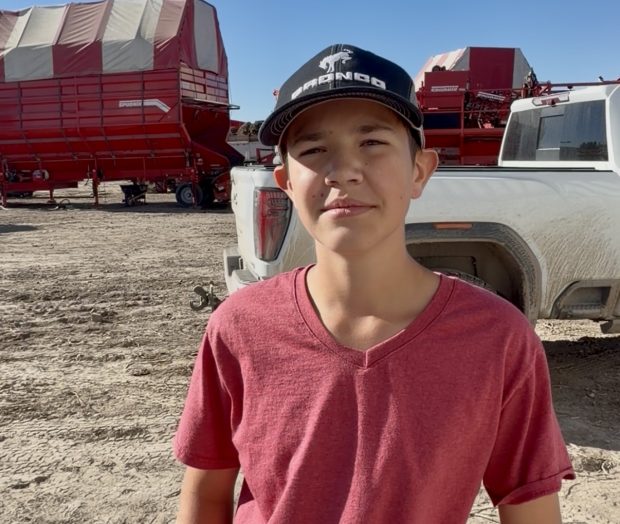
For many, it’s a vacation. But for students like Carlson and his sister, Olivia, a high school junior, it means spud trucks, long shifts and a crash course in rural Idaho work life.
During harvest, the Carlson kids are out of school but up early — 4 a.m. for Olivia, who attends a chilly cross-country practice before pulling on her work clothes and heading to the fields.
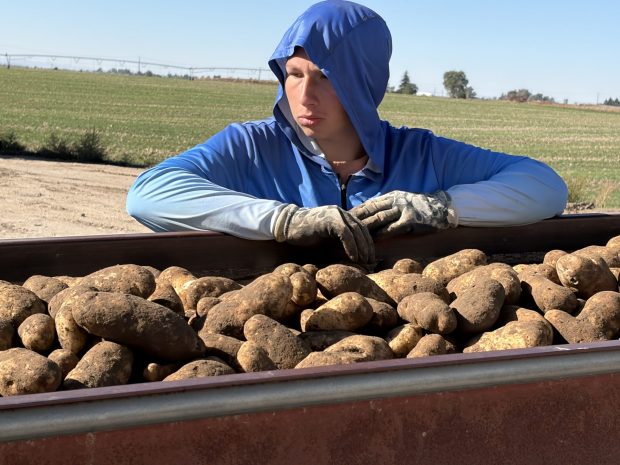
Olivia and Graeme last week joined other students who worked along a conveyor belt sorting an endless, bouncing stream of potatoes. The work moves quickly. Trucks haul loads of spuds from surrounding fields. Machinery rumbles. The potatoes are stored into cellars, then make their way to grocery stores, restaurants and your dinner table.

In the middle of it are students. For better or worse.
“It’s kind of a lot of work, but it’s also nice because school’s not very fun either,” Graeme said.
There is money to be made, but students also pick up something harder to put on a paycheck: the rhythms and responsibilities of a job.
Days can be long. “It’s pretty rough waking up to go to practice and then coming here for seven to 13 hours,” said Olivia.
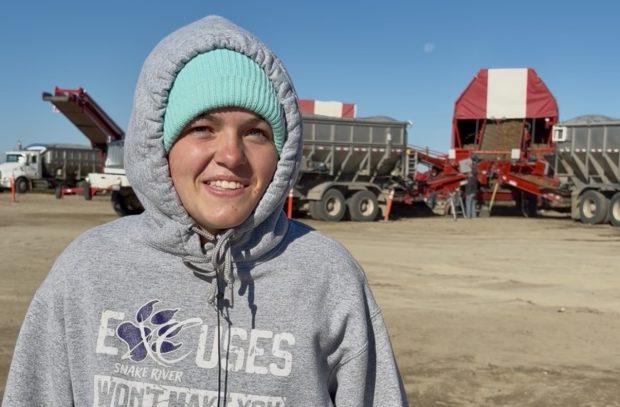
David Dougal, a harvest-break worker and principal of Snake River’s Rockford Elementary, sees the effort as something bigger than a seasonal program. It’s a community effort that pulls in hundreds of regional students, families and workers to get the area’s biggest crop out of the ground and into storage.
“This is a big thing for this community,” Dougal said. “Without community involvement, it would be really hard to pull off.”
Students and educators like Dougal earn extra money and contribute to an industry woven into their community.
For farmers, the timing matters. Spud grower Jeff VanOrden said the two-week break arrives on time. It’s “by far the busiest part of the harvest,” he said.
Extra hands can make the difference between keeping up and falling behind.
The break can also make the roads less complicated for spud trucks, with fewer buses and students traveling during the day.
The arrangement is hardly new. For rural eastern Idaho districts like Snake River, two weeks off are a fixture on the fall calendar.
And for many students, the break offers a first taste of work life.
“For a lot of them, this might be the first job they’ve ever had,” VanOrden said.
For Graeme, Olivia and classmates, it’s a couple of weeks away from the classroom.
But it’s a classroom of its own.