CALDWELL — It was a refreshing night on the campaign trail Tuesday.
And that’s exactly the problem.
It’s unusual — make that rare — to see two statewide candidates on the same stage. Facing a live audience of voters. Answering actual questions. Talking in detail about priorities and policies. Two candidates, to their credit, taking their case to the people.
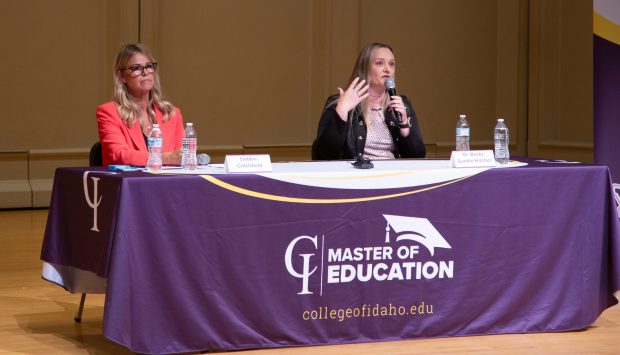
I wish I could say Tuesday night’s debate between GOP state superintendent Debbie Critchfield and Democratic challenger Becky Sundin Mitchell was just the start of a robust fall debate season. That, unfortunately, wouldn’t be honest.
See for yourself. Click here to watch Tuesday’s debate.
The fact is that Tuesday’s debate — co-sponsored by Idaho EdNews and The College of Idaho — is the exception to the rule. Critchfield and Sundin Mitchell will appear again at an Oct. 12 debate sponsored by KTVB in Boise. Aside from that, it’s quiet out there. Way too quiet.
Other Republican incumbents aren’t debating. Gov. Brad Little, Sen. Jim Risch and Attorney General Raúl Labrador either turned down or ignored invites from KTVB.
What gives? In the spirit of the election season — and the spirit of helping you make an informed choice — pick your favorite sports metaphor.
Marc Johnson, a longtime fixture in former Gov. Cecil Andrus’ inner circle, recently invoked the name of legendary North Carolina basketball coach Dean Smith. Johnson — who seldom passes up the chance to chide Idaho Republicans in general, and Risch in particular — accused Idaho’s junior senator of cribbing Smith’s “four-corners” offense. When Smith’s teams had what appeared to be an insurmountable lead, he’d spread players on the four corners of the front court, directing them to pass the ball around with no intention of taking a shot or doing, well, anything. An annoying but maddeningly effective way to run out the clock.
Not to try to upstage Johnson, I’ll call the no-debate gameplan a “business decision.” In football, when a player sidesteps a hit from an opposing player, usually a bigger one moving at full speed, that’s a business decision. Avoid a potential injury — or, at least, some short-term pain — and protect your future earnings potential.
Call bailing on debates whatever you want. Just don’t call it gutsy.
And their opponents, standing on the sidelines, have little left to do but grumble.
At a town hall meeting in Boise last week, independent gubernatorial candidate John Stegner was asked whether he’d get the chance at a debate. He said he wasn’t counting on it. “(It’s) disconcerting at best (and) disheartening at worst,” said Stegner, picking his words with the deliberation befitting a former state Supreme Court justice.
Independent Senate candidate Todd Achilles got some social media traffic and some news coverage recently, by recording a brief and awkward Boise Airport exchange with Risch. Achilles tried to get Risch to commit to a debate. Risch walked away; at the end of the video, Risch is seen talking to airport security.
Achilles tried to keep the narrative going in a campaign text a few days later. “Todd again,” the text began. “Risch still has not said a word since he pulled his hand away and kept walking.”
Debates weren’t always so rife with drama.
Once, they were actually commonplace.
I’ve been to a few rodeos. I believe my first statewide debate was the gubernatorial showdown between Phil Batt and Larry EchoHawk, in 1994. You know, that faraway distant year when Idaho last rewrote its K-12 funding formula.
And much like school finance, a lot has changed in Idaho politics over these past 32 years. The Batt-EchoHawk race was a thriller. For much of 1994, the conventional wisdom held that EchoHawk would make the move from attorney general to governor, succeed Andrus, and maintain the Democrats’ hold on the state’s highest office. Batt, the Republican, spent much of the year running from behind. When Batt won with 52.2% of the vote, it was seen as an upset in many political circles.
In a close race, it would have been unthinkable for Batt or EchoHawk to refuse a debate and a statewide appearance on Idaho Public Television.
So I draw a straight line between the demise of statewide debates and the GOP’s hammerlock in Idaho politics — a trend that began with the 1994 wave election that helped carry Batt to the second floor of the Statehouse. GOP incumbents like Little, Risch and Labrador don’t debate because, in a heavily Republican state, they don’t need to debate.
They aren’t viscerally opposed to the exercise of debate, acting out of some long-held principle. I’m an eyewitness. I was there in April 2018 when Little and Labrador took part in a statewide televised debate — along with Tommy Ahlquist — as their historically spendy three-headed gubernatorial primary neared its conclusion. All three candidates debated because they really couldn’t afford the hubris of saying no.
Which brings us back to Tuesday night, and the stage on the C of I campus.
Based on the short- and long-range history, Critchfield had nothing to gain and everything to lose from a debate. A Democrat hasn’t won a statewide election since 2002. Four years ago, Critchfield captured the state superintendent’s race with nearly 70% of the vote. Critchfield is heading into the home stretch of this year’s race with nearly $194,000 on hand; Sundin Mitchell has barely $8,400.
And during the hour-long debate, Critchfield didn’t always cater to the Republican base. She said the $50 million private school tax credit program, passed by GOP lawmakers in 2025, doesn’t have as much transparency and accountability as she would like to see. She said she would oppose an elimination of the property tax — a plank in the Republican Party platform — without a replacement for the local tax dollars that go to schools. And she all but said Republicans in the Legislature had strayed too far into the social fabric of education.
“I wish that I was the one that could hand them the list of things I’d like them to talk about all of the time,” she said.
That’s the good thing about debates. Voters hear interesting things sometimes.
Which might explain why the likes of Little, Risch and Labrador are so afraid of them.
Senior reporter Kevin Richert writes a weekly analysis on education policy and education politics.