If the Idaho Legislature follows Scott Herndon’s plan for eliminating property taxes, public schools would miss out on over $400 million.
Herndon, who in May won his primary election against Sen. Jim Woodward, R-Sagle, said he wants to get back to the founders’ original vision for America: true private property ownership.
He led the charge at last weekend’s Idaho GOP state convention to add a plank to the party platform calling for the elimination of property taxes and a replacement with “revenue sources that do not place a lien on a citizen’s home.”

Herndon told EdNews that his plan doesn’t call for increasing sales or income tax rates. Instead, he is banking on overall growth in the state economy to increase tax revenue. He said his plan is realistic. All it takes is the will of the people.
“Was going to the moon realistic?” Herndon said. “Humans are capable of doing anything they set their minds to.”
For House Minority Leader Ilana Rubel, D-Boise, Herndon’s plan to eliminate property taxes without an increase in income taxes is like hoping that money will fall from the sky.
“Maybe money will magically appear, and we’ll be fine,” Rubel said. “That is not a budget plan. That’s preposterous.”
The newly elected first vice chair of the Idaho GOP, Adams County Commissioner Viki Purdy, told EdNews she isn’t sure how Idaho could ever get rid of property taxes without a replacement, but it will be nice to shed some light on the issue.
“I don’t expect that the state is just going to dump property taxes,” Purdy said.
Shifting to state revenue
According to the Idaho State Tax Commission, counties in fiscal year 2025 levied and distributed $404.4 million in property taxes for public schools.
Herndon said he would like to shift that local burden for school funding onto the state.
“It’s just changing the water in the pipe,” he said. “So you got a pipe that’s feeding schools right now that’s mostly state tax revenue, but has a little bit of property tax in it. You’re going to turn a valve and you’re going to change it to 100% of state tax revenue and eliminate the property tax portion.”
He said it would be easy to come up with $400 million over time. It could take a couple of years or could happen all in one year. It just depends on how fast the state tax revenue grows. And, he said, the key is to not add any additional government programs.
“That’s how you can get rid of property taxes,” Herndon said. “It requires spending discipline.”
If state revenue funded schools 100%, he said, school districts wouldn’t need to run levies. But the state would not be able to fund all capital projects around the state. He said he would like to allow districts to create a local option sales tax to fund new schools.
“I envision expanding that opportunity for local governments around the state,” he said.
A reverse Robin Hood scheme
Rubel said the new plank in the GOP platform is “extremely troublesome.”
She could get behind replacing property taxes with an increase in income tax, but that’s not on the table for the Republicans. The platform calls for a reduction of income tax.
“In fact, they want to scale back income tax further, which really puts all of the burden on sales tax, which, everybody should note, includes grocery tax,” she said.
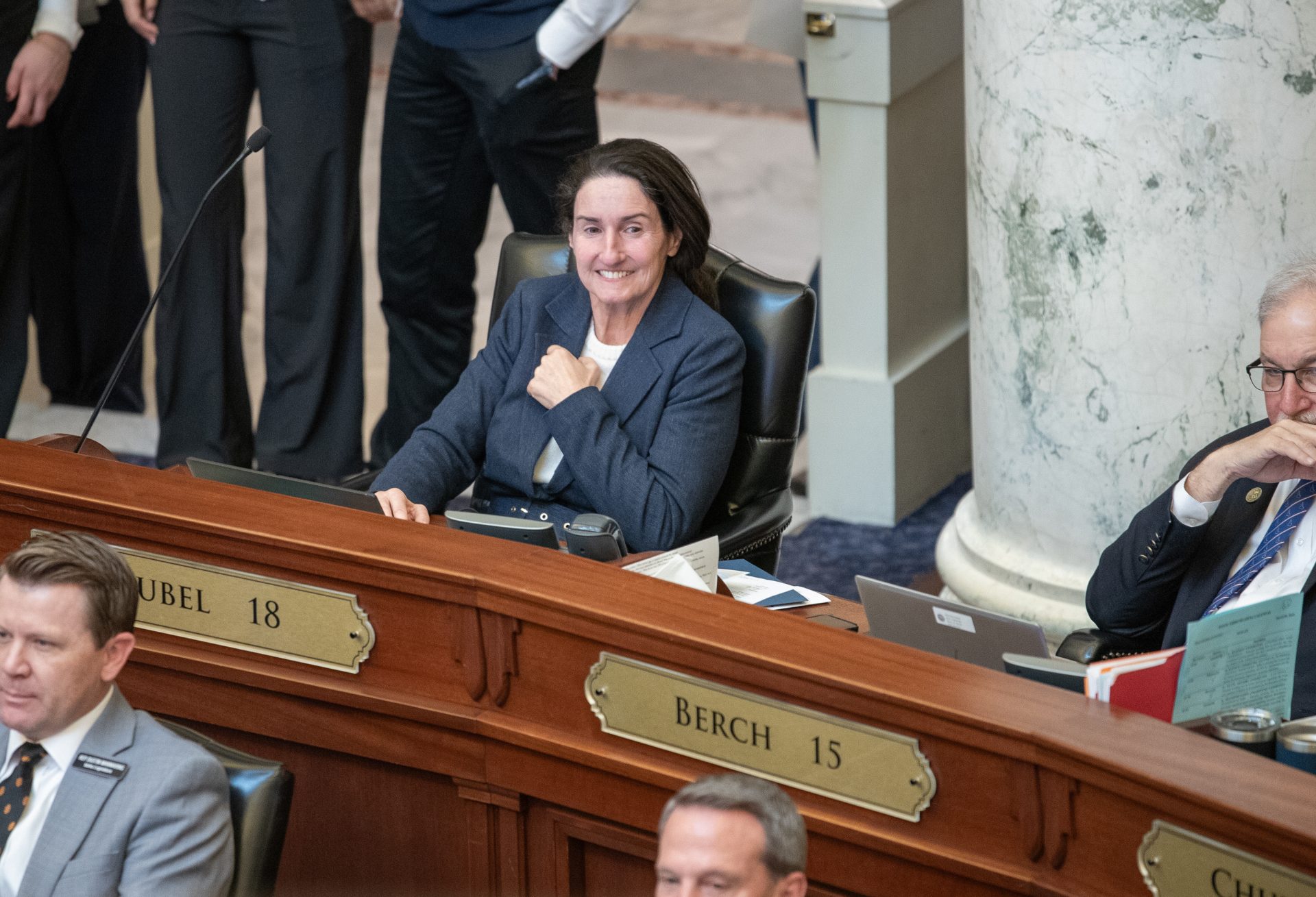
Sales tax is the most regressive form of taxation, she said, and increasing it would shift a massive burden away from the very wealthy onto the back of the very poor and working class.
“When you shift it all to sales tax, it’s essentially a total reverse Robin Hood scheme,” Rubel said, adding that eliminating property taxes would be disastrous for schools, and the fallout would be catastrophic.
“Schools would just take it in the shorts and would not have the funds they need to operate, would not have the facilities funds they need to keep safe, functioning buildings running,” she said.
For Herndon, including the new plank in the GOP platform means it is a principle that the party should aim toward. He said it was approved with a standing vote at the convention, with about 80% support.
“There were 600 delegates in the room, and there were probably 475 or more of them standing up,” he said.
The first step to eliminating property tax, he said, is to scale up House Bill 292 from 2023 and House Bill 521 from 2024.
The former is a property tax relief bill that created a School District Facilities Fund that districts receive based on average daily attendance. The latter created the $1.5 billion School Modernization Facilities Fund that districts could receive over 10 years to pay for capital projects.
Renting from the government
Herndon believes that property taxes are inherently unjust and that they mean no one can ever truly own a home.
“Right now property taxes means that the government has a permanent claim on your home,” he said. “If you don’t pay, then your home is going to be taken from you.”
A family can own property for five generations, but never truly own their home, he said. It is akin to renting from the government.
“That’s the tax system that we have in property taxes,” Herndon said. “It’s really simple to say that that is a completely unjust tax system.”
Herndon says his plan is serious. Rubel said it’s a joke.
“I think it’s just intended to be kind of a crowd pleaser of, ‘Hey, don’t you hate property tax? Here, we want to end it,’ without any credible plan of how they would backfill that revenue,” she said.