Editor’s note: This article uses pseudonyms for minors and a parent who were involved in litigation over the state’s transgender bathroom restrictions. Jane Doe, Daisy Davis and Dana Davis are pseudonyms.
Last year, a Boise High School student was in the girls’ bathroom when she heard “deep grunting noises” coming from the adjacent stall and saw “two black shoes pointed toward her.” Jane Doe believed that a transgender classmate was masturbating, and she reported what she had witnessed to the principal’s office.
The transgender student, Daisy Davis, denied the “humiliating” accusation. Davis is autistic and engages in self-stimulating behavior, or “stimming.” These repetitive vocalizations and movements might explain what Doe heard while Davis was scrolling on her phone during a free period, according to Davis and her mother.
It’s unclear which account of the incident is true, according to court records reviewed by Idaho Education News. Whether the lewd act occurred, or it was just a misunderstanding, ultimately rests on one teenager’s word against another’s.
But this uncertainty hasn’t slowed the masturbation story from circulating, as Idaho litigates the state’s controversial transgender bathroom restrictions. Over the last year, attorneys have cited one side of the contested story — Doe’s account — in high-profile court battles to support Senate Bill 1100. Enacted in 2023, the law requires that public school students use bathrooms aligned with their birth sex.
Attorney General Raúl Labrador’s office shared Doe’s account in federal court last summer — a decision that Davis’ mother called “reckless and irresponsible.” Labrador’s office pointed to the alleged masturbation incident as an example of the “dangers” posed by letting transgender students use their preferred bathrooms.
Now, the story is at the center of a lawsuit seeking monetary damages from the Boise School District on behalf of Doe. Attorneys from the Idaho Family Policy Center (IFPC), a lobbying group with a legal team, are representing Doe in the ongoing case.
In an interview with EdNews last week, Blaine Conzatti, president of IFPC, and Caleb Pirc, director of the group’s legal center, didn’t provide evidence supporting the masturbation allegation, citing professional ethics rules shielding the release of evidence that could prejudice a jury. But they defended Doe’s account and their decision to include it in the lawsuit.
“She’s our client, and we’re going to tell her story,” Pirc said.
Labrador, a Republican, declined to speak with EdNews about why his office shared the story. Labrador’s spokesman, Damon Sidur, declined to comment after multiple interview requests.
The Boise School District also declined to comment, citing ongoing litigation. “The court pleadings and filings speak for themselves, and we have nothing further to add at this time,” said Dan Hollar, public affairs administrator for the district.
Through an attorney, Daisy Davis and her mother, Dana Davis, also declined an interview request.
Court declarations show conflicting accounts of bathroom incident
The following narrative is based on written testimony from Daisy Davis and Jane Doe, provided under penalty of perjury to the U.S. District Court for Idaho in July 2025.
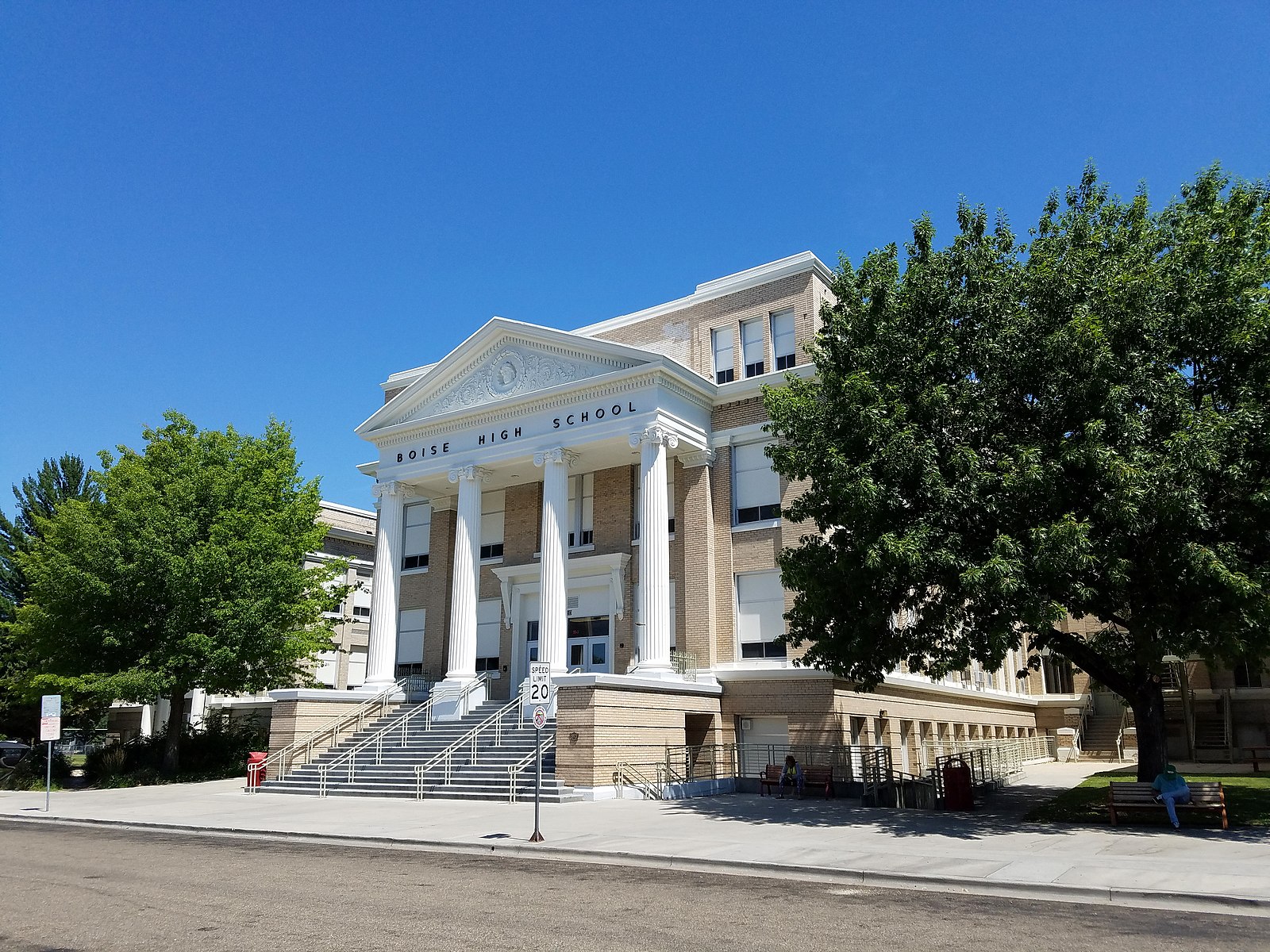
On a cold February day last year, Boise High School student Daisy Davis spent her free period in a girls’ bathroom stall, where she could scroll on her phone in private.
A school rule prohibits cellphones on campus while classes are in session. But social media had become a “lifeline” for Davis, who struggled to make friends, according to her mother. Davis could have gone off-campus to log into apps like Discord and YouTube — and she often did during free periods — but the high temperature was 41 degrees on Feb. 5, 2025.
Davis is autistic, and, like many other people on the spectrum, she engages in stimming. Most people stim in some form — by biting their nails or tapping their feet, for instance — but people with autism tend to do it more frequently and intensely, as a way to release excess energy and regulate their senses. Davis makes vocal sounds, slaps her arms and legs and wiggles her fingers.
“It is not uncommon for me to stim when I am on my phone without knowing it, until someone else brings it to my attention,” she testified in a written court declaration.
Davis thought she was alone in the bathroom that day, so she was startled when someone in the adjacent stall said, “Excuse me.” Davis didn’t respond and stayed put until she heard the bathroom door open and close. When Davis finally opened her stall door Jane Doe was waiting for her by the bathroom sinks.
This wasn’t the first interaction between Davis and Doe in the girls’ bathroom. About a month earlier, Doe’s stall had run out of toilet paper, and she asked the person next to her for help. The reply came from a “transgender student who said in a deep voice that he did not have any,” Doe recalled.
Doe felt uncomfortable sharing the bathroom with transgender students, and she had been harassed by her classmates for this belief. But school administrators continued to let transgender students use their preferred facilities while Senate Bill 1100 was paused amid a legal challenge.
This time, what Doe had heard and seen made her feel not just uncomfortable but unsafe. She heard “deep grunting noises” and what she described as “the sound of a male individual masturbating.” Doe looked down and saw “black shoes pointed at me.” After she said “Excuse me,” the noises stopped.
Doe waited outside the stalls for a confrontation. When Davis didn’t immediately come out, Doe pretended to leave by opening and closing the bathroom door. Both students recalled that, during their brief conversation, Davis said she was allowed to be in the girls’ bathroom.
“I felt panic to be challenged about being in the restroom,” Davis wrote in a court declaration..
Then Doe left to call her mom, who recommended that she report the incident to school administrators, which she did. Both students left school early that day, shaken up by the confrontation.
When Davis was home, her mom got a call from the assistant principal. A classmate had reported that Daisy was masturbating in the bathroom. Davis’ mother asked her “point-blank” whether it was true.
“I was mortified and mad,” Davis recalled. “I told her that I was not. That is the truth.”
State attorneys cite incident among ‘dangers’ of ‘opposite-sex access to restrooms’
About five months later, Doe’s account of the Feb. 5 incident surfaced in federal court. Labrador’s office detailed her story in the introduction of a legal brief that argued the Boise School District should be allowed to enforce SB 1100.
At the time, Labrador’s office was defending the law against a constitutional challenge from Sexuality and Gender Alliance (SAGA), a student group at Boise High. After the Legislature passed SB 1100 and Gov. Brad Little signed it into law, SAGA filed a lawsuit arguing that the law is unconstitutional and asking the U.S. District Court for Idaho to issue a preliminary injunction blocking its enforcement.
Davis was one of two transgender members of SAGA and a plaintiff in the case.
In 2023, U.S. District Court Judge David Nye denied SAGA’s motion for a statewide injunction on SB 1100. But the Ninth Circuit Court of Appeals agreed to review the decision, and Nye paused the law from taking effect during the appeal, which lasted from October 2023 to March 2025.
After the Ninth Circuit affirmed Nye’s decision, SAGA moved for a narrower injunction, which would have prohibited the Boise School District from enforcing the transgender bathroom restrictions against the plaintiffs at Boise High.
That’s when state attorneys shared Doe’s story. The attorney general’s office cited the Boise High masturbation allegation — alongside a tabloid news article about an alleged rape by a transgender student in New Mexico — as an example of the “real potential dangers” posed by all “opposite-sex access to restrooms.”
“The Idaho legislature passed SB 1100 in part to prevent incidents exactly like this,” state attorneys wrote in the July 21, 2025, legal brief.
The brief was signed by James E.M. Craig, chief of the attorney general’s Civil Litigation and Constitutional Defense Division; Lincoln Davis Wilson, special deputy attorney general; and lawyers from the Alliance Defending Freedom, a national legal defense group, which Labrador’s office bought on to help with the case.
State attorneys also attached Doe’s written declaration. Doe told the court that she had panic attacks after the incident and planned to transfer to another school. “I have felt unsafe at Boise High School since that day,” she wrote.

Davis’ mother says promoting story was ‘reckless and irresponsible’
The attorney general’s brief prompted a response from Daisy Davis and her mother, Dana Davis.
Daisy Davis told the court in a written declaration that the accusation was “not only false but humiliating.” Dana Davis backed Daisy’s story, and she suggested that Doe had likely “misinterpreted” the sounds that Daisy makes when she stims.
“When Daisy came out to me as transgender, one of my deepest worries as a parent was about how the world might treat her, and whether others might jump to negative assumptions about her simply because she is transgender,” Dana Davis wrote to the court. “This experience has only confirmed those fears.”
Dana Davis also shared an email exchange between herself and Boise High’s assistant principal on Feb. 6, 2025, the day after the bathroom incident. The assistant principal, whose name is redacted in the court record, wrote that they didn’t have “any evidence that (Daisy Davis) did anything wrong at this point” and “my main frustration in this situation is with the other student.”
The Boise School District’s attorneys, meanwhile, declined to endorse Doe’s account of the incident. The district was a defendant in the lawsuit along with the state, but the district declined to sign on to the portions of the attorney general’s July 21 brief that mentioned Doe’s account.
Dana Davis wrote that it was “reckless and irresponsible” for Labrador’s office to promote the “unsubstantiated” claim.
“These allegations are serious: They are the type of accusation that could destroy a young person’s life, putting them at risk for torment from their peers, as well as the broader community, and suicidality,” she wrote in a court declaration.
The other transgender student who was a plaintiff Sexuality and Gender Alliance v. Critchfield died by suicide earlier this year.
Ultimately, Nye rejected SAGA’s request for a narrower injunction, siding with Labrador’s office. Nye reasoned that the state had demonstrated a “legitimate governmental interest” in regulating school restrooms for privacy reasons, and SAGA was unlikely to succeed in its arguments that SB 1100 was unconstitutional.
But Nye also noted that the examples of “dangers” that state attorneys cited — including the “hotly contested” Boise High incident and the New Mexico story — were “unclear, exaggerated, or speculative.”
SAGA dropped its lawsuit in May, after Davis graduated from Boise High and after the other transgender plaintiff had died by suicide.
Labrador didn’t mention the suicide in a news release celebrating the end of the court challenge.
“From the district court to the Ninth Circuit, we defended Idaho’s right to protect students’ privacy in bathrooms and locker rooms,” he said in the release. “Idaho families can be confident that this law is fully in effect and will remain so.”

Timeline of events
2023
March 22 – Gov. Brad Little signs Senate Bill 1100 into law after it passed the Legislature on a party-line vote. The law requires that public school students use bathrooms, locker rooms and other gendered-separate facilities that align with their birth sex.
July 6 – Sexuality and Gender Alliance (SAGA) files a lawsuit arguing SB 1100 is unconstitutional and asks the U.S. District Court for Idaho to issue a preliminary injunction, temporarily barring enforcement of the law statewide.
Oct. 12 – U.S. District Court for Idaho denies the request for an injunction, and SAGA appeals the decision to the Ninth Circuit Court of Appeals.
Oct. 26 – U.S. District Court Judge David Nye issues a statewide injunction on SB 1100 while the Ninth Circuit considers SAGA’s appeal.
2025
January – Jane Doe first encounters Daisy Davis in girls’ bathroom at Boise High on an unspecified date.
Feb. 5 – Doe encounters Davis in the girls’ bathroom a second time and alleges that she heard Davis masturbating.
March 20 – Ninth Circuit Court of Appeals affirms Nye’s decision denying SAGA’s request for an injunction on SB 1100.
July 3 – SAGA requests a narrower injunction that would block enforcement of SB 1100 against the student group’s members at Boise High.
July 21 – Attorney general’s office details Doe’s version of the Feb. 5 incident in a brief opposing SAGA’s request for a narrower injunction.
Aug. 12 – U.S. District Court for Idaho denies SAGA’s request for a narrower injunction.
Sept. 17 – Idaho Family Policy Center announces a tort claim signaling that it intends to sue the Boise School District on behalf of Doe.
2026
March 2 – Idaho Family Policy Center (IFPC) files lawsuit against the Boise School District.
May 20 – SAGA drops its constitutional challenge to SB 1100 after Davis graduates from Boise High and after the other transgender plaintiff had died by suicide months earlier.
Today — Ada County District Court Judge Lynn Norton weighs Boise School District’s motion to dismiss IFPC’s lawsuit.
Ongoing lawsuit seeks damages against district
The end of the federal court challenge wasn’t the last word on the Boise High bathroom incident, however.
After Labrador’s office detailed Doe’s account in its legal brief, the Alliance Defending Freedom published it online. Earlier this year, Idaho lawmakers cited Doe’s story in Statehouse debates on transgender bathroom restrictions.
Now, it’s central to a lawsuit seeking monetary damages against the Boise School District.
Doe’s attorneys at the Idaho Family Policy Center argue that the district should have been adhering to SB 1100 when Doe encountered Davis in the girls’ bathroom in January and February of 2025. The lawsuit seeks $10,000 in civil fines, along with additional damages, to be argued at trial, for the “psychological and emotional harm” that Doe endured.
According to Pirc, who worked for Labrador’s office before leading the IFPC legal team, Doe and her parents reached out to IFPC after it published articles about the Boise School District’s bathroom policy.
The Boise-based nonprofit describes itself as the “premier conservative Christian policy research and educational organization in the state.” Among other hot-button topics, IFPC frequently lobbies on LGBTQ+ issues, supporting policies that recognize “biblical truths in sexuality and gender” and opposing celebrations of lifestyles that Conzatti has called “sinful” and “immoral.” In addition to writing SB 1100, IFPC backed a ban on gender-affirming procedures and medications for transgender minors.
In 2024, Conzatti and a former IFPC staff member were sued for defamation after they alleged that a drag performer at a Coeur d’Alene LGBTQ+ Pride event exposed his genitals to an audience that included children. IFPC cited the allegation in support of a bill that would have prohibited children from attending drag shows. An Ada County judge last year found that the statements about the Coeur d’Alene drag performer were false, although he asked a jury to weigh whether they amounted to defamation, Boise State Public Radio reported.
In its March lawsuit against the Boise School District, IFPC attorneys detailed the Feb. 5 bathroom incident, writing that a “male student masturbated loudly” in a stall next to Doe. IFPC also mentioned the allegation in press releases, which local news outlets reported.
Conzatti and Pirc told EdNews last week that the focus of the lawsuit isn’t Davis or other transgender students in the Boise School District. Rather, it’s about holding the district accountable for allowing transgender students to use bathrooms that don’t align with their biological sex.

“The story is not about the other teenager,” Conzatti said. “This is a story about the girl that the legal center is representing, who has been traumatized as a result of this experience.”
Attorneys for the school district, meanwhile, have asked the Ada County District Court to dismiss Doe’s complaint. They argue that when Nye enjoined SB 1100 while the Ninth Circuit considered SAGA’s appeal — and the law was paused between October 2023 and March 2025 — it prevented the district from enforcing it.
During oral arguments last month at the Ada County Courthouse, Mitchell Kolberg of Anderson, Julian and Hull argued that the injunction effectively returned state law to the “status quo” prior to SB 1100. Before the law was enacted, districts could set their own bathroom policies, the district’s attorney argued.
IFPC countered that the law also includes a “private cause of action,” which grants private citizens the right to sue a school district if they encounter someone of another sex in the bathroom. Pirc told Ada County District Court Judge Lynn Norton that the injunction applied to the government’s enforcement of the law, but it didn’t “immunize” the district from the private enforcement mechanism.
“(Doe’s) private cause of action continued to accrue,” Pirc said. “The law was still there in the background.”
Norton is expected to rule in the coming days or weeks on whether the case will continue.