
A 46-year-old graduate student, a 12-year-old homeschooler and an 18-year-old college freshman gathered with others on a sunny Tuesday afternoon at Moscow High to kick off the last week of an archeological dig.
The dig is part of a continuing push by the university’s anthropology department to help Idahoans connect to their own history through archeology — and connect with each other through a shared interest.
This fall marks the third time the group has dug at the high school, built in the 1930s. Organizers say it was also the most productive, with students discovering a corner of the original 1890 school that was demolished years ago to make way for the current high school.
Students also dug in what was once an alley behind area homes, uncovering artifacts of daily life, like buttons, a doll face and remnants of dishes. Graduate students recently started a project underneath Moscow’s public library, where they discovered hundreds of intact literary artifacts, like bookbinding supplies, ink pads and lightbulbs.
The program provides students with real-world experience that is typically offered through a field school, where they often pay to travel to a remote location to complete a dig during a school break. Other community members are also welcome to participate.
“It gives them more than just the skills training — it gives them the why,” said Katrina Eichner, associate professor of anthropology. “It’s not just fun for us to play in the dirt. This is important to people because it’s their history.”

Cost-effective and community-driven
The anthropology program was going through a curriculum shift when Eichner joined about eight years ago.
It became clear the program needed to add field training into the mix, she said, but Idaho had unique needs.
“We knew we were looking for something local and cost-effective,” she said.
About a third of University of Idaho attendees are first-generation college students. They are often from Idaho or the region, and it can be intimidating to consider spending between $3,000 to $10,000 to fly abroad or to another state for a six-to-eight-week fieldwork course.
“A lot of people pay for their projects through tuition,” Eichner noted.
So Eichner and fellow professors Mark Warner and Renae Campbell put together the first dig at Moscow High School in 2019. The event stemmed from other public archaeology work Warner started in 2012, when members of Boise’s Basque community asked Warner to dig at a well on the Basque Block in Boise.
That led to the U of I’s Idaho Public Archaeology program, which has the goal of doing “public-oriented projects to connect with community members.”
The Moscow High multi-year project brought a curriculum and public connection together. The high school’s 1970s expansion happened on land that previously had homes on it. There was a lot to find, but the first dig was a bit chaotic, Warner admits.
“We would all acknowledge (that) it was flying by the seat of our pants,” Warner said with a chuckle.
The digs have since become more productive, he said, with new artifacts discovered each year. This fall, 25 undergraduates and five graduate students are digging three days a week for course credit. Many students will take a lab course next term to analyze what was unearthed this fall.
Students don’t just learn the basics of fieldwork; they also provide community tours. Many of those community members return as volunteers, eager to connect with Moscow’s history.
“This is an Idaho school, doing Idaho history, with Idaho students,” Warner said.
Hands-on exploration
Carmen Stevens, 19, never thought she’d be one of the college students digging on campus when she was a student at Moscow High. But two years later, she was sitting on a portion of the 1890s school she helped uncover.
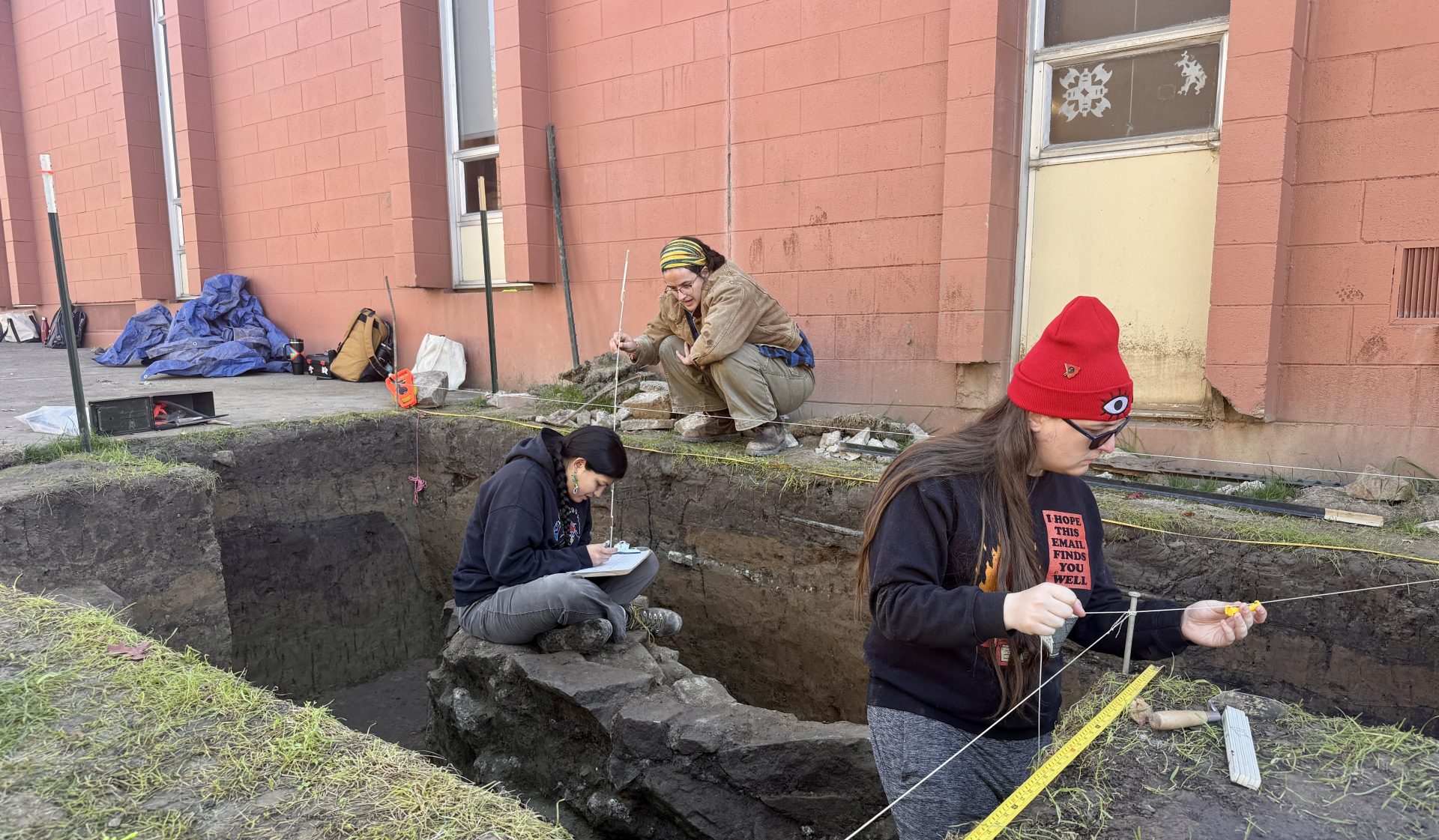
Stevens is a sophomore studying cultural anthropology and secondary education. She hopes to return to the San Carlos Apache Tribe reservation in Arizona, where she’s from, to teach high school.
She said she likely wouldn’t have invested in going to field school but has loved learning about the process this semester.
Freshman Violet Southmayd, 18, was thrilled to complete field school her first semester of college. She hopes to become a forensic analyst.
“It’s such a good opportunity, and it gets you exposed to options that are out there so early,” she said. “It’s such a good opportunity as a freshman for me to learn what I want to do and what I don’t want to do.”
Up the hill, Elise Provant, decked out in a mask and pink jumpsuit, digs through artifacts pulled from under Moscow’s library. Provant plans to graduate in December with a degree in anthropology. She hopes to work on a master’s degree in lithics, stone tools, after a gap year.
“It’s really awesome that we have this opportunity because I know a lot of field schools are usually in remote locations, and they’re usually pretty expensive,” she said.
Kaitlyn Hafter, 20, also plans to graduate this year. She also completed a field school focused on maritime archaeology in Florida.
The experience was invaluable, but it was expensive, with $3,000 in tuition on top of room and board.
“It added up very quickly,” Hafter said.
Maintaining her busy schedule as a member of the university’s swim team while building field skills has been invaluable, she said.
The digs have also allowed younger community members to participate.
Homeschooler Easton Harrison, 12, recently asked Morgan McCully, a 21-year-old senior, to explain the archeological process known as flotation to him last week. The process allows archeologists to use water to separate sediments found in soil samples.
Harrison has become a fixture at the dig over the last few weeks. His mother, Janelle Harrison, surprised him by letting him help after she saw a sign explaining the project.
“My son has been obsessed with archaeology,” Harrison said, noting that his passion started after reading a book at age 5. “He’s been here every single day they’ve dug since then.”

