
In the aggregate, the Legislature might have moved a tick or two toward the center Tuesday night.
However, the primary election was neither a definitive win nor a statewide sweep for the Idaho GOP’s mainstream. True to form, Tuesday’s legislative results landed all over the map, one region to the next.
Let’s turn to the scoreboard.
Where the mainstream won (and the hardline lost)
Guthrie defeats Worley. Senate State Affairs Committee Chairman Jim Guthrie, R-McCammon, won the one primary the mainstream had to have — defeating hardline challenger David Worley in what appears to be the state’s costliest legislative primary.

This win reverberates far beyond Bannock, Franklin and Power counties, home turf that has long been friendly to centrist Republicans. It’s a proxy win for Gov. Brad Little, state superintendent Debbie Critchfield and three other statewide officials who endorsed Guthrie, and a loss for Attorney General Raúl Labrador, who endorsed Worley.
It’s rare for statewide officials to split, and split publicly, on a legislative election, and that underscores this race’s importance.
The governor’s race. Little’s win, while expected, validates the GOP’s establishment base — to some degree.
Little certainly didn’t campaign to the center. As you might have heard in TV ads or might have seen on roadside signs, Little carried the endorsement of President Donald Trump. But make no mistake: Little was challenged from the right, particularly by unabashed culture warrior and Old State Saloon owner Mark Fitzpatrick of Eagle.
Little was never threatened Tuesday night, winning an eight-person primary with 59% of the vote. There is one cautionary sign: Little received more than 8,000 fewer votes than he picked up in the 2022 GOP primary.
The Gang of Eight becomes a gang of three. It was a rough night for the self-named Gang of Eight, a subcaucus of hardline fiscal conservatives. Five “gang” members lost Tuesday: Sens. Glenneda Zuiderveld and Josh Kohl of Twin Falls, and Reps. Lucas Cayler of Caldwell, David Leavitt of Twin Falls and Faye Thompson of McCall. A sixth hardliner also fell: Rep. Tanya Burgoyne of Pocatello.
On a night when 10 sitting lawmakers lost, the right wing absorbed the brunt of the fallout.
Where the hardline won (and the mainstream lost)
The far north. In District 1, Idaho’s northernmost outpost, the pendulum swung again, this time back to the right. Former Sen. Scott Herndon ousted Sen. Jim Woodward, R-Sagle, in what appears to be Idaho’s second most spendy legislative primary. (To put it mildly, these two candidates have a history: Herndon ousted Woodward in the 2022 primary, and Woodward avenged that loss two years later.)
Also in District 1, Jane Sauter ousted Rep. Mark Sauter, R-Sandpoint. No relation here, and a definite ideological shift. Jane Sauter’s win is a win for the hardliners.
District 6, the Moscow area. In another high-profile showdown, the hardline held serve. Sen. Dan Foreman, R-Moscow, defeated moderate Rep. Lori McCann, R-Lewiston. On top of that, conservative Colton Bennett got the nomination for the House seat McCann abandoned. While District 6 includes the University of Idaho campus, you’d be hard-pressed to see evidence of that in recent election cycles. Unless and until this district acts purple — like the swing region it’s commonly painted to be — District 6 could provide a net win for hardliners in November.
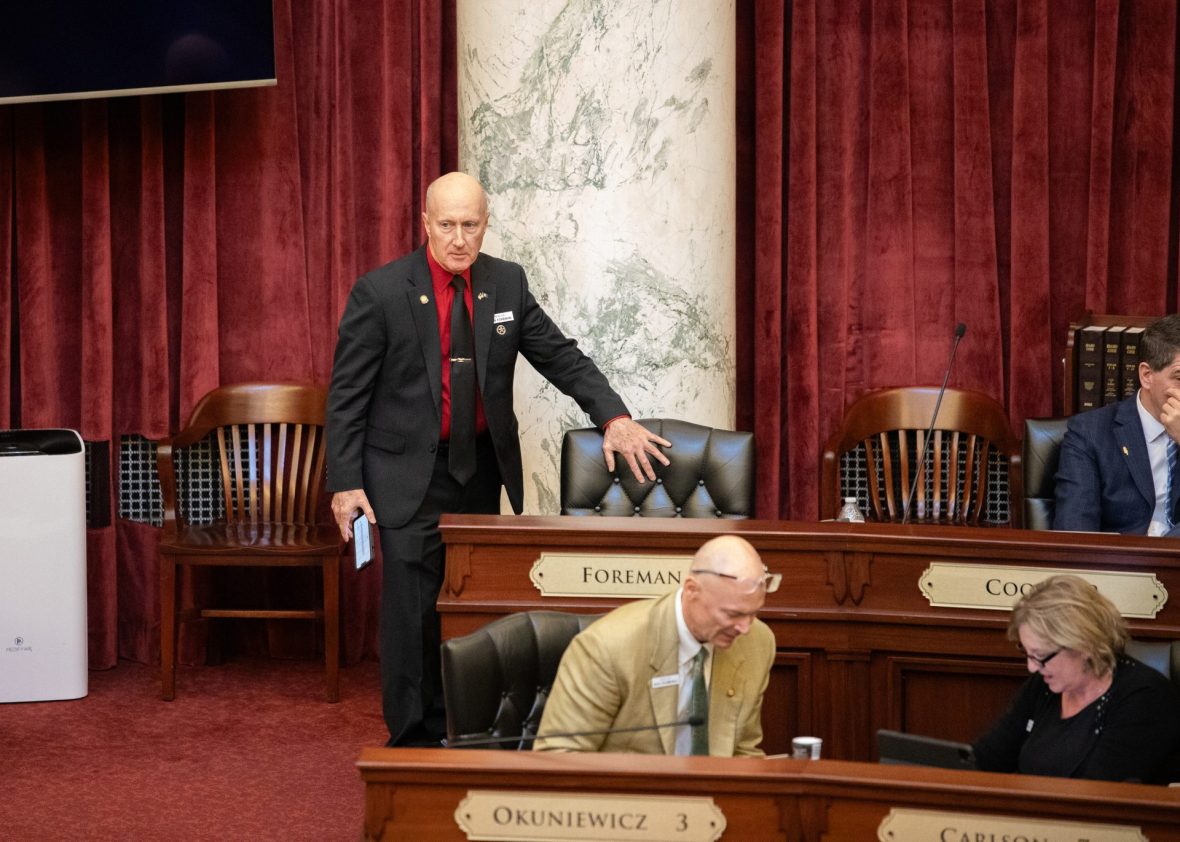
Some key holds on JFAC. Zuiderveld had been the most staunch no vote on the budget-writing Joint Finance-Appropriations Committee. She’s gone now. Also gone is JFAC House vice chair Steve Miller, R-Fairfield, who often aligned with committee conservatives.
But three of JFAC’s House hardliners survived primary challenges: Chris Bruce of Kuna, Kyle Harris of Lewiston and Elaine Price of Coeur d’Alene. If all three win in November, they could be poised to return to the most powerful panel in the Statehouse.
Here’s what it means — or, actually, doesn’t mean
It’s a bad idea to read too much into any primary.
First off, this election cycle isn’t done yet. There’s still a general election. Democrats have recruited candidates in all 35 legislative districts — and while many of these candidates face an uphill battle in chipotle-red rural Idaho, parties tend to lose 100% of the races they leave uncontested.
The general election will affect the GOP’s balance of power, to a degree. There are, after all, still a handful of legitimate legislative swing districts around Idaho: West Boise’s District 15; south-central Idaho’s District 26, which takes in Blaine County; the Pocatello area’s District 29. The outcomes in the swing districts will shape the House and Senate Republican caucuses. The same would apply if Democrats land any breakthrough wins elsewhere around the state.
Second, this year’s primary was simply not as turbulent as the 2022 and 2024 primaries. The 2022 purge took out 20 incumbents, including Senate Education Committee Chairman Steven Thayn and JFAC Senate Chairman Jeff Agenbroad. Fifteen incumbents lost in 2024, including Senate President Pro Tem Chuck Winder and House Education Committee Chairman Julie Yamamoto. Yes, 10 sitting GOP lawmakers lost Tuesday — no small number from a 105-member Legislature — but none of these 10 chaired a committee or held a leadership post. Five of the 10 were first-term lawmakers.
Third, there’s no statewide pattern to Tuesday’s results. By turning out Gang of Eight hardliners elected in a string of 2024 upsets, Magic Valley Republicans voted more like they have for decades, skewing back to the mainstream. From Moscow to the Canadian border, the hardliners held ground or gained ground, as they have in recent election cycles.
Legislative elections affect state policy — and because of that, they attract attention from out-of-state donors. But when the campaigns end and the vote tallies roll in, legislative races are ultimately local in nature.
Tuesday’s primary illustrated that, once again.
Kevin Richert writes a weekly analysis on education policy and education politics. Look for his stories each Thursday. Due to the timeliness of the topic, this week’s analysis was published on Wednesday, May 20.