Idaho has reported only 10 measles cases so far this year.
The big numbers — and the signs of trouble — loom beyond the state’s borders.
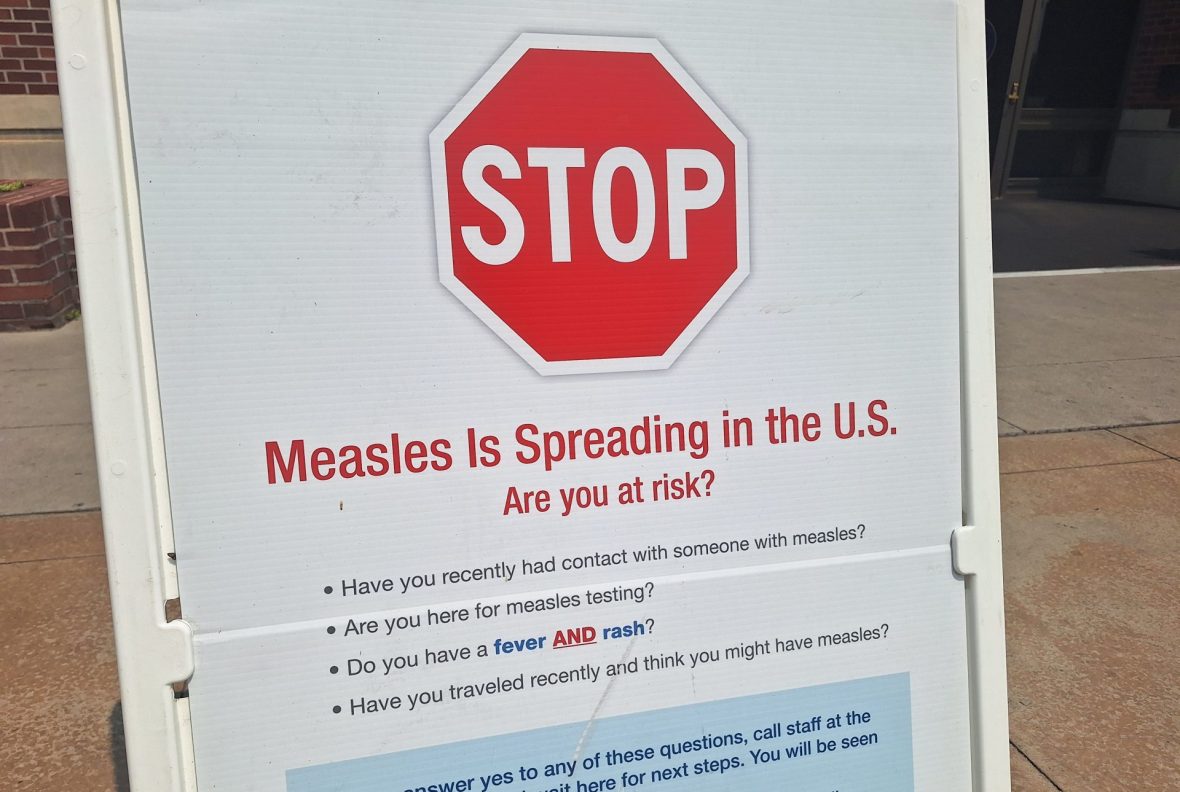
Two neighboring states have reported recent outbreaks of the highly contagious virus. Overall, measles cases are increasing across the nation — reaching a 35-year peak.
“This is a concern but not a surprise,” said Kathryn Turner, Idaho’s deputy state epidemiologist, noting that case numbers have been rising for several years.
It’s one more concern as Idaho school officials prepare for the new academic year.
The actual risk is as unpredictable as the virus itself. But this much is predictable: The spike in measles cases sharpens a polarized debate over vaccines — and Idaho’s immunization rates, which have fallen sharply since the COVID-19 pandemic.
The measles caseload, in context
It’s still July, but it’s already been a rough year. The national case count has already passed the 2,300 mark — eclipsing the total for all of 2025. These 2026 numbers are the highest since 1991, during the infancy of a national measles vaccination effort, States Newsroom reported recently.
Here’s another way to look at it: In 2000, the World Health Organization declared measles eliminated in the United States. This year’s case numbers represent a post-“elimination” peak.
Idaho’s 10 cases include a January outbreak in a single unvaccinated household in Canyon County, involving five people. Another Idaho case is an outlier, according to health officials: Earlier this month, a vaccinated adult in Idaho’s Teton County contracted measles. (According to a national measles tracker maintained by Johns Hopkins University in Baltimore, Maryland, the vaccine protects 97% of its recipients from the virus.)
While Idaho hasn’t seen a measles spike, outbreaks have struck close to home. According to the Johns Hopkins database, Utah has already reported 514 cases this year, second only to South Carolina. Idaho’s Teton Valley case coincides with a cluster of five cases across the state line, in the global tourist destination of Jackson, Wyoming.
“No place is protected from the risk of an outbreak,” said Turner, in written responses to questions from EdNews.
In a ‘very mobile society,’ measles can move rapidly
The Utah case spikes and the Canyon County cases have concerned Tamara Frederickson for months.
“We live in a very mobile society,” said Frederickson, the Boise School District’s health services supervisor. “People travel a lot.”
If anything, measles travels even more quickly. It’s far more contagious than pertussis, or whooping cough, a disease that is persistent enough and mobile enough to occasionally force school closures. Measles is also more contagious than COVID-19.
Boise has tried to get ahead of the virus by educating local school officials. The district has pushed out information about measles spread and measles symptoms. The district has also talked about slowing the spread of measles by using tools familiar from the COVID-19 pandemic, including personal protective equipment and isolation.
Frederickson, meanwhile, keeps an eye on wastewater test results — another byproduct of the COVID-19 pandemic. The wastewater tests can detect a range of diseases, including measles. In April, one test result uncovered what the Central Health District called “an isolated detection” of measles virus RNA.
A post-pandemic slide continues
Like the case numbers, the vaccination numbers are also troubling.
Idaho has long had some of the nation’s lowest immunization rates. Idaho has also had one of the nation’s highest immunization exemption rates. Parents can opt their kids out of vaccinations simply by turning in a slip of paper.
During and since the COVID-19 pandemic, the vaccination rates have dropped sharply. The exemption rates have continued their climb. The 2025-26 school year produced more of the same.
The state Department of Health and Welfare tracks statewide immunization rates in kindergarten, first grade, seventh grade and 12th grade. Here’s a look at the past two school years — and, for a grim comparison, the 2019-20 school year that overlapped with the beginning of the pandemic:
| 2019-2020 | 2024-2025 | 2025-2026 | |
| Immunization rate | 86.5 | 68.8 | 66.4 |
| Exemption rate | 7.9 | 14.2 | 15.9 |
| Incomplete student records rate | 4.4 | 14.9 | 15.2 |
| “Conditional” rate (students with immunizations in progress) | 0.8 | 1.2 | 1.6 |
These numbers cover all vaccines, not just the measles vaccine. But as measles rates are clearly rising, it is also clear that more Idaho parents are choosing to opt out of vaccinations.
Vaccination rates vary widely from county to county. For the 2025-26 school year, 93% of Minidoka County kindergartners had received the MMR vaccine, the series of shots specifically for measles, mumps and rubella. Adams County ranked last in the state, with less than a 42% rate. (Click here for the county-by-county breakdowns from Health and Welfare.)
At each grade level, Boise’s overall immunization rates beat the statewide averages, often by 10 percentage points or more. But Boise doesn’t reach a 95% rate — which, according to the science, provides a “herd immunity” that also protects unvaccinated students. So Frederickson is still concerned about Boise’s numbers.
In Boise, as elsewhere, vaccine hesitancy has proven to be a challenge. “Post-2020, our vaccination rates decreased … and they’re starting to trend up again,” Frederickson said in an interview. “But it’s taken a lot of work on the part of schools to get information out to parents and provide that support and access to immunizations.”
Lines of defense, levels of protocol
In schools, the first lines of defense are straightforward and familiar. Cleaning down classrooms and buses. Encouraging kids — especially incoming kindergartners — to “vampire cough,” using their arm to cover their mouth. None of this is measles-specific, nor does it need to be.
“It’s a communicable disease protocol,” said Anita Christenson Koons, student safety administrator for the Nampa School District. “It works for all of the things.”
But if case numbers spike, schools can move beyond preventative steps.
State law allows a school administrator to send students home, if they have (or are “diagnosed or suspected” of having) an infectious disease.
Nampa has done this during recent whooping cough outbreaks, Koons said. But the district didn’t take the next step allowed under state law: excluding students “who are not immune and have been exposed to a contagious or infectious disease.” That’s a case-by-case decision, Koons said; the district might send unvaccinated students home during “rampant spread” of a disease, but not if case numbers are low or limited to kids from the same household.
A similar kind of calculus could come into play with measles — with school and health district officials weighing the local case numbers against the state and national trends, she said.
Schools have one more, last-ditch option at their disposal. Working with their local health district, trustees can shut down a school if they determine that “conditions warrant such closure.”
Notably, the language allowing school officials to send home sick or unvaccinated kids — or close entirely — has survived recent legislative sessions. These sections of law were left untouched in 2025, when lawmakers passed a far-reaching “medical freedom” law written in direct response to the COVID-19 pandemic.
A front line in the immunization debate
But vaccines, meanwhile, remain squarely in the political crosshairs.

The 2025 medical freedom law specifically prohibits schools from requiring any “medical intervention,” including vaccines. That means people can work at schools or attend classes or campus events, regardless of vaccination status.
A 2026 follow-up bill would have labeled vaccinations as “voluntary” — even though, in essence, the exemption process does pretty much the same thing. It also would have required parents to opt in to Idaho’s immunization registry, instead of allowing them to opt out. The bill died in a House committee.
Whether Idaho sees a spike in measles cases or not, the specter of the virus puts Health and Welfare and local schools on the front line in the immunization debate.
Turner, Health and Welfare’s deputy epidemiologist, says her agency isn’t changing its messaging on vaccinations. The national measles spike isn’t changing the message, and a “single case” involving a vaccinated person won’t either.
“We continue to emphasize the importance of immunizations as the best defense against measles and recommend that people with questions talk with a trusted healthcare provider,” she said.
But it also falls to schools to deliver the message to parents.
By law, schools must outline the exemptions process “in any communication … regarding immunization.” But in Nampa, that also comes with a caution — an explanation that schools might exclude an unvaccinated child from class during an outbreak.
“We want to make sure parents know they have choices,” Koons said in an interview. “We just also want them to understand what comes with making some of the choices.”
In Boise, meanwhile, school officials want to help parents choose the vaccine. “We want to make it as available to them as we possibly can,” Frederickson said.
Even if that comes down to the wire. On Aug. 11, Boise schools will partner on a student immunization clinic at Whittier Elementary School.
Classes begin on Aug. 12.
Kevin Richert writes a weekly analysis on education policy and education politics.