All three candidates for Idaho’s top education job say that the state should be more transparent about who’s benefiting from a fledgling private school choice program.
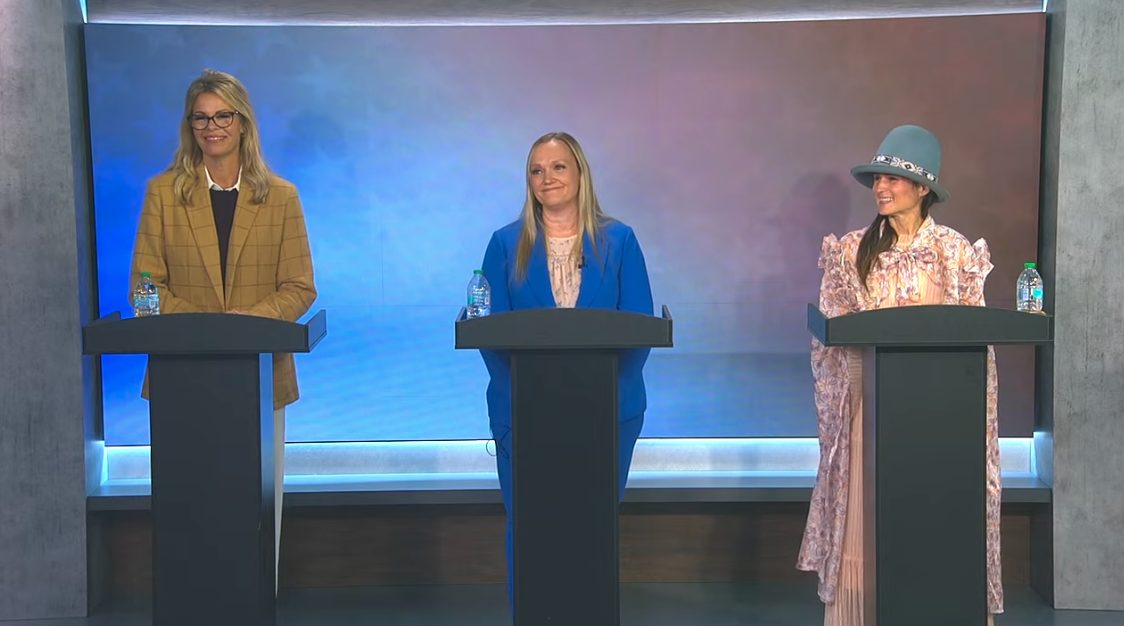
Incumbent state superintendent Debbie Critchfield, a Republican, faced challengers Becky Sundin Mitchell, a Democrat, and Teresa Roundy of the Constitution Party in a live, televised debate Monday. Idaho News 6, a Boise-based TV station, hosted the debate.
The candidates agreed on many topics during the hourlong event, including whether the state should release data that shows how many recipients of the Parental Choice Tax Credit were previously enrolled in private school. They also agreed that private schools receiving taxpayer funds should be subject to similar academic reporting requirements as public schools.
“It’s no different than any other government program that is funded through taxpayer dollars,” Critchfield said. “We have an expectation to know where those dollars go.”
Critchfield added that the state should find out whether parents are satisfied with the education choices that they made for their children.
The tax credit offers families up to $5,000 — or $7,500 if they have a disability — to offset private school tuition and other nonpublic education expenses, including homeschooling costs. Since the program launched Jan. 15, the Idaho State Tax Commission, the state agency responsible for administering the tax credit, has yet to release data that would test a key selling point of the program: that it would help students who couldn’t otherwise afford private education.
“Any time that taxpayer money is used for anything, there should be accountability attached to it,” Sundin Mitchell said. “I’m concerned that we passed this tax credit system without having any accountability measures in place.”
Roundy agreed. “The state should track and publicly report these figures to ensure total transparency, fiscal responsibility and equity for Idaho taxpayers,” she said. “Public funds must be used effectively and should never subsidize the wealthy at the expense of families who are genuinely struggling.”
Idaho News 6 senior reporter Riley Shoemaker and neighborhood reporters Greenlee Clark and Allie Triepke moderated the debate. Candidates were given one minute to respond to each question.
The candidates also discussed Idaho’s aging school funding formula, school security, facilities funding and special education, among other topics.
Click here to watch the full debate.
Here are some highlights:
Timberline investigation and addressing threats at school
Each candidate also weighed in on the investigation into alleged violent threats against a female student at Boise’s Timberline High School. Students staged a school walkout last week, calling for accountability as police investigate the incident.
State superintendent candidates were asked what “specific actions” they would take to ensure students feel safe reporting harassment and threats. They were also asked how they would hold school districts accountable when parents feel those concerns aren’t being addressed.
Sundin Mitchell said the Idaho Department of Education (IDE) should step in when there’s a “breakdown in communication between districts and families.” She proposed creating an office within IDE where families can air their concerns. The superintendent could “not only hold districts accountable” but also “partner with districts,” she said, “so that if a breakdown in the communication happens, that they can assist.”
Roundy, who has made student safety a centerpiece of her campaign, said the issue starts at home and extends into schools, and both environments should be supportive. She proposed transforming schools into “trauma-aware environments” while dismantling “coercive control” and prioritizing “deep connections” instead of “punitive discipline.”
Critchfield said that she worked with lawmakers on a law enacted last legislative session, House Bill 785, that defined what constitutes “inappropriate online behavior” and outlined how schools should respond to it. The law gives school districts the authority, in some circumstances, to act on student behavior that occurs off-campus. “So now our districts and charters have the tools to be able to respond better,” Critchfield said.
Previous debates
Monday’s debate marked the second time that all three candidates debated and the third time that Critchfield and Sundin Mitchell squared off.
Here’s the timeline:
- On Aug. 4, the three candidates answered questions during the Idaho Association of School Administrators’ annual conference.
- On Sept. 22, Critchfield and Sundin Mitchell participated in a debate organized by Idaho Education News and the College of Idaho. Roundy did not meet the fundraising threshold to participate in that debate.
- Critchfield and Sundin Mitchell were scheduled to debate again Monday on KTVB. Roundy also did not meet KTVB’s fundraising threshold. But Critchfield backed out of the event after declaring that she would only participate if all three candidates were invited.
Three other Republican incumbents in statewide elections declined or ignored KTVB’s invitations to debate their challengers: Gov. Brad Little, Attorney General Raúl Labrador and Sen. Jim Risch.
PragerU
Critchfield also faced a question about one of the most controversial decisions of her first term: endorsing PragerU classroom materials that espouse right-wing political views. Touted as an “alternative to the dominant left-wing ideology in culture, media, and education,” PragerU is a supplemental curriculum, meaning local school boards can choose whether to use it.
Still, Critchfield’s decision to endorse it drew backlash, including from Nez Perce tribal leaders who called the curriculum “heavily biased.”
On Monday, the state superintendent candidates were asked whether education leaders should be endorsing supplemental curriculum from organizations with a “clear ideological perspective.” Shoemaker said the question came from an Idaho News 6 viewer.
Critchfield responded that, as long as curriculum aligns with state content standards, supplemental materials are the purview of local school boards. “If somebody doesn’t like a book that I do like, or vice versa, it’s up to them and their local community to decide if they want to implement that in the classroom.”
Sundin Mitchell said PragerU should have been vetted by experts before the Idaho Department of Education endorsed it. The state needs to be “very, very careful” about material that “hasn’t had the vetting process” through a statewide curriculum committee, she said.
Campaign fundraising
Critchfield has far outpaced her opponents in fundraising, with more than half of her contributions coming from businesses.
Here are the fundraising totals as of Monday:
- Critchfield — $159,658.20
- Sundin Mitchell — $24,591.57
- Roundy — $0
Four-day school week, moment of silence
During a “lightning round” of questions, candidates had 30 seconds to explain their stance on a handful of trending topics in education, including the four-day school week.
More than half of Idaho’s school districts and charter schools now operate on four-day calendars.
Roundy said the four-day schedule “could be good.” She noted that in Finland, which is “No. 1 in the world on education,” some students only go to school for four hours per day.
Sundin Mitchell, a middle-school teacher, said that having Fridays off sounds great, but students benefit from consistency, and many students rely on school for balanced meals. “What I have found is best for students (is) if we can keep a five-day school week,” she said. “But I do understand that four-day school weeks sometimes exist because it’s the only way that schools can keep their doors open when we cut their funds.”
Critchfield also said that her “personal preference” is a five-day week, but she will “always champion” local control by communities and their elected school boards. “They decide what their community wants, and then we support high-level learning for all students.”
The candidates also opined on a divisive new mandate for schools: one-minute periods of silence each school day.
Critchfield said she hasn’t heard a “negative report” from educators on the Legislature’s new requirement since it took effect this school year. “I think it’s been an opportunity to reset a classroom before they get going,” she said. “I have yet to hear — and I may get emails after this — but yet to hear of it not working in a school.”
Roundy also supports the requirement. It’s a “refreshing way to get prepared for the day,” she said, adding that she would support students doing yoga and tai chi, as well.
Sundin Mitchell, on the other hand, said it’s challenging for her seventh graders to not fill silence with “farting noises and whatever else they can possibly think of.” She also said the legislation could have been less “punitive” for teachers. “It kind of puts a teacher in a position where they feel that they might get in trouble with an administrator if they walk by and it’s not a quiet classroom.”
Election Day is Nov. 3. Click here for information on how to vote.