
MOSCOW — Moscow patrons will have the long-awaited chance to overhaul their schools this fall after trustees put a seven-year, $9.37 million per year plant facility levy on the November ballot Wednesday night.
The vote followed decades of complaints over the nearly 90-year-old high school, years of discussion over how to update facilities, months of planning by a facility committee, and weeks of presentations to the school board.
If the levy, totaling $65.6 million, passes, it will kick off the first phase of a decade-long plan to convert the district’s middle school into a high school. The second phase, building a new middle school, would require a second ballot measure.
The approach is groundbreaking in Idaho, where plant facility levies are typically used for maintenance. However, districts are more frequently considering plant facility levies for major building projects as bond passage becomes nearly impossible.
‘It is not an option to do nothing’
After a presentation of 10 different paths forward by Superintendent Shawn Tiegs Wednesday night, trustees quickly nixed most of them, including doing nothing or running a $157 million bond to complete everything in the district’s facility plan.
“It seems to me that it is not an option to do nothing,” said Trustee Dulce Kersting-Lark.
She argued that after decades of complaints about the state of the high school, which was built in 1937 just up the hill from Moscow’s downtown, trustees had a mandate from voters to put something on the ballot.
“There is no polling to be done,” she said. “The polling is you give an election.”
Longtime trustee Jim Frenzel emphasized running a bond isn’t an option.
A school bond hasn’t passed in Idaho since May 2024. In the years before that, passage was still a rarity. Districts instead are just maintaining the buildings they have with plant facility levies — but passage for those is dropping, too.
This spring, 80% of plant facility levies failed.
Read more about the state of building schools in Idaho.
There are major differences between bonds and levies when it comes to the practicality of major building projects.
A bond requires a supermajority of two-thirds in favor to pass. But once a bond passes, districts get those funds up front, then pay it back over time, similar to a traditional mortgage.
Also similar to a mortgage, taxpayers spend nearly 90% of the initial bond price in interest.
“The chances of passing a bond in Moscow in our current environment is impossible,” Frenzel said.
Fellow Trustee Dawn Fazio agreed.
“I just don’t think Idaho is the environment to do that,” she said.
Plant facility measures are levied each tax year, so districts get annual payments rather than funds up front. Districts can, a 2015 state Supreme Court ruling affirmed, use a lease-to-purchase agreement to get some funds up front via a loan.
The levy also can require a lower threshold to pass at 60 or 55% of voter support, depending on the district’s overall debt load.
The problem for Moscow comes in the order projects need to be completed. The district plans to convert the existing middle school into a high school for a total of $55 million.
Experts Moscow consulted said a lease-to-purchase agreement for a conversion isn’t possible because the district already owns the building, so if there was a default, the bank wouldn’t be able to take control of the assets.
A lease-to-purchase agreement would allow for a new middle school to be built, at an estimated cost of $67 million, in phase two of the plan.
The benefit of the lease-to-purchase agreement is the shorter timeframe. Plant facility levies can run for up to 10 years, compared to 30 years for a bond, meaning the district would pay a fraction of the interest.
Districts in recent years have attempted to pass plant facility levies to build new buildings but haven’t seen success. An attempt by West Ada to pass a $500 million plant facility levy in 2023 failed.
The plan
Trustees unanimously voted to put a seven-year, $9.37 million per year measure on the November ballot. That will cost taxpayers $280 per $100,000 of taxable assessed value before state property tax relief.
The measure will require 60% of voters in support to pass.
That will generate $65.6 million in funds to do projects, combined with about $12 million in savings the district plans to start the middle school-to-high-school conversion.
Read more about the proposed projects here.

The conversion would be done in stages while middle schoolers are still using the building. One summer a new performing arts center might be completed; the next a new commons built.
The district would also convert the former Russell Elementary into a home for Paradise Creek alternative high school with the district office on the second floor. The move leaves the district office empty to become a medical arts center.
Some of the new facilities, like the performing arts center, could open as soon as completed, showing the value of the project immediately to taxpayers, Tiegs said.
Over the course of five to six years, the renovation would be completed, then the middle schoolers would move to the current high school.
“Those challenges would be passed on,” Tiegs said of the high school building.
Tiegs presented an estimated timeline of how the project would impact each graduating class for the next decade, using his own children as an example.
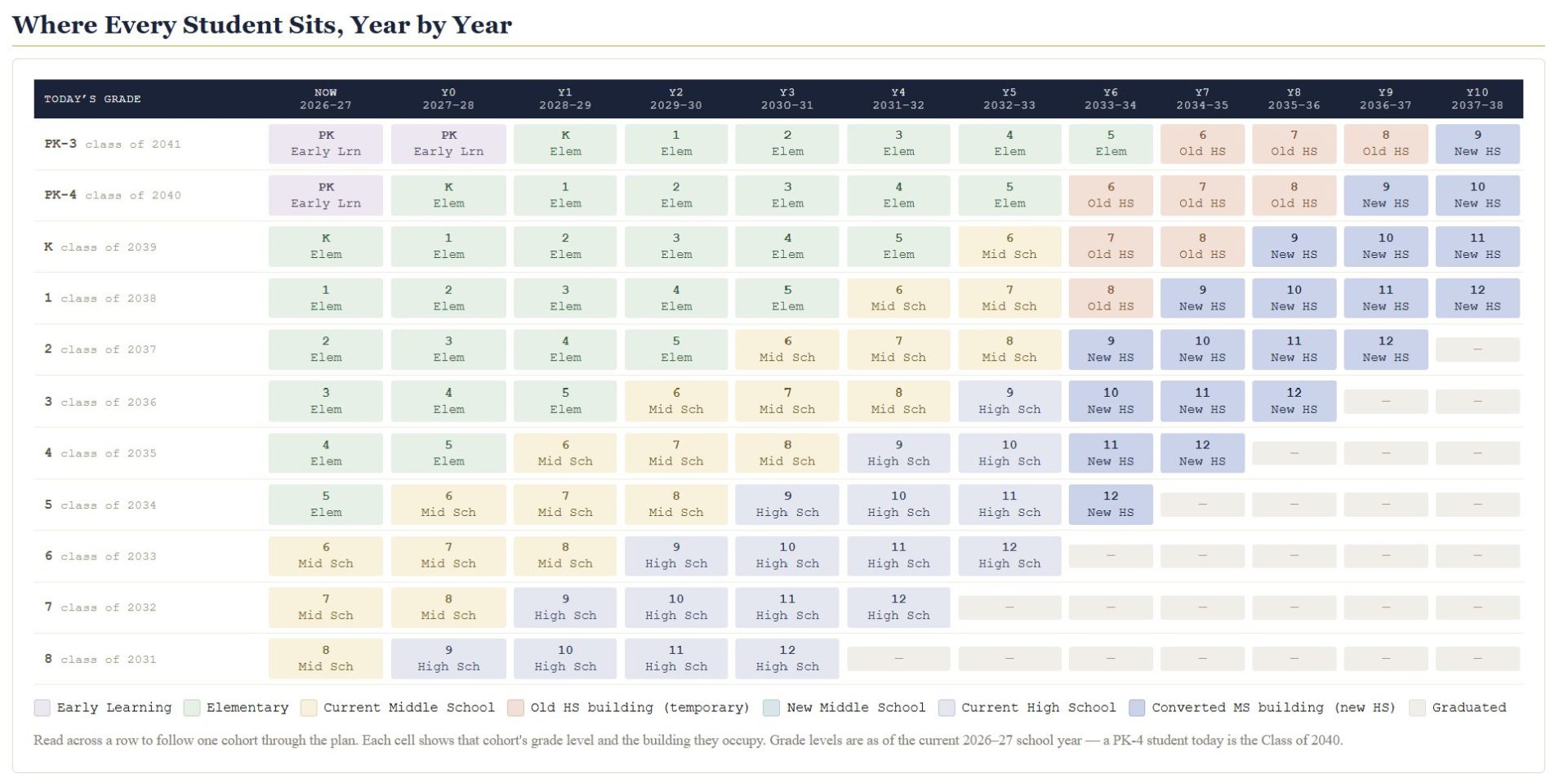
Tiegs’ fourth-grade son Seth would attend the middle school during construction.
“He’ll be walking through a gerbil tube to get to the Bear Den,” Tiegs said with a chuckle.
The problem, Tiegs and trustees noted, is that a second plant facility measure would have to pass in seven years to build the new middle school.
“We have to make this mark,” Tiegs said.
Frenzel said: “People will be excited about the phase 2.”
He hopes the conversion, which is cheaper than the estimated $110 million to build a brand new high school, will entice voters to pass a second ballot measure. The district’s current bond also runs out in seven years, meaning the tax burden would decrease even with a continued plant facility levy.
Middle school faculty and staff have asked Tiegs, “What happens if we get stuck here like the high school has got stuck here?”
“I get it, I think it’s a legitimate concern,” Teigs said.
Patrons signaled support to trustees
All nine of the patrons who spoke Wednesday voiced support for any plan trustees approved, but most raised concerns about the reality of the measure passing.
Retired teacher Kathy Dawes, who ran unsuccessfully for state representative in 2024, said trustees should consider just running a large bond proposal to cover both projects.
“Go for the whole ball of wax,” Dawes said. “I’m not sure we could pass it, but it’s worth a try.”
Carole Wells, who is running for Latah County Commissioner, agreed but said she would “spread any word that you guys decide upon.”
Allen Johns has three kids, one still in high school and two who have graduated. While his children won’t see the benefits of a remodel, he supported the move.
When talking to family over the summer, the first thing his kids had to say about their high school was that it had a bomb shelter in the basement. Not exactly what Johns said he hoped they’d remember from their high school years.
Johns said his employer is in a hiring push, but many of his new colleagues aren’t moving to Moscow, they’re settling across the border in Pullman, Wash.
“We miss out sometimes on what could come to our community if there was the impression that the schools were better,” he said, noting academically the schools are exceptional. “I love that people have been able to do so much with what we have here.”
Marie Duncan, who has four children, said she remembers when Moscow’s last bond attempt failed in 2005.
“Public education is at an all-time high for attacks,” Duncan said. “It’s going to get harder and harder for things to get passed.”
She encouraged trustees to select the seven-year measure they eventually approved but was supportive generally.
“I’m in support, obviously, of whatever happens,” she said.
Voters will have their say on November 3.

