
Funding for school facilities, both building new ones and maintaining existing buildings, is growing more unpopular at the ballot box, an Idaho EdNews analysis of 10 years of election data shows.
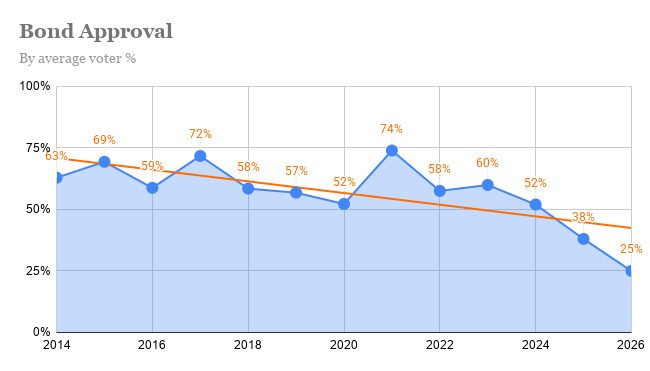
A school bond hasn’t passed since May 2024, more than four election cycles.
“I think it is a rarity if it happens,” said state superintendent Debbie Critchfield. “It has now become the outlier.”
Since the COVID-19 pandemic, districts have been cautious about attempting to pass a bond. In 2019, there were 20 bonds on the ballot. In 2025, there were six.
During that time, a slew of election and funding changes impacted bond passage, said Rich Bauscher, a retired superintendent who consults with districts attempting a bond.
The Legislature reduced the number of school election dates from four to two. Lawmakers also provided districts with $1 billion in facilities funds to deal with aging school buildings.
That figure didn’t equate to enough money to build a new school or overhaul buildings in many small and mid-sized districts, school leaders and Critchfield say. The new funds came with cuts to lottery funds traditionally used to pay for routine maintenance costs.
But the $1 billion figure has stuck in many voters’ minds, Bauscher said.
Critchfield thinks it’s “overall voter fatigue,” a bad economy and tight budgets.
“People aren’t comfortable saying, ‘Yeah, I’m going to tax myself more,'” Critchfield said. “I don’t attribute that to ‘I don’t care about or support our local school.’ Folks are like, ‘Hey, I’ve got to have this money to live.'”
Voters often don’t understand the state sends very little money for building upkeep and almost none to build new schools, she said.
“It really all comes back to this very complex funding formula that we have that doesn’t fund building,” Critchfield said. “That doesn’t fund construction or repairs, that doesn’t, doesn’t, doesn’t.”
Bonds aren’t passing, so instead, districts are turning to plant facility levies, which typically need 55% of the vote to pass.
Bonds need a supermajority — two-thirds of voter support — to pass. Idaho and Kentucky are the only two states in the country with that high of a threshold.
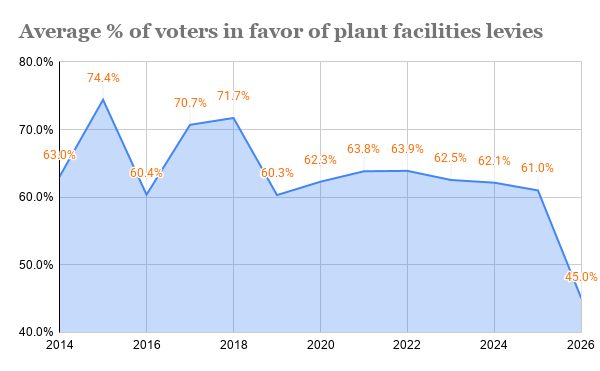
This spring, however, 80% of plant facility levies failed, despite their lower threshold. That’s the highest rate in more than a decade.
To learn more about how bonds and levies work check out our Spelling it Out series.
Bonds are increasingly unpopular
School bonds are typically paid back over 20 to 30 years and are most often used to build new facilities.
Since 2024, two bonds have passed.
One bond was in the Ririe School District, where officials tried — and failed six times — to pass a bond before doing it in May 2024. The bond was for $1.5 million and would pay only for maintenance on existing buildings.
On average, over the last 10 years, 30% of bonds passed.
“I don’t know how people get there,” Critchfield said of a bond’s two-thirds threshold to pass. “As I think about the whole sustainability part, I do not see a future where local communities are saying, ‘Yeah, we’re going to tax ourselves to get the new roof or build a building.'”

Districts are also running fewer bonds. From 2015 to 2019, there were, on average, nearly 16 bonds on the ballot per year. From 2021 to 2016, the average is about seven.
‘The people spoke’
“The reluctance of superintendents, as I talk to them, to run bonds is that it’s risky with their jobs,” Bauscher said.
Patrons in Kimberly expressed frustration to trustees after a bond and plant facilities levy both failed last month.
“The people spoke,” Kimberly resident Steve Long told trustees. “Are you listening?”
May 19 was a “great day” because the community won, Long said. They saw an “irresponsible” bond and defeated it by a 7-1 margin.
But trustees and Superintendent Luke Schroeder were frustrated by the lack of community engagement, with less than a handful of calls and questions about the ballot measures. On top of that, Schroeder said he’s constantly responding to misinformation about the district’s finances online.
“If the worst thing they did was misgauge our citizens by putting it out on a ballot, which is democracy, so that their voice could be heard,” Schroeder said of frustrations with trustees. “I just don’t understand why we’re so frustrated with them over that.”
People need to have trust in a district for a bond to pass, Bauscher added. Property tax relief dollars and legal limits on ballot language have made it harder to explain what homeowners will actually pay, he said.
In 2023, legislators passed House Bill 292, which reduces what voters pay in school property tax. But districts are not allowed to account for those savings in ballot language that outlines cost breakdowns for a bond.
The ballot language rules had good intent, Critchfield said, but, in practice, they haven’t panned out.
“The goal, of course, was to be more transparent for voters,” Critchfield said. “I think the way it’s put together is clunky and doesn’t get to the transparency part.”
School district leaders must do a lot of work and engagement to explain why a bond is necessary, and the difference between the sticker price on the ballot and what they’ll actually pay, Critchfield said.
“Many times voters will default to no,” Critchfield said. “This looks complicated, it looks detailed, they weren’t studied up when they got there.”
Districts have fewer opportunities to run measures
Legislators also took away the March and August school election dates for bonds and levies.
“I don’t believe that running in November against the legislative seats does any good for schools,” Bauscher said. “Our favorite one was August.”
Lawmakers and party leaders argued that eliminating low-turnout, under-the-radar school election dates would save administrative costs.
Rep. Joe Alfieri, who sponsored a bill to remove the March date, said the move could save counties $1 million in administrative costs, and eliminate low-turnout elections.
“We serve the public. … We must engage them in the best manner possible,” said Alfieri, R-Coeur d’Alene. “They’re listening in May and they’re listening in November.”
Republican Party Chair Dorothy Moon argued last year that further consolidation might be necessary.
“How do we get more people involved?” Moon wrote in an op-ed. “One idea is to move all elections to even-numbered years. It would save money and reduce the burden on everyday citizens trying to keep up with constant voting cycles.”
‘It’s absolutely sticker shock’
The cost to build a school has also grown exponentially in recent years.
Middleton’s high school was built in 2008 after a fire destroyed the historic school building. The school cost $42 million. Vallivue built Ridgeview High School for $50 million when it opened in 2016.
Owyhee High School cost about $70 million when it opened in 2021.
Bauscher tells superintendents, for ballpark numbers, that an elementary school costs half of a middle school, and a middle school costs half of a high school.
So if a new high school costs $100 million, a new elementary school costs about $25 million, he said.
That number often seems outrageous to voters, Critchfield said. “It’s absolutely sticker shock. In some ways, it crowds out the rest of the story.”
Many old school buildings are grandfathered in when it comes to safety and security concerns, but new buildings aren’t, Critchfield said. There are dozens of “must-have” safety and security considerations, along with technology needs and career-technical education facilities, which require expensive wiring.
“In addition to it just costs more per square foot, we have other usages and needs in classrooms that didn’t exist,” Critchfield said.
Schools often have to buy land, usually at market price, Critchfield noted, and they are “highly regulated facilities.”
Plant facility levies also struggle to pass
Superintendents are looking at the dwindling support for bonds and turning to plant facility levies.
Not only are these measures also failing, but “people don’t want to ask,” Critchfield said, noting there’s also a trust cost for running a measure. “There’s a lot at risk when we go to the local voter and ask them to be supportive of these things.”
Plant facility levies typically run for five to 10 years and most often require 55% of voters in support to pass. The measures pay for ongoing building maintenance like painting and new carpet, but also larger items like new roofs and HVAC systems.
On average, 28% of plant facility levies have failed over the last 10 years — well below May’s 80% failure rate.

When the levies do pass, they do so with less support than in previous years. Over the last five years, an average of 59.7% of voters supported plant facility measures, far below what a bond would need to pass.
Bauscher said districts often view supplemental levy elections as a test of voter sentiment. If a supplemental levy barely clears the 50% threshold needed to pass, a bond requiring two-thirds support is unlikely to succeed.
“Our supplementals now are passing with 51 or 52%, and I always use the supplemental as a barometer,” Bauscher said. “I want my supplementals, because I run them every other year, to pass with 75% so that you have continuity, passage-wise, with bonds.”
When it comes to solutions, Critchfield has a few. She encourages districts to look at sharing services.
“Nobody wants to talk about consolidation, but the reality is we need to be looking at how we share services,” Critchfield said.
People often ask why state spending for schools has risen so much in recent years. Critchfield argues it’s partially because of the increase in the overall number of schools, especially charters, serving the same or, in many communities, a declining number of students.
“We need to also take into consideration that every time a new charter school comes online, that is in fact a deconsolidation of public schools,” she said.
For Critchfield, it all comes back to Idaho’s antiquated and complicated funding formula. Critchfield is on a statewide listening tour ahead of a summer working group set to attempt another rewrite of the state’s funding formula.
“I understand the place where districts are,” Critchfield said. “We need to supplement, but the community doesn’t have extra to give. How do we do this then?”

