
After four years in the U.S. Army, Brian Kane wanted to go someplace he’d never been before. He traded central Texas for the University of Idaho.
“I signed out at about 5:30 in the morning, drove two straight days from Fort Hood up to Moscow, just in time for classes,” Kane said in a recent EdNews interview. “And the minute I got out of my little pickup truck, it was the first time I ever felt like I was at home, and that’s never left me.”
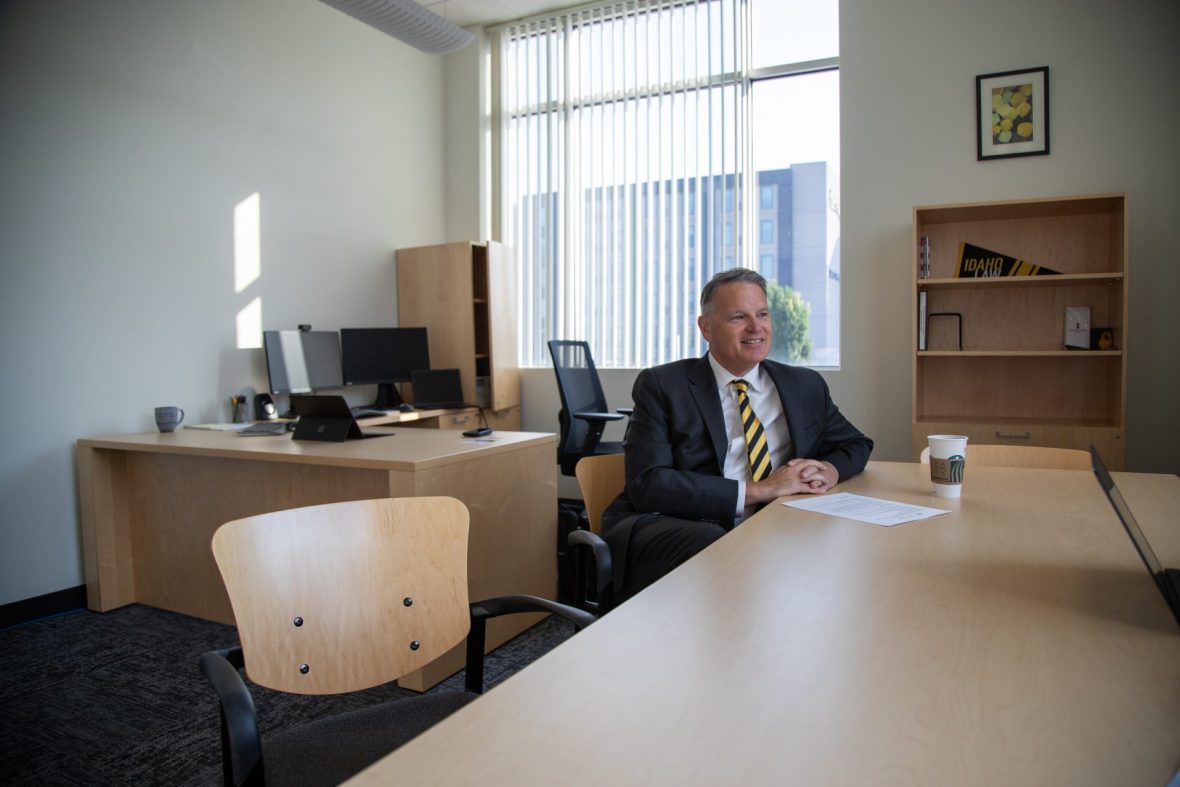
Kane has come back home, as dean of the U of I’s College of Law. He’s taking over a growing program, and believes the school has the potential for outreach beyond its Moscow and Boise campuses.
‘(We’re) really poised for a significant evolution’
The stats are enough to inspire an obligatory lawyer joke or two.
Bolstered by the largest first-year class in history — 121 students in Boise, 79 in Moscow — law school enrollment increased by 9.8% last fall.
The school received 823 applications this year, also a record.
Nothing is final until fall, but the signs are pointing to another record first-year class. And that presents a challenge of sorts. Traditionally, first-year Boise students gather outside the law school building for the start-of-semester group photo. This year’s photo session will take place on the Statehouse steps, to accommodate the influx of students.
An advocate for transparency
For many people in the public sector and the news media, University of Idaho College of Law dean Brian Kane is known for another role. The former chief deputy attorney general has long been active with Idahoans for Openness in Government, a nonprofit that advocates for government transparency.
Former Attorney General Lawrence Wasden says he and Kane teamed up on close to 200 presentations on open records and open meetings — a multiyear roadshow designed to provide training for elected officials and journalists.
Kane said he will “absolutely” be active with IDOG in his new role. “We’re at a point now where confidence in government is probably at a lower point in history. The only way to turn that around is actually through more transparency.”
Several factors are contributing to the growth, Kane said.
The college is capitalizing on growth in the state, especially the Treasure Valley.
The college makes affordability a priority. All first-year students pay in-state tuition, no matter where they come from. This allows out-of-staters to establish residency before Year Two. None of the law school’s 502 students pay full tuition.
Another driver, Kane said, is quality. “I think that folks are seeing that and saying, ‘Hey, this is a tremendous opportunity for us to advance our careers and advance what we want to do.’”
Kane said his goal is not to remake the law school, but to build on its momentum: “(We’re) really poised for a significant evolution.” And Kane is hoping to build on his background at the Statehouse and on the national stage.
‘A relationship of opportunity’
At 56, Kane brings a high political profile to one of Idaho higher ed’s most public positions. For 20 years, he was one of Attorney General Lawrence Wasden’s top deputies, putting him in the epicenter of Idaho public policy, and making him a fixture at the Statehouse.
The U of I hopes to leverage Kane’s institutional knowledge and Capitol contacts.
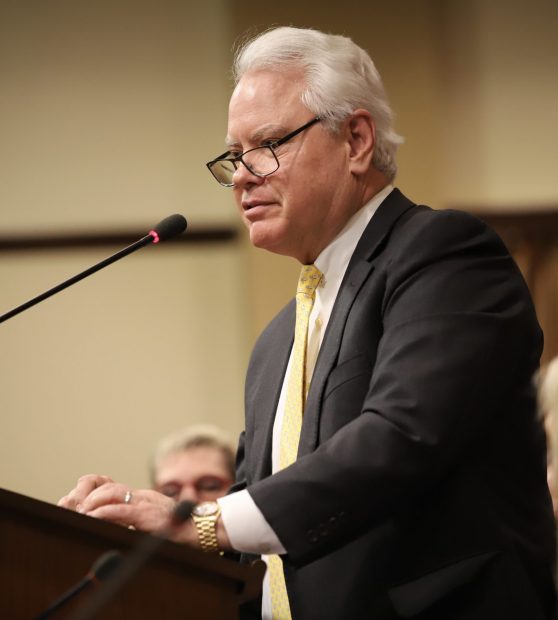
“Brian’s broad understanding of the issues facing our state and his time working in state government will enhance our College of Law and the school’s connections to our state,” President C. Scott Green said in a statement.
Kane’s background makes him an ideal fit, Wasden said in an interview.
“I think that they couldn’t have made a better choice,” Wasden told EdNews. “He’s a very quick study, very sharp. … (And) he reads people very well, and he understands the legislative process, the budgeting process.”
During Kane’s time at the Statehouse, the building’s dynamic changed. Idaho is less of a “mom-and-pop” state, he said — where legislators were easy to flag down on the House or Senate floor, and many deals were closed with a handshake.
As the process grows more complex, he said, the need for well-prepared law school grads only increases. And it gives the College of Law an opportunity to work more closely with lawmakers — providing spot analysis of legal issues, or a multiyear deep dive into complex policy matters.
“I think it’s a relationship of opportunity,” he said.
‘We have this higher function here’
Kane’s first day at the U of I was July 31. Three weeks earlier, he wrapped up his work as executive director of the National Association of Attorneys General, a group of 56 elected officials from states and territories.
Despite their deep ideological and partisan divisions, members were able to find common ground on legal issues that affect constituents personally. Issues like opioids, AI-generated child pornography, and an antitrust lawsuit against concert ticket behemoths Ticketmaster and Live Nation.
The organization illustrates how public policy — and public-spirited legal advocacy — can work.
“They always have this ability to say, ‘Hey, we have this higher function here that we need to come together,’” Kane said. “I started referring to them as the highest functioning unit of government.”
“If somebody’s doing bad in Idaho, they’re probably doing bad in Iowa, Indiana, and New York too,” Wasden said. “It doesn’t matter whether you’re a Republican or a Democrat, a violation of law is a violation of law.”
Kane began his work with the attorneys general four years ago, after Wasden’s five terms in office came to an abrupt end. In his new job, Kane worked with new Idaho Attorney General Raúl Labrador, who ousted Wasden in the 2022 Republican primary.
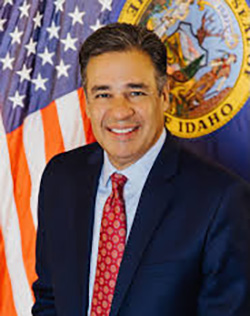
Kane said he has had a “great” working relationship with Labrador, who is active in the national organization. In a statement, Labrador praised Kane.
“Brian Kane has spent his career practicing and defending Idaho law, and that experience will serve the University of Idaho College of Law well,” Labrador said.
‘Building blocks for the continued ascent of our nation’
Personal experience shapes Kane’s view of his new job. Kane joined the Army after failing out of school. After four years in the military, he pursued his undergraduate degree at the U of I — serving as student body president and graduating with a degree in history and political science. He received his law degree from Lewis & Clark College in Portland, Oregon.
“Everybody comes here from a different background and with a different body of knowledge and experience, and they all also have differences in what they want to do with their law degree,” Kane said. “The great thing about a law degree, all of those opportunities are available to you.”
The U of I offers options, he said. For students who want to pursue a fast-paced job with a city law firm, the Boise campus is a fit. For students interested in a slower pace — or work in natural resources or tribal law — the Moscow campus fits. (Kane plans to split his time between the two campuses.)
But as the College of Law grows, so too does the skepticism about the legal profession. Like many bedrock pillars of 2026 America, the legal profession and the judiciary are under a harsh spotlight.
Not surprisingly, Kane advocates for his profession, and the importance of his new role. His message to students is straightforward.
“There’s no more critical point in time than to have legal education and to continue to have legal education evolve and provide those building blocks for the continued ascent of our nation,” he said.