An insurance trust that more than 100 school districts and charters rely on has depleted its reserve funds, and the trust’s manager informed school leaders they are responsible for covering the shortfall.
The trust’s benefit manager, Debbie Hainke, sent a letter to member schools last week stating medical claims have been “extremely high” over the last year and the trust has “exhausted its reserve funds to pay those high claims.”

The shortfall is estimated to be equivalent to one month of contributions, Hainke wrote. The trust is working with the Idaho Department of Insurance and Blue Cross of Idaho — the trust’s benefit plan administrator — to better estimate the shortfall and find ways to “soften the immediate cash impact for participating school districts,” she added.
The letter made clear that the trust and “participating school districts are responsible for the funding shortfall.”
School administrators are anxiously awaiting more information from the Idaho School Benefit Trust.
The lingering question is how the trust will pay for insurance claims that continue to come in, said Todd Howard, superintendent for Wallace School District.
“How is that going to be addressed?” Howard said Thursday.
For Zach Wagoner, chief financial officer for Caldwell School District, the letter from Hainke came as a surprise.
As a finance guy, he said he likes to look at income statements and balance sheets, but the letter did not have any financial details.
“At the moment I just — I got a lot of questions.” Wagoner said.
He wants to know if there will be an “immediate cash impact” and what that could look like. He noted that districts have already adopted budgets for the fiscal year that began July 1.
Hainke’s email spurred a quick response from State Superintendent of Public Instruction Debbie Critchfield. Two days after Hainke’s message, Critchfield sent an email to school administrators that said she’s aware of the situation and is working with the governor’s office and the Department of Insurance on next steps.
“No decisions have been made and we will be in communication with you as we work through solutions,” Critchfield wrote. “We are just learning the details and have questions ourselves.”
Founded in 2014, the Idaho School Benefit Trust allows school districts and charter schools to pool their insurance money and use one pot to cover claims. The trust collected $171 million from its members in 2023.
The money is managed by five trustees, who are appointed by the Idaho School District Council, and a benefits manager. The council, made up of superintendents across the state, calls itself a “cooperative service agency” that helps public schools pool resources for materials and services like insurance.
The trust is one of a handful of employee insurance options for public schools. Districts and charters can also enroll in the state’s insurance plan. Or they can work directly with plan administrators like Blue Cross or Regence.
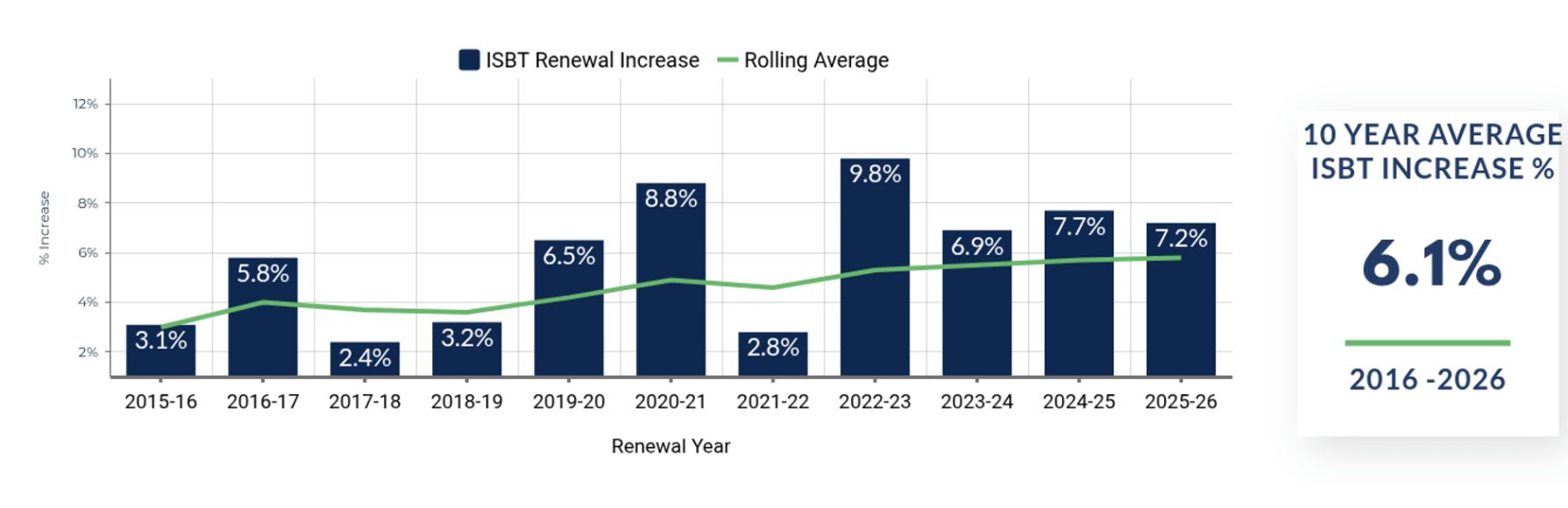
According to plan renewal presentations reviewed by EdNews, the trust in recent years has touted its low rate increases — 6.1% annually, on average, over the last decade — compared to other benefit plans.
At the same time, the trust has been running a deficit, according to financial disclosures required of tax-exempt organizations. In August 2021, the trust had a $22.5 million fund balance, but by August 2025, it was $2.1 million, according to the disclosures.
Dale Layne, executive director of the Idaho School District Council, last August wrote in an annual report that the trust “continues to be on solid financial ground, with excess reserves of approximately $3,004,082.”
Layne is a non-voting member of the trust’s board of trustees. He declined to comment for this article, referring EdNews to Hainke, who didn’t respond to messages seeking comment.
Now, the trust has exhausted its reserves, and renewal rates have spiked. For the upcoming benefit year — which runs from Sep. 1, 2026, to Aug. 31, 2027 — trust participants will see a 19.5% increase in medical plans along with increases of 6.6% for dental plans and 5.6% for employee assistant plans.
The rate increases are tied to inflation, according to a renewal presentation that the trust shared with participants. During the 2024-25 benefit year, medical claims went up $9.8 million, the presentation said. Cost increases are concentrated in physician services, inpatient hospitalizations, surgeries and medical drugs, including chemotherapy and infusions. A 15% hike in hospital claim costs is expected for the upcoming benefit year, the presentation said.
Districts and charters are responsible for covering the surge in claims because the trust was self-funded during the 2025-26 benefit year. Unlike fully-insured plans — where the plan administrator (Blue Cross) covers the cost of higher-than-expected claims while also keeping the savings when claims are lower than anticipated — self-funded plans require that employers (districts and charters) bear the risk.
The trust is transitioning to a fully-insured plan for the upcoming benefit year, according to Hainke’s email to members last week. The transition will “help reduce the cost of benefits and reduce risk borne by the school districts,” Hainke wrote. “This renewal will not be impacted by the remaining funding requirements for the 2025-2026 benefit year noted above.”
In the meantime, school leaders are wondering how much they’ll owe for the current benefit year. Public school budgets are already tight after state lawmakers kept K-12 spending flat and didn’t increase discretionary funding for the second consecutive school year.
West Bonner Superintendent Kim Spacek said districts set budgets based on what they know, and there isn’t a lot of “fiddle room” to adjust.
“It’s always a concern when you set a budget and you’re told here’s what your increases are going to be, and then you’re told, ‘Oh, by the way,'” Spacek said.
“If you’re in a benefit trust, you’re really handing off decisions with the people who are at the trust,” he added.