
Educators, lawmakers, students and architects gathered in Boise and Star Wednesday to celebrate the groundbreakings of two new schools.
The projects will give hundreds of students in the West Ada and Middleton districts new classrooms in 2027 and 2028 — and get some of those students out of portables.
The projects have something in common: Neither district passed a local bond measure or increased property taxes to fund them.
“The most important thing is that we’re getting this school built,” House Speaker Mike Moyle, R-Star, told EdNews at the Middleton groundbreaking in Star. “The second most important thing is that we’re getting it done without raising property taxes.”

‘That’s the way it should be’
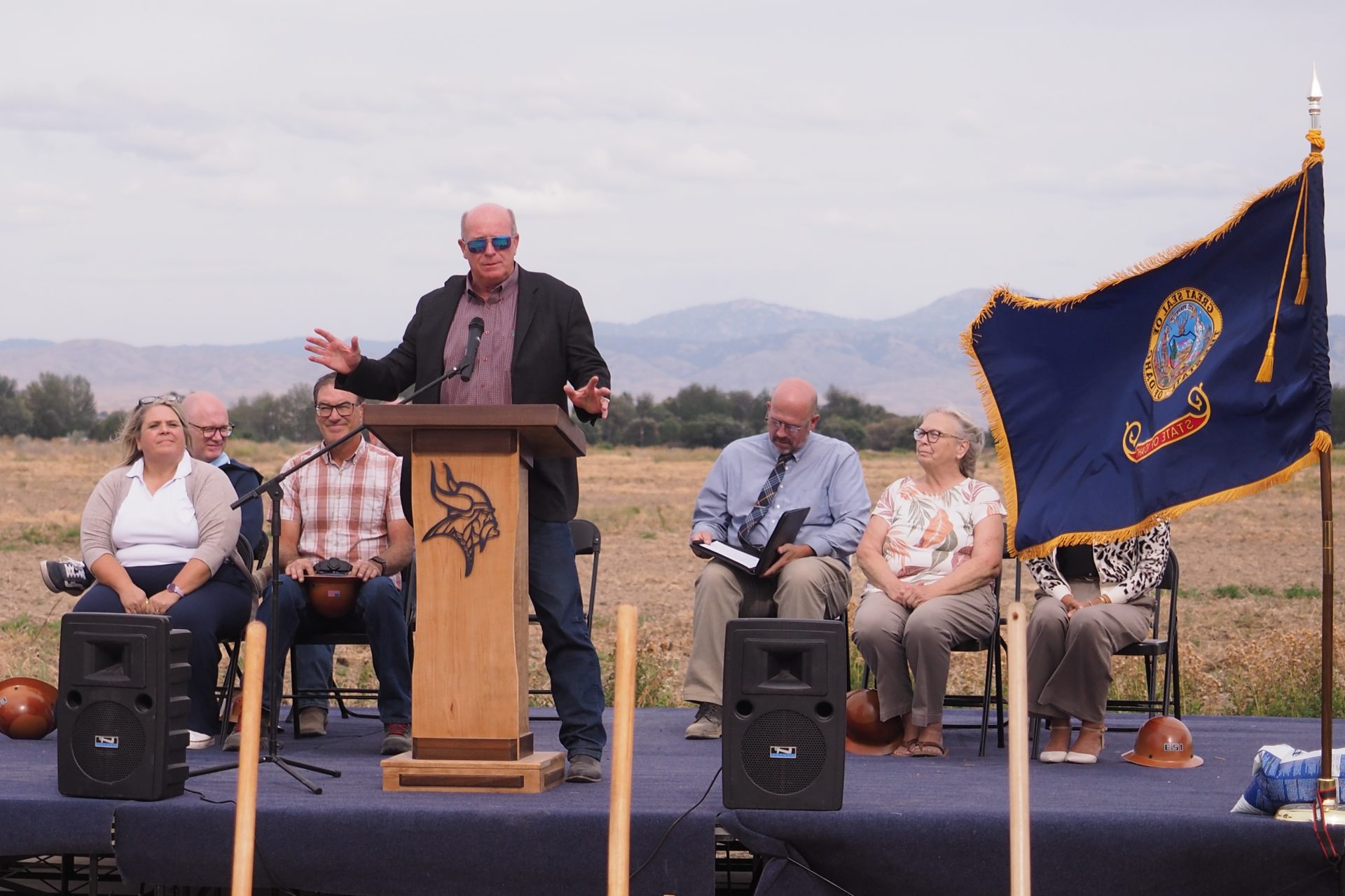
On an empty dirt plot in Star, a city served by the two school districts, around 60 people gathered to celebrate the groundbreaking of Freedom Elementary.
After the national anthem, Middleton Superintendent Marc Gee had attendees recite the Pledge of Allegiance — fitting for a school named Freedom with an Eagle mascot.
Freedom will alleviate overcrowding in the district’s three elementary schools, which have reached as much as 150% capacity.
Wednesday’s attendees included Moyle, state superintendent Debbie Critchfield, Sen. Tammy Nichols of Middleton and Rep. Bruce Skaug of Nampa. Also there were Middleton Mayor Tim O’Meara and Star Mayor Trevor Chadwick, who addressed the crowd to tout the process for funding the schools.
“No property tax dollars are paying for this. No property tax dollars paid for the other one,” Chadwick said, referring to West Ada’s recently completed Independence Elementary, also in Star. “That’s the way it should be.”
The $19.1 million Freedom Elementary, a project in Middleton’s sights since around 2015, will serve 400 students, with the ability to extend a wing of the school to bring future capacity to 700.
Funding did not come from a locally approved bond, the way school construction projects are typically bankrolled in Idaho. Local voters rejected five consecutive bond measures, helping Middleton to qualify for $11.1 million from previously untapped state money: the Public School Facilities Cooperative Fund. The other $8 million came from House Bill 521, 2024 legislation that divided $1 billion among Idaho’s school districts.
Critchfield acknowledged that bonds have become increasingly difficult to pass.
“I think it’s a model of where we’re going,” she told EdNews, referring to the use of state funds for school construction projects. “Our local taxpayers really do feel the pinch in their own checkbooks.”
Middleton and West Ada aren’t the only districts avoiding bond measures to pursue new schools. Moscow will run a $65.6 million plant-facilities levy in November, rather than attempting a bond.
“The Legislature provided a mechanism that the locals can control and do it right,” Moyle said of HB 521. “They’ll be able to build buildings without property taxes now if they use the tools that we’ve given them.”
Middleton had to rerun an unsuccessful bond issue to receive the cooperative fund money, but legislators removed the requirement during the 2026 session, leading Middleton to cancel its planned May proposal.
The district plans to open Freedom Elementary in the fall of 2028.
‘Almost too good to be true’
In 2024, West Ada determined it would be cheaper to rebuild its Lake Hazel Elementary than repair a 52-year-old building, a figure-eight-shaped school with triangular classrooms that lack windows.
The district found a rebuild was a better fit for its HB 521 money, some of which it already used to build Independence Elementary in Star and to purchase a warehouse in Meridian for career-technical programs.
On Wednesday, hundreds of Lake Hazel students wearing plastic construction helmets gathered on the field behind the school for the groundbreaking. The dirt pile — typically reserved for faux gilded shovels wielded by superintendents or architects — also had dozens of small, colorful scoops so students could take their ceremonial dig.
The district received $140 million from HB 521 in 2024, an amount tied to its enrollment, the highest in the state. By comparison, some of the state’s smallest districts received around $26,000 through HB 521.
Classrooms share doors in the current building, so fourth-grade teacher Cortney Randall is grateful for the new building after thirteen years of teaching at Lake Hazel.
“We’ve heard about this for … years,” Randall said of the rebuild. “When we got word, I was still just like the slightest bit hesitant because it was almost too good to be true. And then it really is official.”
The new building mirrors Star’s recently-finished Independence Elementary, with one exception: Lake Hazel will have two full-length wings, bringing its maximum capacity to around 700 students. The district chose more space in anticipation of growth driven by Micron Technology in southwest Boise, said West Ada spokeswoman Michelle Edmonds.
The old Lake Hazel building will be demolished after the new building is complete.
Like Independence, Lake Hazel will be built on an aggressive 10-month timeline. Edmonds said the lack of snowfall this year allowed construction crews to work through the winter and finish the school in time for the 2026-27 school year. Lake Hazel’s timeline could depend on similar circumstances, Edmonds told EdNews: “Some of it depends on Mother Nature.”