
This story was originally published by Chalkbeat. Sign up for their newsletters at ckbe.at/newsletters
The U.S. Department of Justice is taking over aspects of civil rights enforcement in schools, while oversight of special education is moving to the Department of Health and Human Services, the Trump administration announced Tuesday.
The change will move some of the most essential and integrated functions provided by the federal Education Department to two separate agencies and further accelerates the dismantling of the department without congressional approval.
Senior department officials said the changes would not reduce or affect students’ rights and would instead lead to more effective services for students and families. But many details are still being worked out.
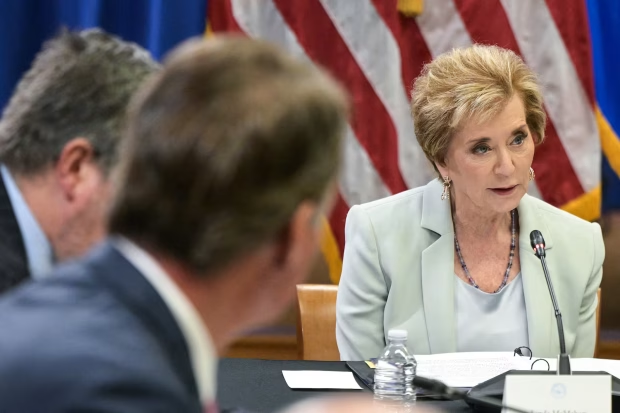
“The Trump Administration has been clear: as we scale back federal micromanagement when it hinders success, we are equally committed to bolstering the efficacy of federal oversight where it is essential,” U.S. Secretary of Education Linda McMahon said in a press release.
Advocates for students with disabilities have been fighting the move involving special education for more than a year. They had hoped that the overwhelming opposition voiced during listening sessions earlier this spring might sway officials.
They fear that Health and Human Services lacks not only the experience but also the appropriate perspective to support the education of students with disabilities, most of whom are educated alongside their peers in general education classrooms.
Meanwhile, complaints related to children with disabilities make up a significant portion of the work of the Office for Civil Rights. While the Department of Justice has always played a critical role in civil rights enforcement, the Education Department’s Office for Civil Rights historically has focused specifically on getting school districts to change their practices rather than penalizing violations. Advocates have valued that approach as a way of improving education for a larger group of students.
The law that established the Department of Education says the agency is responsible for overseeing and funding the education of children with disabilities, and for enforcing civil rights in schools. The Individuals with Disabilities Education Act also places special education oversight within the Department of Education.
Recent budget laws give control of IDEA funds to the Department of Education and say that money can’t just be transferred to another agency.
Education advocates quickly condemned the move.
“These continued disruptions will create confusion for states and school districts, undermine accountability, and inject uncertainty into services that students and families depend on every day,” The Education Trust, a progressive advocacy group, said in a statement. “Without a clear plan, these shifts risk weakening implementation of the Individuals with Disabilities Education Act and decades of hard-fought civil rights progress.”
The Education Department is using interagency agreements to move the Office of Special Education and Rehabilitative Services to HHS and the Office for Civil Rights to Justice without a green light from Congress. Historically, such agreements were used to allow departments to contract with other agencies for certain services outside their core mission.
It’s the same mechanism that the department used to move career and technical education and the bulk of K-12 programming to the U.S. Department of Labor.
Members of Congress have raised questions about these moves, with Democrats even calling them illegal, but there has been no meaningful congressional oversight or other steps to block the changes.
Supporters of the changes have said it would better align educational programs with workforce needs.
Moving special education to Health and Human Services is a much bigger change, and one where the policy justifications are less clear.
Supporters of IDEA and its critics can both point to many problems with the law, including persistent underfunding and a focus on compliance rather than meeting students’ needs.
But many advocates fear moving special education to Health and Human Services will mark a return to a medical model of dealing with disability. A recent study found that students with disabilities benefit from special education services, suggesting the system is working for at least some students.
A senior department official said partnering with Health and Human Services will improve coordination of services for infants and toddlers, on one end of the spectrum, and services for adults with disabilities on the other end, with the education provided in schools.
The official said the Trump administration also plans to increase funding for special education by roughly $500 million, although it remains to be seen if Congress will agree to that.
The move follows a blueprint laid out in the conservative Heritage Foundation’s Project 2025, which calls for moving special education to HHS and converting funding into a small voucher for individual families. Project 2025 also calls for moving civil rights enforcement to Justice.
Lindsey Burke, the lead author of Project 2025’s education chapter, is a top official at the Education Department.
“Downsizing this agency and returning education to the states achieves a long-standing goal to empower families and local communities,” Burke said during a Chalkbeat event earlier this year. She said that the Education Department has proven to be a costly failure.
Under McMahon, the Office for Civil Rights has been cut significantly even as it’s continued to receive thousands of discrimination complaints. The office received more than 9,000 complaints of alleged discrimination between March 2024 and Sept. 2025, according to a recent U.S. Government Accountability Office report. The department resolved more than 7,000, though 90% were resolved through dismissal.
The administration previously laid off Office for Civil Rights staff before more recently moving to rehire attorneys. It also closed seven out of 12 regional offices, reassigning caseloads to the five remaining offices.
Erica Meltzer is Chalkbeat’s national editor based in Colorado. Contact Erica at emeltzer@chalkbeat.org. National reporter Lily Altavena and Ideas Editor Matt Barnum contributed. Chalkbeat is a nonprofit news site covering educational change in public schools.

