
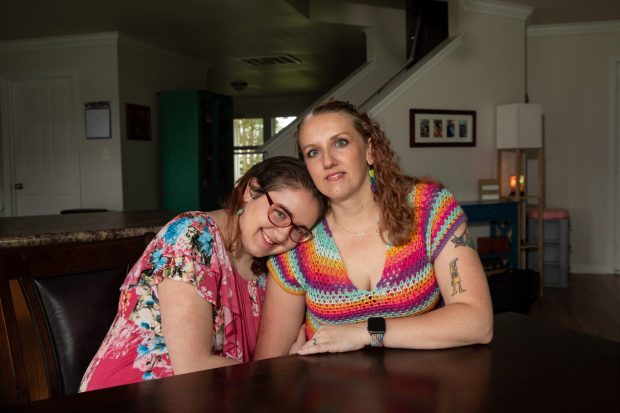
Cori Space spent her freshman year of high school in Madison, Alabama, trying to keep up with her coursework while managing her celiac disease and other health problems that her school wouldn’t accommodate.
For her sophomore year, her family opted for the Alabama Destinations Career Academy, a public, virtual school that promised a jump-start on an occupation. Run by the publicly traded company Stride Inc., it advertises five career tracks and the chance to earn industry-recognized credentials.
But in Cori’s year at the academy, staff never spoke with the family about enrolling her in a career path, said her mother, Hilary Space. Cori had just two hours of live class twice a week, on Mondays and Wednesdays, and typically finished her homework in under an hour most days. It all added up to school days that her mother called “concerningly short.”
“To be honest, I don’t really understand why ALDCA is considered a career readiness program,” said Space.
But in Idaho, Mileka Hager had a different experience at a Stride Inc. school, the Idaho Technical Career Academy. Having chosen a business career track, Mileka had live, online classes for four hours a day in math, English and other core subjects, as well as marketing and other business-related courses. She eventually earned eight professional certifications, she said, which could help her when she seeks an entry-level job.
Interest in career and technical education is booming now, as students seek ways to get a start on a well-paying career, and perhaps cut short or avoid paying for a pricey college degree. Stride and other for-profit education companies that already run traditional high schools online have taken note and expanded their career-oriented offerings in recent years.
Yet delivering career training online to high schoolers can be challenging. For one thing, some students drawn to online options choose them because of anxiety or other issues that complicate in-person education. For another, it’s hard to arrange for hands-on, in-person training, which is often needed for some careers.
State regulations for and oversight of these programs vary widely, as do their results. Some students, like Cori, leave the programs with little career prep to show for their time enrolled. Others, like Mileka, thrive.
Alabama Destinations Career Academy did not respond to requests for comment, but Stride spokesperson Brooke Gabbert defended the company’s performance on career preparation, noting that the students their schools serve, including many students who enroll midyear and are academically behind, makes it difficult to compare outcomes to those of other schools. She said all students are monitored through several measures — including assignment completion, course performance and participation — and many students explore career courses without finishing a career track.
Some students enroll in career courses to satisfy elective or graduation course requirements of their school district, Gabbert said, rather than to pursue a full career path. “This variation is by design, not a gap in outcomes,” she said.
Schools, especially in rural areas, often can’t find enough career and technical teachers, which drives up the demand for online courses. States have built their own online systems, but private companies, including Stride, Pearson and Edmentum, have moved into the space too.
In fact, online career learning for middle school and high school students is the fastest growing part of Stride’s business, the company says. The company, which has provided virtual education since 2000, now manages more than 50 online secondary schools that offer career programs. In fiscal year 2026, revenue from middle and high school career learning programs topped $1 billion, a 19 percent increase from the year before.
There’s little research on how well online career-training programs work, said Alisha Hyslop of the Association for Career and Technical Education, a national advocacy group. Some research on virtual schools, though, suggests those run by for-profit companies do not help students perform as well academically as virtual schools run by independent or nonprofit organizations.
But no matter how it’s delivered, Hyslop said, quality vocational education should offer students hands-on experience through job shadowing, work-based learning and chances to earn industry-recognized certificates.
For example, at Stride, Inc.’s 750-student Wisconsin Destination Career Academy, teachers help set up job shadows in which students spend part or all of a day with an industry professional. For some career courses, the school ships its students practice kits related to the coursework. Students in a health sciences course get blood-typing or suture materials to train with and then must demonstrate mastery over this in live video during class, said the school’s executive director, Sara Cutler.
Students there attend live online classes only two days a week, Cutler said. The other three days each week are set aside for optional career activities such as job-shadowing or field trips.
As students move through a career track, they can earn industry-recognized credentials. The business path offers a certificate in entry-level marketing concepts. Students in the construction and engineering track can receive an operating engineer’s pre-apprenticeship credential, which signals readiness to train for a career working with heavy equipment. Agriculture track students have gotten work-based learning credits for working a required number of hours on dairy farms and then writing about how the work connected with classroom lessons, said Mindy Brickley, the school’s agriculture teacher.
But because of the voluntary nature of this work, the onus is on the student to seek it out at these schools. For some students, the factors that drew them to a virtual school might also make them less likely to engage in extra opportunities.
According to Wisconsin’s Department of Public Instruction, only 16 of the Wisconsin academy’s students earned an industry-recognized certification between the 2021-22 and 2024-25 school years. Many also struggled academically: The school’s 2024-25 academic growth score put it in the bottom 10 percent of state high schools.
Stride officials dispute that low certifications number, and say that more than 500 students have earned certifications. Gabbert said Stride defines some industry certifications differently than does the state.
Mileka Hager enrolled in Stride’s Idaho Technical Career Academy in 2023 after she’d endured repeated online harassment by other students at her public high school and her grades plummeted. The academy, a virtual school of about 200 students, promised a jump-start on a career, which appealed to her.

It offers five career tracks, and Mileka, who lives in Coeur d’Alene, picked business. Along with the live classes in core subjects, she studied management and entrepreneurship. For one class, she wrote a business plan. She had worked at coffee shops since her early teens and mapped out a vision for one that would appeal to her target customer group — high school kids — by staying open late and offering quiet corners to study.
Like Mileka, 61% of students at her school earned industry-recognized credentials in 2024-25, compared with a state average of just 7%, according to state data.
In Idaho, all online schools operated by private providers like Stride must be established as public charter schools and governed by independent, nonprofit boards. The state must approve their learning platforms, plans for teacher-student interaction, means of verifying student attendance and more.
The state also closely oversees all vocational programs, both in person and online. The Idaho Division of Career Technical Education develops quality standards for career tracks that all vocational schools must comply with, and the division reviews each program every five years, said Chet Andes, director of program quality there. “We’ll say, ‘Hey, we’re noticing that your end-of-pathway assessments are low. What’s going on? How can we as a division support you?’” he said.
By contrast, in Alabama, where Cori Space went to school, oversight is much more decentralized. Under a 2015 state law, local school districts can contract directly with outside entities, including private companies, to operate virtual schools for the district. Local boards must create rules for how the virtual schools are run but have considerable latitude in designing them.
And some districts have done little to monitor their online schools, as state and local education officials told the Alabama Political Reporter in 2020. “There has never been enough oversight of these schools,” one county superintendent said. Neither the Alabama State Department of Education nor current or former Alabama state legislators who focus on education responded to questions from The Hechinger Report.
Experts say there are steps lawmakers could take to improve online CTE schools run by for-profit companies, such as adopting partial payment schemes. Under that approach, the companies would receive half of their per-pupil funding for the year up front and half when they hit specified metrics, such as a certain percentage of students earning professional credentials.
In Texas, legislators did something similar last fall, amending state law to give school districts a $3,000 to $5,000 bonus for each student who graduates with an industry-recognized certificate.
Among the students who did not end up with career-related credentials at the Stride Destinations Career Academy in Wisconsin was Elly Krawinkel. She entered the academy as a junior in 2023, after having struggled in her public high school with attention-deficit/hyperactivity disorder and social anxiety.
Elly chose the agriculture and natural resources career track because she loves animals. Her mother, Heather Krawinkel, said a mentor checked in regularly, and teachers were responsive and supportive. But Elly’s anxiety kept her out of most activities, and she graduated last May with no industry credentials or work-based credits.
One critic of for-profit virtual schools argues that they fail many students who have personal and academic challenges like Elly’s. Carol Corbett Burris, executive director of the Network for Public Education, which advocates for public schools, said struggling students, including those with anxiety, are more likely to succeed in mainstream schools provided they have some extra support.
She worries that online programs are becoming dumping grounds for those who are disaffected or struggling academically. “To me, if a child has social anxiety, the school should be working with the family to overcome that anxiety so they can have a rich and fulfilling adult life,” she said.
Elly isn’t working or in school right now because of her challenges with personal interaction, she said, but plans to look for a job soon.
Mileka, on the other hand, graduated a year early with a 4.5 GPA. Now she’s seeking investors to open her coffee storefront.
“If you’ve had a bad experience with online school, it doesn’t mean it’s [because it’s] online school,” said Jadie Hager, Mileka’s mother. “It could just be the school.”
That’s what Cori Space’s family is banking on. She’ll start at a district-run virtual school in August.
This story about Stride Inc was produced by The Hechinger Report, a nonprofit, independent news organization focused on inequality and innovation in education.

