
As a bill targeting teachers’ unions sat on Gov. Brad Little’s desk in early April, the emails rolled in.
Nearly 1,100 emails urged Little to sign House Bill 516, according to the governor’s office. Only 53 emails called for a veto.
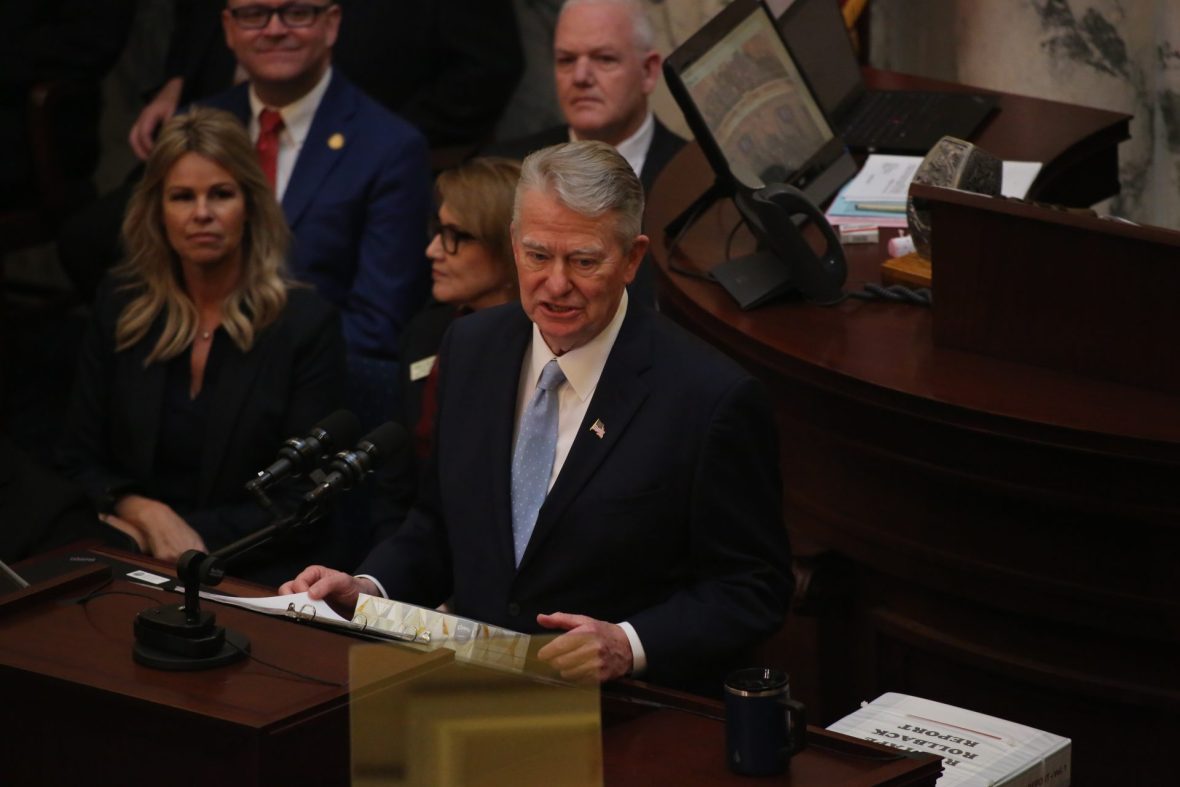
Little signed the controversial HB 516 on April 10.
Then, Little’s staff deleted almost every email referring to the bill.
The prompt purge means Idahoans must take Little’s office at its word. Idahoans said they supported HB 516. Little signed it. Emails provide, at best, anecdotal evidence of public sentiment. In this case, though, the governor’s numbers cannot even be verified.
Idaho Education News filed a public records request with Little’s office in April, seeking emails for and against HB 516. It was an attempt to get a behind-the-scenes look at the politicking on the bill — and the runup to one of Little’s final and most contentious decisions from the 2026 legislative session. It didn’t work out as planned.
Here’s what we learned, and what we couldn’t learn.
About our records request
On April 24, EdNews requested emails to and from Gov. Brad Little’s staff and Little’s office, on two bills restricting teachers’ unions. For House Bill 516, the amended union bill that Little signed on April 10, EdNews sought emails going back to March 30.
On May 7, Little’s office said it would cost $648.90 to provide the emails — covering the staff time needed to individually download each item in the office’s constituent email system and search for references to the two bills.
But most of the emails originated from one special-interest group, and stuck with an identically worded script.
“Almost all of the written comments on (HB 516) were form letters in support of signing the bill,” spokeswoman Joan Vargas said in a statement to EdNews last week. “We did not save the form letters past the date of the governor’s signature of the bill.”
Idaho public records law does not have language that speaks to retention (or destruction) of documents. “State agencies should adopt policies that are consistent with best business practices and generally accepted principles of accounting to classify and retain records,” Attorney General Raúl Labrador’s office says in its 2025 public records law manual.
Little’s office provided a copy of one of the form emails. Little’s office also provided 80 emails for and against HB 516 — the emails that were not form letters. EdNews was not charged for these emails.
The rapid runup on HB 516
As soon as any controversial bill passes the Legislature, supporters and opponents immediately turn their attention to the governor. Acting on their own, or at the urging of a special-interest group, they fire off an email or call the governor’s office.
With HB 516, everything unfolded within a matter of days. The Senate overhauled an unrelated education bill on March 30 — stripping its original language, and inserting language to ban any taxpayer support of teachers’ unions. The Senate passed the amended bill on April 1. The House followed suit on April 2, the final day of the session.
Little was quickly lobbied from both sides.
Honor Idaho — a conservative group headed by Greg Pruett, founder of the Idaho Second Amendment Alliance — urged its members to email Little in support of HB 516. The Freedom Foundation, an Olympia, Washington-based group that has long sought restrictions against public employee unions, spent $15,000 to direct a telephone blitz at Little’s office.
The state’s largest teachers’ union, the Idaho Education Association, launched a phone campaign urging a veto. Reclaim Idaho made a similar push.
In the aggregate, more supporters than opponents reached out to Little’s office. But that’s only part of the story.
By the numbers
Here’s the breakdown on calls and emails for and against House Bill 516. These numbers — as provided by Gov. Brad Little’s office — run through April 13, three days after Little signed the bill.
- Emails: 1,095 in support, 53 in opposition.
- Phone calls: 954 in opposition, 497 in support.
- Total: 1,592 in support, 1,007 in opposition.
Callers urged a veto, by almost a 2-to-1 margin. Based on caller feedback, Little’s office says an IEA “call to action” mobilized many of these bill opponents.
Emails overwhelmingly supported HB 516, by more than a 20-to-1 margin. But almost all emails were identically worded form letters, Little’s office says. The office deleted these emails after Little signed HB 516.
Little’s office provided EdNews with one of the form letters, to offer an example of the message that flooded the governor’s inbox. Its wording was identical to a template that still appears on the Honor Idaho website.
A glimpse at public sentiment — but now, a less transparent one
Tallies of emails and phone calls to the governor’s office are a go-to on the Statehouse beat.
The numbers are never scientific — unlike a poll with a random, representative sample. But they measure something: the number of people energized enough to speak up on an issue. They also provide a glimpse into the process of politicking, and whether special-interest groups are mobilized for or against a bill.
In terms of sheer volume, HB 516 was no record-setter.
In 2025, Little’s office received a staggering 37,457 emails and phone calls on House Bill 93, the controversial proposal to create a $50 million private school tax credit. An overwhelming 86% of the messages urged a veto. Little signed the bill anyway.
In 2023, Little’s office received nearly 2,000 emails and about 800 phone calls on a polarizing “library porn” bill that sought to keep harmful materials away from minors. The phone calls were split. The email traffic — skewed by a spate of form letters — urged a veto, by about a 40-to-1 ratio. Little vetoed the bill.
But in 2023, the virtual paper trail was easier to verify. The governor’s office provided EdNews with all emails on the library bill, including the form letters, at no charge.
A narrow snapshot
This time around, Little’s office provided EdNews with 80 emails — less than a tenth of what arrived in the governor’s inbox before and after he signed HB 516.
The emails echoed the debate that had unfolded on the floors of the Legislature in the final 72 hours of the 2026 session.
“Let the unions pay the teachers for their time or have the teachers volunteer their time for union activities,” wrote Cindy Goldsmith of Meridian. “Use my tax dollars for classroom time, not as a union subsidy.”
Sara Olds, a Pocatello teacher, lauded the work of the IEA’s children’s fund, a nonprofit that supports students in need. Olds said the fund was instrumental for one of her students — who was struggling to read assignments on her Chromebook, and desperately needing a replacement pair of glasses. “Forget the politics and remember the children,” Olds wrote. “The union has work to do. Let them do it!”

Charlette Kremer, vice chair of the Lewiston School Board, criticized the “backhanded” politics that sent the union bill to Little’s desk. As opponents noted in floor debate, the 11th-hour rewrite of HB 516 bypassed legislative committees and allowed no public testimony. “That’s not how Idahoans expect their leaders to act,” Kremer wrote.
The politics of the moment also factored heavily into the emails.
Teachers voiced betrayal — echoing the IEA, which issued an April 21 vote of no confidence and rescinded its support from Little’s 2018 and 2022 elections. “I’m a registered Republican AND a member of the IEA,” wrote Madeline Pacold, a teacher from Boise, after Little signed HB 516. “I will no longer vote for you. You lost my confidence as a champion for public education.”
And as Little approached what would be a successful May 19 GOP primary — an easy win over his most active challenger, hardliner Mark Fitzpatrick, owner of the Old State Saloon in Eagle — some voters did nothing to hide their skepticism about Little’s conservatism. “I hope you will sign HB 516 to help demonstrate to Idahoans before the election that you stand with them,” said Shane Macaulay of Worley.
Where your email goes … and what happens next
Little’s office uses the industry standard tool for handling constituent emails — a platform called Intranet Quorum. Its developer, Alexandria, Virginia-based Leidos Digital Solutions, says it serves 65% of congressional offices, half of the nation’s governors’ offices and more than 100 federal, state and local government agencies across the country.
This “constituent services management system” allows staff to respond to emails that come in through the governor’s office website, and track emails by topic, said Joan Vargas, a spokeswoman for Little.
These are the HB 516-related emails Little’s office provided to EdNews. The rest are long gone, and that appears to be standard practice.
Little’s office can receive thousands of form letters per month, Vargas said. When they show up at a “generic email address,” they are soon discarded.
“Form letters are counted for tracking purposes but are not entered into the constituent services management system for response,” Vargas said. “Form letters are only saved for the duration of their useful purpose, typically until after the governor acts on a bill.”
Which means the governor’s tally is the only tally.
Kevin Richert writes a weekly analysis on education policy and education politics.