
When Margo Hollingsworth started teaching an in-depth pharmacy assistant course at Meridian Medical Arts Charter two years ago, she knew her students would need hands-on experience in a pharmacy.
So she built a faux pharmacy in her classroom, complete with hundreds of prescription bottles with labels she created by hand.
But the process was slow and cumbersome because she couldn’t access the software used in professional pharmacies because of the amount of patient information in the connected databases.
“It really limited how much real world experience I could give my students,” Hollingsworth said.
Hollingsworth could describe what kind of software she needed but admittedly isn’t the most techy.
“We just needed to find someone who can write it and it just happened to be the kids next door,” she said.
Over the course of the last year, 10 students from Meridian Technical Charter built the software, which they’re calling Lumen, as their senior project.
Now, a trio of students is planning to continue the project after graduation in hopes of turning it into a product that other pharmacy technician programs can use.
From math teacher to pharmacy tech program founder
Hollingsworth started teaching at Meridian Medical Arts in 2015 after years of teaching math and homebound students in West Ada.
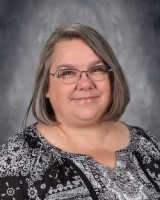
A few years later, a community advisory group told the school’s career technical education administrator, Carie Staub, that the area really needed more pharmacy technicians.
Initially, the school offered a one-credit elective online course to students but they weren’t finishing with a certification. In casual conversation one day, Staub asked Hollingsworth if she’d get certified as a pharmacy technician and create a more in-depth program at the school. Typically, the math involved in the exam was a barrier, Hollingsworth said.
She spent three weeks studying over the holiday break and was certified not long after. At a job fair not long after, Hollingsworth ran into the head of pharmacy at St. Luke’s, Kelley Curtis, whose child attended the school.
When Curtis heard about the program in the works, she gave Hollingsworth a job on the spot to get practical experience the next summer.
In the fall of 2024, the school launched a capstone pharmacy technician program where students spend three periods a day in Hollingsworth’s classroom. They practice skills like inputting prescriptions and checking for drug interactions at school then work at local pharmacies to get real-world experience.
To get that classroom practice, Hollingsworth created a mini-pharmacy, but it was tedious. She shopped around for computer programs at a national conference, but the ones on the market weren’t very adaptable.
Then she thought, what if the students at Meridian Technical could build the program she needed?
A parking lot partnership
The two schools are right next door, so Hollingsworth reached out to a Meridian Technical administrator, and weeks later, she was presenting to the senior class as they selected their capstone projects.
“They were just absorbing everything I said like a sponge,” Hollingsworth said of her first presentation. “I’m watching students problem solve in real time. I’m telling them what I need, and they’re writing the program in their head.”
One of those students was Chance Spradley, 18. While some classmates were building video games, Spradley jumped at the idea of having a real client with a real-world issue to solve for his senior project.
“I really enjoy that aspect of working with a client and having that relationship,” he said.
Landon Hansen, 18, also liked the idea of making a difference and improving someone’s daily life.
When Hollingsworth showed the group the hundreds of prescription bottles she had labeled by hand, the teens were shocked.
“It’s an astronomical amount of work that she has done,” Hansen said. “We hope to really make that a lot easier for her.”
Hollingsworth was shocked by how creative and considerate the group was.
“They really are adept at taking in information, taking in what I need, clarifying what I want and then writing that program,” she said.
There are often negative stereotypes of computer scientists that they’re bad communicators but Hollingsworth found the opposite to be true of this group. They were clear, concise and curious as they asked her follow-up questions.
While Hansen and Spradley were thinking about how to code the program, their teammate Brady Sligar, 17, saw a business concept.
He talked with Hollingsworth and began doing market research.
“These other schools have this same problem and there’s nothing to solve it,” Sligar said. “I think we can take that to the level of making this a real business.”
The group assisted by seven other students now has a working model that allows students to enter medications and their interactions, build a database of dummy patients and then fill prescriptions for said dummies.
They even added a function so that when a patient’s name is entered some basic information pops up, a function even professional pharmacy software doesn’t have.
“They had to back out some features to make it more realistic,” said Craig Miller, charter administrator at Meridian Technical.
Spradley and Sligar are headed to Boise State University next fall and plan to work with Miller to find a fair way to turn the program into a business. Hansen plans to serve a mission before heading to Brigham Young University.
Other students involved in the project were: Daniel Sagan, Gideon Hammond, Kian Whittingham, Nicole Prosser, Vlad Kuletski, Elias Warren, and Mar Bradford.

