
Bryson Kimball-Romero joined a local gang in seventh grade and his troubles only escalated over time.

His parents found videos circulating of him smoking, fighting and arguing with opposing gang members in his freshman year.
Kimball-Romero didn’t quit the gang, despite their encouragement.
The gravity of his involvement hit close to home when his friend Robert was shot dead while walking to the store on Dec. 3, 2025.
“My dad said people got killed because of that life, but I never expected it to be my friend or someone I knew,” Kimball-Romero said.
That tragedy pushed him to realize that he had the power to break generational cycles and so he dropped out of a traditional high school and joined the Idaho Youth ChalleNGe Academy in Pierce a month later.
The Idaho Youth ChalleNGe Academy is a state-run, quasi-military program for students 16 to 18 years old who are not succeeding in a traditional high school. It combines academic instruction with military-type discipline.
“This academy has helped me change my attitude toward the people who love me, find a silver lining when things get rough, or just helped me with not being lazy,” Kimball-Romero said. “The thing this place has helped me with the most is realizing what I want out of life.”
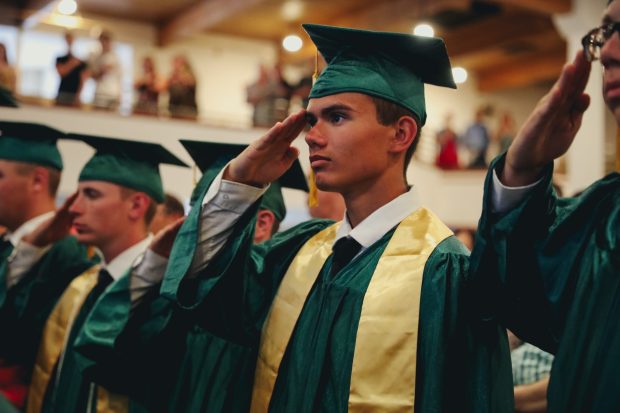
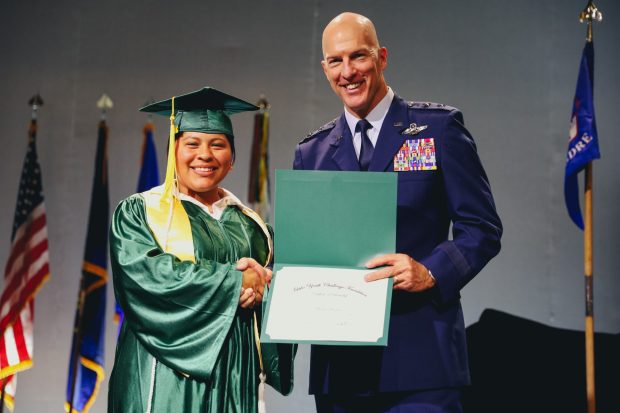
After 22 weeks at the academy, he graduated with another 105 cadets in mid-June.

The ceremony was held at Calvary Chapel in Boise in front of leadership from the Idaho National Guard and IDYCA.
Roughly 350 applicants at risk of dropping out of high school apply to join each class. There are two sessions each year with the first from January to June and the second from July to December. Like Kimball-Romero, these 16- to 18-year-olds come in with issues such as gang violence, addiction and parental strife.
Applicants will sometimes be in the admissions system for two years because they won’t commit. The things that can keep kids from being accepted are felonies or an unwillingness to attend and follow the rules of the academy.
Greg Billups, admissions coordinator for the Idaho Youth ChalleNGe Academy, noted the desperation of some parents to see their children change.
“The toughest part as the admissions coordinator is the immediate help parents need,” Billups said. “Some of them spent their retirement funds and cashed in their 401(k)s.”
For families making that investment, the state-run program offers a mix of classroom and military-style education.
Cadets attend standard academic classes for eight hours a day, eat three meals and two snacks and participate in two to three physical activities a day. Counselors also teach classes in emotional regulation, addiction and recovery in the evening. The education is worth 15 credits, which is roughly eight more than a typical high school student earns in a year.
The transformation from cadets doesn’t just encompass the mental aspect. Some of them have seen drastic physical changes.
“We’ve had some kids lose 90 pounds,” Billups said. “It’s very common for us to have eight to 10 kids lose between 40 pounds.”
Graduates have gone on to attend college, Job Corps or the U.S. military.
“The support of stakeholders and partners that we have in this huge responsibility of raising teenagers is greatly appreciated,” Billups said. “We are also extremely grateful to the school counselors, probation officers, health and welfare workers all over the state.”
For more information, click here.

