
Reading proficiency took a slight dip in the Idaho Reading Indicator this year, but state officials say they are trying not to compare the new data with previous years.
Students this past school year took the twice-a-year reading assessment on a new platform that requires kids to speak their responses into a microphone instead of picking from multiple-choice answers. It was the first year that the state used Amira Learning as the vendor.
“It’s not an apples to apples comparison,” said Andrea Dearden, spokesperson for the Idaho Department of Education.
Students in grades K-3 take the IRI each fall and spring. The department released spring test scores this week. Compared with last spring, proficiency across all four grade levels dropped a half-percentage point, from 70.9% to 70.4%.
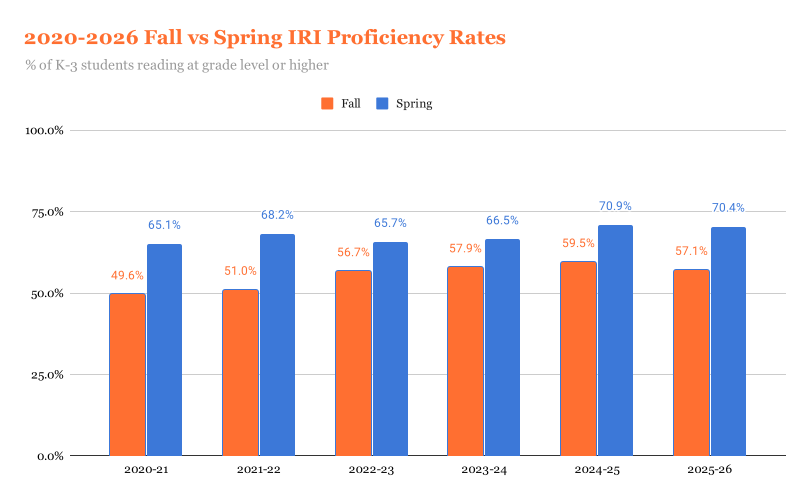
All grade levels showed growth from fall to spring, from an average of 57.1% proficiency in the fall to 70.4% this spring.
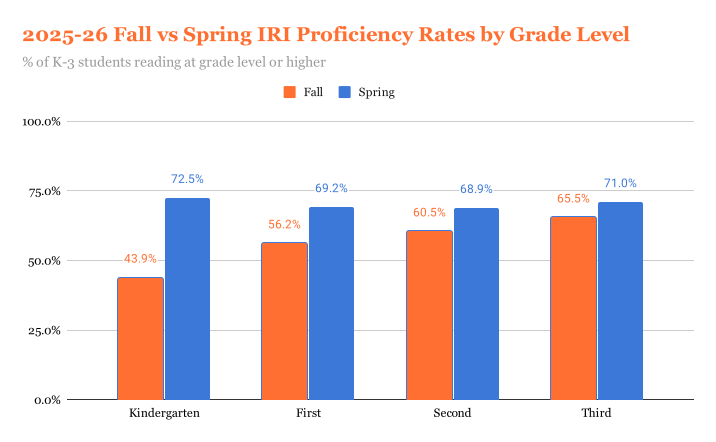
Kindergarteners showed the most improvement. Proficiency for the youngest students increased from 43.9% in the fall to 72.5% in the spring, an increase of 28.6 percentage points.
“Kindergarten teachers are really working hard at making sure that their students are understanding not only the system, but also learning how to read,” Kacy Proctor, IRI program director for the department, said.
The new test
The rollout of the new Amira assessment was bumpy.
Some districts found it difficult to have an entire classroom of elementary students speaking into microphones on their laptops at the same time, as EdNews previously reported.
Proctor said the state has recommended schools use headphones with an arm microphone, especially for really quiet students, and to not administer the test to a whole class at once. It is best to test students in groups of five to six.
“That was not necessarily given at the beginning of the school year, but definitely once we got into the school year, we did change that recommendation to say this is actually best practices,” Proctor said.
While West Ada purchased(opens in new tab) 8,845 headsets for this school year for $173,986, other districts are not able to make that kind of investment.
Proctor said the state is not providing any additional money for headphones because they are not required to take the test. Students can just speak into the built-in microphones on their laptops.
And, she said, schools don’t need an entire class set of headphones. If a class is only assessing five students at a time, they would only need a set of five headphones.
Dearden said the state is still developing baselines and best practices for the new version of the IRI. She said there are several different dynamics.
“Not only the way they’re asking the questions but also just the way the environment has affected the actual test,” Dearden said.
In addition to a shift from multiple choice to speaking an answer, Proctor explained how the new exam is scored differently.
When reading a word, such as “cat,” students get points for reading it correctly and are graded for knowing the separate sounds in the word and how they blend together.
“Before they got one point for knowing that one question,” Proctor said. “Now there’s so many more points that go into reading a word, and it’s no longer an option of multiple choice.”
While students are required to take the benchmark assessment twice a year, teachers are encouraged to let students take a practice test at least once a month to become familiar with the platform.
Coming next week: A breakdown of the results by district, school, demographics and top performers.
Some students are exempt
Proctor said students taking speech therapy and students who are learning English are not at a disadvantage under the new version of the IRI.
“Amira says that they can understand and hear many, many different dialects,” she said. “However, if a student does not feel like they’re being heard by them, there is always a paper pencil test that is given by Amira as well, and so the school district can choose for that one if they want to.”
English language learners can take the assessment, but Proctor said students can qualify for an exemption if a student is in their first two years in schools in the country and if they score below 2.0 on a screener exam.
There is no alternative exam for those students, she said. They can still take the IRI, but their scores would not be included in the state data.
The contract with Amira
The state is paying Amira $650,000 per year for the IRI platform.
The contract began in the 2024-25 school year, but it was a transition year and the state did not pay Amira. The state began paying Amira during the 2025-26 school year.
Proctor said the department did not make an intentional decision to use the new Amira platform. The state put out a request for proposal, and Amira won the contract.
“We always do an RFP to make sure that we’re always doing what’s best for students and taxpayer money,” she said.
Idaho Education News data analyst Randy Schrader contributed data to this story.