
Update: This article was updated Thursday to clarify that Boise State projects it will need 750 new student beds to accommodate enrollment growth. A previous version included a typo.
The State Board of Education Wednesday approved Boise State University’s 10-year master plan, which took a different approach than previous development plans guiding growth at the land-constrained urban campus.
Annie Hightower, Boise State’s chief operating officer, told the State Board that past master plans were “too prescriptive,” locking in building sites and forgoing funding opportunities that arose later. And deviations led to “costly and time-consuming” plan updates, required by city planners.
“Instead of prescribing specific buildings, it defines zones of activity across campus — academic research, housing, student life — and allows flexibility within those zones to determine what’s built, when and how,” Hightower said. “This is similar to how a city uses zoning to guide development without dictating exact outcomes.”
The plan projects 9% undergraduate and 11% graduate enrollment growth over the next decade. Accommodating the growth would require more than 270 new staff members, 750 student beds and 370 parking spaces.
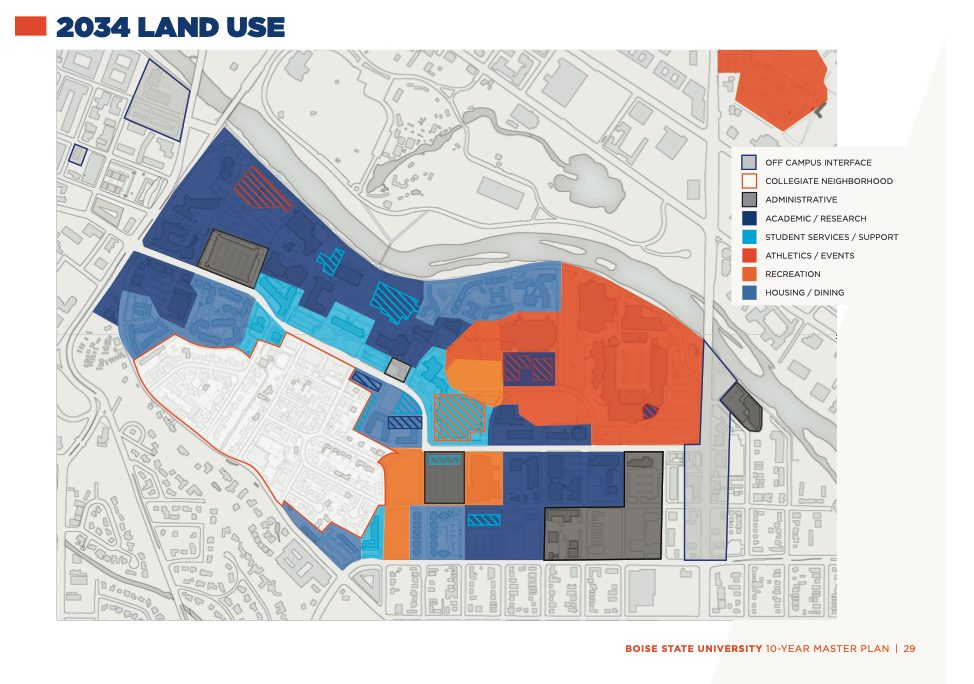
Drew Alexander, associate vice president for campus operations, broke down campus improvement plans into four “focus areas:”
Academics and research. Boise State has a “significant deficit” in research space compared to peer institutions, Alexander said. The plan addresses this through an already-approved new science research building and renovation and renewal of existing facilities, along with a shift toward “shared, flexible and interdisciplinary space,” he said.
Student housing and campus life. The master plan “outlines multiple housing strategies and sites for future consideration, allowing us to respond to market conditions and funding opportunities,” Alexander said. It also includes expanded recreation, dining options and study environments “to support retention and engagement.”
Mobility and infrastructure. The plan also includes improving pedestrian and bicycle connectivity by completing upgrades on “key corridors” like the Boise River Greenbelt and enhancing traffic safety near the Morrison Center and along University Drive, Alexander said.
Campus and community integration. Lastly, the plan recognizes that Boise State’s infrastructure decisions have “ripple effects across the community,” Alexander said. The plan prioritizes “integration with surrounding neighborhoods” and coordination with local planning agencies, he said.
Boise State officials have been working on the plan for more than a year, gathering input from more than 300 stakeholders, including students, faculty, staff, community members and local agency officials, Hightower said.
State Board members unanimously approved the master plan, after applauding the outreach efforts and the plan’s new zoning-style map. Board vice president William Gilbert said it would ease the board’s consideration of future projects and lead to more “fulsome discussion.”
Board president Kurt Liebich agreed, noting that the plan “prioritizes the uses of capital” in a way that’s “very well done.” But he was still trying to wrap his head around the university’s “sources of capital” — Boise State’s $500 million philanthropy campaign, a new fundraising effort or state dollars.
Facing a budget deficit this year, state lawmakers canceled $33.7 million worth of projects earmarked from Idaho’s Permanent Building Fund. And colleges and universities bore a disproportionate brunt of budget cuts, losing a combined $7.7 million next fiscal year.
Gilbert told Liebich that future funding questions will be answered “more effectively” under Boise State’s flexible new plan. “It’s not just simply, ‘OK, here’s our plan to build new stuff,’ right?” he said. “It’s, ‘Here’s how we’re going to adjust the assets that we have and what our asset mix looks.’”
Click here to read the master plan.