
The Lakeland School District has redacted, withheld and delayed the release of public records in recent months, potentially violating Idaho’s public records law, following Superintendent Rusty Taylor’s ouster.
Trustees placed Taylor on paid administrative leave in late March after less than a year on the job. Taylor is gone with little to no explanation and a nest egg. Lakeland will pay him approximately $200,000 to honor the second half of his two-year contract.
Chair Michelle Thompson only told EdNews Taylor was “not a good fit” and that he was not investigated for wrongdoing.
While Taylor’s departure is shrouded in secrecy, he arrived during a time of crisis. The district’s prior superintendent, Lisa Arnold, retired early, and the assistant superintendent resigned after two failed levies in as many years.
“A lot of us left because the board is so toxic,” Arnold said, referring to a wave of staff departures.
Recent turnover adds up to four superintendents in four years and a string of tense board meetings.
Seeking more information on the leadership carousel, Idaho Education News asked Lakeland for three months of email correspondence between the board chair and Taylor, along with a week’s worth of emails between trustees. The district is withholding the request pending a more than $1,000 payment, for what clerk Sara Brodarious describes as more than 500 pages of documents, requiring 41 hours of staff time for redaction.
A log of all public records requests since Jan. 1 shows similar efforts by Lakeland to impede the release of public records:
- The clerk told patrons to find records on their own by reviewing financials on the district’s website or scouring six years of board meeting minutes. Even though state law requires employment and service contracts to be posted online, Lakeland’s contracts are nowhere to be found on the district website. Under “contracts” payroll documents are provided instead.
- The clerk delayed the release of records because of spring break, although Idaho code provides for no such extension.
Idaho code requires public records requests be fulfilled within three to 10 business days. Fees can only be charged for large requests, after the first two hours of labor or first 100 pages are provided for free. Fees “shall not” be charged if the request “is likely to contribute significantly to the public’s understanding of the operations or activities of the government.”
Over the last decade, EdNews has placed hundreds of records requests with districts across Idaho and has never been charged. Fees are waived because the requests are typically seen as in the public interest.
The details of EdNews’ request for public records
EdNews placed two records requests with the district on March 24.
The first request was for emails between Thompson and Taylor from Jan. 1 until March 24.
The second request was for emails between the other four trustees from March 16 to March 24, the week the board held multiple executive sessions related to Taylor’s employment.
Broadarius, the custodian of records, said EdNews must pay nearly $1,200 to get the requested documents. She said the cost would cover 41 hours of redactions.
The clerk indicated the two records requests cover more than 500 pages of emails but did not give an exact page count. She estimated it would take five minutes to review each email, partially because of potential links and attachments.
EdNews responded and said that the links and attachments were unnecessary and could be removed to reduce the hours needed to redact the emails. Broderius still estimated a cost of nearly $500 for the two requests.
Managing Editor Jennifer Swindell emailed Broderius and interim Superintendent Jake Massey asking that the request be filled without charge. Swindell argued the information was in the public’s interest. Massey declined to provide the records, citing district policy. He said the request “entails over 500 emails, the majority of which contain confidential personnel information that would require individual attention to redact.”
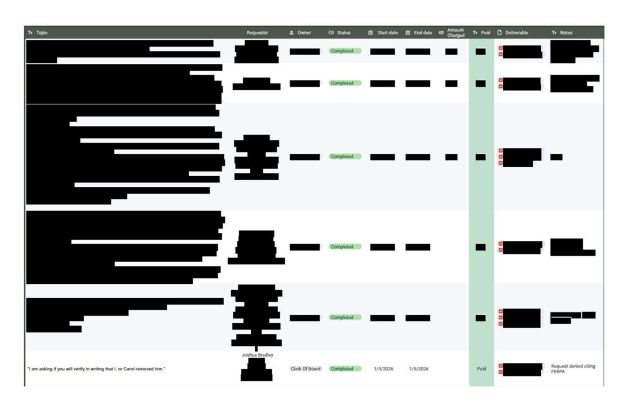
EdNews then asked for a log of public records requests, not the records themselves, to see how often Lakeland withholds records until a payment is made. Heavy redactions make it impossible to tell what was requested, who made the requests, and whether the district received payment for records. The clerk redacted not only names, broadly citing the Family Educational Rights and Privacy Act (FERPA), but the requests, dates, amounts charged, and the deliverables.
On other pages of records requests, redactions appear inconsistent with some addresses and names redacted, while others are not. Swindell emailed Massey to protest the redactions, but he did not respond.
Meanwhile, it’s still unclear why trustees placed Taylor on leave.

