
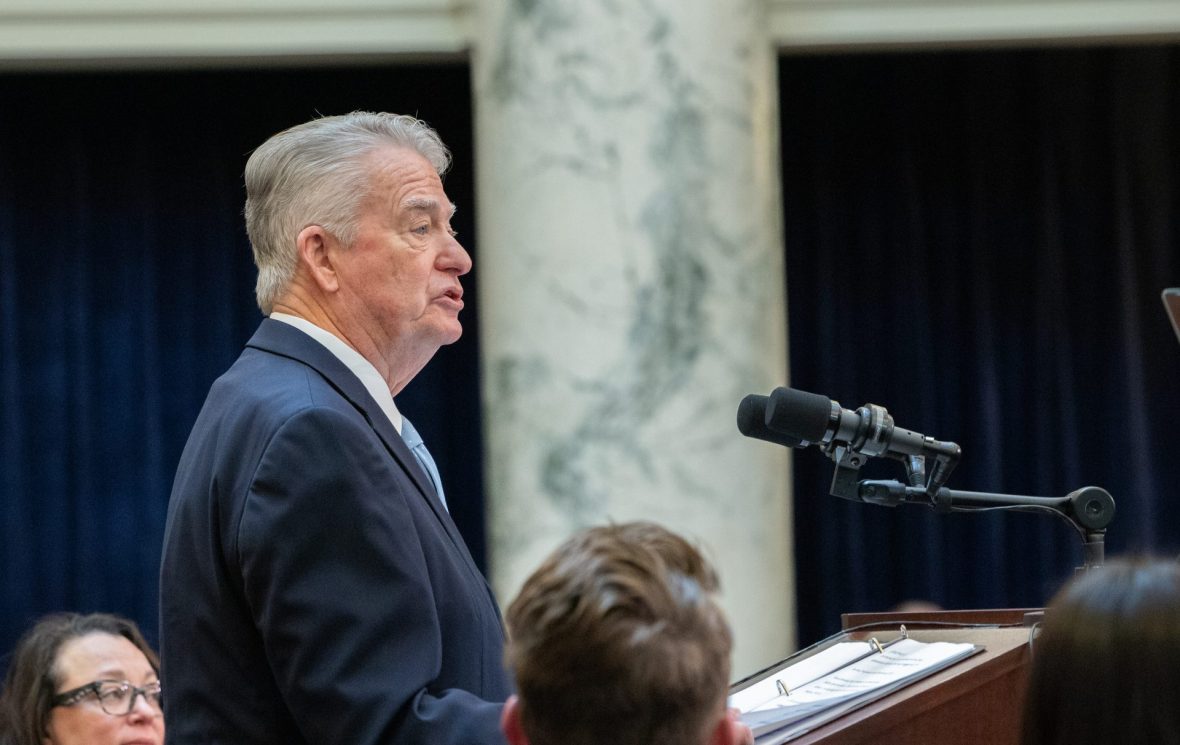
Gov. Brad Little closed the books on the 2026 legislative session Friday — turning his attention straight to re-election.
When he signed a last-minute bill to restrict teachers’ unions, Little catered to his Republican Party base, the voters most likely to show up in the May 19 GOP primary. He also may have looked at how the wind was blowing; he received 1,592 e-mails and calls urging him to sign the bill, and 1,007 emails and calls urging a veto, spokeswoman Joan Vargas said Tuesday.
So, all about playing politics, and all about playing it safe?
It’s at least as plausible as the tortured explanation Little offered up Friday, in a two-page letter on House Bill 516.
The bill prohibits taxpayer support of teachers’ unions, and Little said he wanted to correct that “imbalance.” But Little spent a full paragraph outlining some good reasons to veto HB 516.
First off, he said, “Some of the new definitions in the bill are overly broad and ambiguous and will lead to increased scrutiny of a teacher’s actions purely based on their affiliation with their local association.”
Little didn’t elaborate. But in the hurried debates in the final days of the session, opponents criticized the bill’s far-reaching definition of “teachers’ union activities.” The explanation covers everything from supporting or opposing candidates or ballot measures to “promoting or soliciting (union) membership,” taking part in union events or taking part in negotiations or mediation. The definition, said critics, essentially silences a union.
Little also said the bill could have a “chilling effect” on unions and school districts, preventing them from working together on training and charitable events. “These are real and valuable activities that exist to improve the competency of our educators and, in turn, student outcomes.”
But Little wasn’t sufficiently concerned to reach for his veto stamp.
We’ve seen this before, and repeatedly, in Little’s eight years in the governor’s office. Criticize a bill. Point out its flaws. Sign it anyway.
Little also ignored some perfectly valid arguments for vetoing HB 516.
He could have called the bill a rush job, and no one could have disputed it. The reworked anti-union language emerged on the Senate floor on March 30, the Senate passed the bill on April 1, and the House passed the bill on April 2, the final afternoon of the session. Instead of telling lawmakers to slow down and get this bill right in 2027, Little signed on — while saying the “finished” product “contains language I hope the Legislature works to address moving forward.” So much for getting it right the first time.
Little easily could have built an entire veto message around the process. HB 516 started out as one education bill — focused on LGBTQ+ instruction. But in that final week of the session, Senate hardliners metamorphosed HB 516, yanking out all the LGBTQ+ language and replacing it with the anti-union language.
Around the Statehouse, this uncommon practice is known as “radiator capping” — taking one part off of a car and slapping it onto an entirely new set of wheels. That makes it all sound mischievous. But opponents raised serious procedural concerns, saying the HB 516 overhaul bypassed the normal committee process, giving the public no chance to testify for or against the bill.
A student of the Idaho political process, Little had an opportunity to stand up for that very process. Instead, his silence said he’s OK with some end-of-session legislative shenanigans — as long as the bill isn’t so bad it requires a veto. If Little is re-elected, and spends the next four years dealing with Frankenstein monster bills from the Legislature, it’s a problem partly of his own making.
Was Little concerned about the process? Vargas wouldn’t say. “As always, Gov. Little was focused on the substance of the bill,” she said in an email. “He spoke with representatives of the Idaho Education Association directly about this legislation, and our office had several discussions with other stakeholder groups and interested parties.”
Little also could have taken a page from a fellow Republican, Wyoming Gov. Mark Gordon, who vetoed a similar anti-union bill in March. Gordon dismissed the Wyoming bill as an out-of-state “solution” to a problem that didn’t exist. In Wyoming, as in Idaho, the Washington state-based Freedom Foundation was a driving force behind the anti-union legislation.
Of course, Little has been OK with out-of-state groups asserting their influence over Idaho education policy. Outside groups lobbied heavily for Idaho’s new $50 million private school tax credit program — which Little signed into law in 2025, as I wrote at the time, with one eye on the 2026 GOP primary.
Little had several end-of-session education bills in his inbox Friday: a comprehensive civics education overhaul; a bill requiring school employees to let parents know if their child seeks help with “social transitioning,” a $3 million virtual education budget cut that came way below the governor’s $20 million request. The teachers’ union bill seemed to be Friday’s best candidate for a veto — especially considering Little’s relationship with the state’s leading teachers’ union.
The Idaho Education Association endorsed Little ahead of the 2018 general election, and endorsed him again before the 2022 GOP primary. More recently, the IEA has praised Little for sparing traditional public schools from state budget cuts — and standing firm against lawmakers who would be willing to cut K-12.
There is, no doubt, some risk-reward calculations at work here.
In an eight-person GOP primary, where Little is sure to be challenged from the right, signing the anti-teachers’ union bill is an overture to voters on the right. Little may be gambling that he doesn’t “need” the IEA in next month’s primary, wagering that many teachers will still support him anyway. And he may well be right. (The general election dynamics are different, of course, but Idaho being Idaho, the GOP nominee for governor is the prohibitive favorite unless and until proven otherwise.)
It shouldn’t be surprising to see Little try to shore up his conservative cred at the expense of his relationship with the IEA.
And yet, even so, Little Friday sounded like someone trying to have it both ways. More than half of his letter on HB 516 actually says nothing about HB 516. It instead restates his resume on funding education — and not just increasing teacher pay. Little offers up a kitchen sink of commitments, from school facilities to Idaho Launch.
“I am proud that supporting our teachers has been at the forefront of our priorities year after year,” Little wrote.
For union members, Little’s track record might ring hollow these days. HB 516 might be a case of, “What have you undone for us lately?”
Kevin Richert writes a weekly analysis on education policy and education politics. Look for his stories each Thursday. Due to the timeliness of the topic, this week’s analysis published on Wednesday, April 15.