
Walking from one end of Meridian Technical Charter High to the other takes only about two minutes, as the entire building is only 19,000 square feet. However, within the 14 classrooms, students are learning curricula that could be taught at university level.
Last week, Idaho Legislators joined representatives from the Idaho Charter School Association to tour Meridian Technical Charter High School (MTCHS) and Meridian Medical Arts Charter High School (MMACHS). After the tours, they sat for panels with students and parents.
The schools are two different buildings that share the same campus. They both set students up for success after high school, but their specialties couldn’t be more different.
At Meridian Technical Charter High School, students take introductory coding and networking lessons their freshman year. MTCHS is focused on providing a progressive, technical education experience. Apart from a regular academic course load, the school provides students with over 1,000 hours of technical training and specific training in personal and workplace skills.
There are six different pathways with various focus areas provided at the school, including Computer, Networking, Media, Web, Software, and Electronics. MTCHS accepts only freshmen by a lottery due to the rigorous 4-year curriculum plan that starts with a rotation of the different pathways. At the end of their first year, they must choose one pathway to continue with until graduation.
“If they don’t come in as a freshman, they’re so far behind because they start taking certifications their sophomore year,” said Craig Miller, Principal of MTCHS.
Industry certifications are a big part of MTCHS. The school provides over 20 certifications in things such as Adobe, JavaScript, Intuit QuickBooks, and more.
In the Business Capstone class, students combine their tech skills with entrepreneurship skills by working on large business projects that benefit their community. In an IT class, students are responding to Computer Help Desk Tickets that have been sent from around the school.
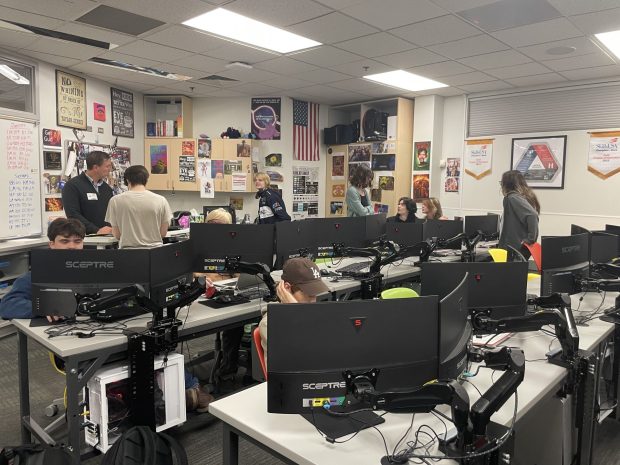
MTCHS partners with businesses in the area to help students find internship opportunities. At the end of each year, juniors go to the Internship Fair to network with potential employers. Seniors are only in school until 12:30 p.m. each day, which allows them to spend the rest of the day on their internship.
Graphic Design Senior Miranda Monzo helped lead the school tour. For her internship, she was employed by MTCHS to do marketing for the school.
Monzo emphasized during the student panel that not only will a specialization help her after high school, but also learning the professional skills that aren’t taught in other high schools.
“Even if you want to go do something else, the programs that we offer here for professionalism and our internship still prepares you for entering the workforce,” she said.
Though all of the students are chasing very specific passions, they could all agree on one thing: the community built at MTCHS is like no other.
“There’s such a huge difference here with actually having a community that understands you,” said IT Junior Rhythm Squires. Squires helped lead the tour with Monzo.
“When I went to [my last] school, I knew like four people total. I didn’t have a personal relationship with any of my teachers, and I was a very socially anxious and very quiet person…It’s just really nice to actually have a place where you belong and fit in,” he said.
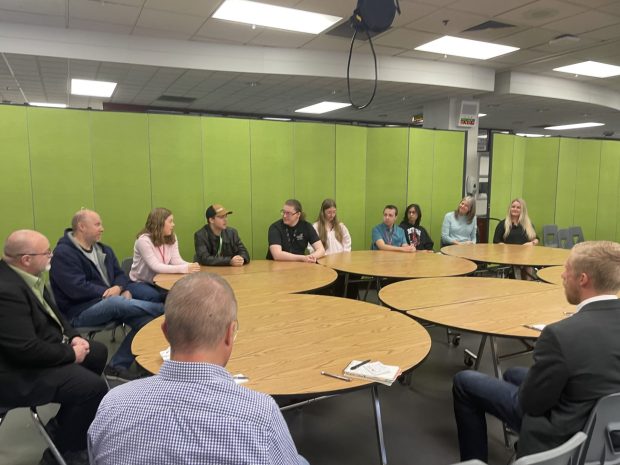
MTCHS doesn’t have traditional sports teams or homecoming dances, but instead, the school plans events that their student body is more interested in.
Coming up is their “Tech Party,” where students can come in at night for video game competitions, board games, virtual reality, and LARPing, or Live Action Roleplaying with props made by students.
Junior Isaiah McDonald agreed that at MTCHS everyone has the space to be themselves and create lasting relationships with their peers.
“A lot of us don’t need a football game to get together because we’ll get together anyway,” he said. “It’s such a close-knit community that we don’t need a football game to go be a community.”
Across an outdoor courtyard, only about a minute walk away, is the Meridian Medical Arts Charter High School, where students learn about specialized medical topics as a part of their regular curriculum.
The school’s goal is to prepare future health professionals to enter higher education and the workforce. Their capstone certification courses include EMT, Pharmacy Technician, Certified Nursing Assistant and Medical Assistant. Most students become certified in these areas before they graduate.
Acceptance to MMACHS is also lottery-based, with only about 65 spots open for new students, but the school expects to see over 500 applications for next year.
Along with their medical-focused classes, students also have a typical course load that would be found at a regular public school, but more tailored to their specialization.
“They really get to incorporate medicine into our classes despite it being math or English because they know we’re so hyper-focused on healthcare,” said Senior Allison Pitman. Pitman helped lead the tour with Kaylee Merrilll, and wants to go to medical school for pediatric oncology. “For instance, if we’re taking statistics, and we have a question, they can base it around healthcare, and something that we may actually use in our real life.”
All students are required to take two years of Spanish, and students have the option to take the Global Seal of Biliteracy certification, which is an invaluable skill in the healthcare field. Instead of taking a typical Spanish class where an emphasis is placed on writing and reading, students take a conversational Spanish class, allowing them to more quickly learn how to communicate.
“It’s really important in healthcare that you’re able to communicate with all different types of families and patients,” said Pitman. “Also, you can get paid more in healthcare if you are bilingual or multilingual.”

The tour continued by showing legislators the Medical Assistance certification class, where students learn how to draw blood, give injections, administer EKGs and more. They observed the EMT class, which was outside working with MMACHS’s fully functional ambulance. They also stopped in the Pharmacy Technician classroom, where students can work with a faux pharmacy.
Once students earn their certifications, they can begin working in their field while still in high school. In the Pharmacy Technician path, students complete about 27 clinical hours per semester at Walgreens, Medicap, and other local pharmacies, and they are often offered full-time jobs after graduation during their clinical rotations.

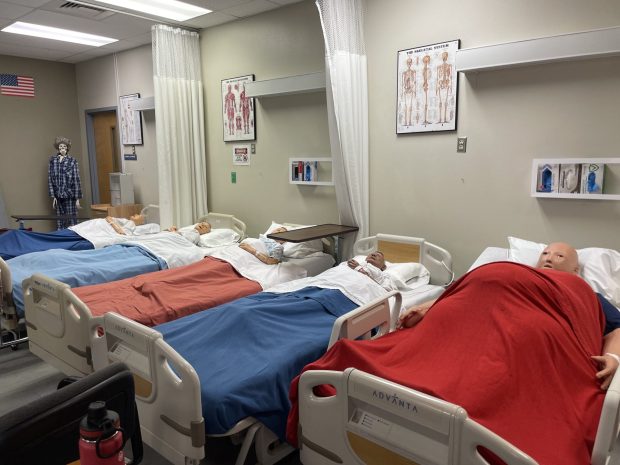


During the panel, students and parents shared their testimonies as to why MMACHS has been such an important first step in their healthcare education journey.
Senior Shahed Aldaher, emphasized how invaluable this opportunity was to her. She hopes to go to Medical School to become a dermatologist and has been able to work in a dermatology clinic as a medical assistant.
“I’m so glad I got introduced to this school because it just offered me so many things that I wouldn’t have been able to do if I went to a normal high school,” Aldaher said. When I graduate, I’ll be a second or third year [in college].”
She also noted how much her current studies help prepare her for more rigorous college courses like anatomy and physiology.
“We have been learning medical terminology since freshman year…having that pre-knowledge from Sports Med, Healthcare, Health Occupations, it just helps set us up much better than [regular] college students are.”
Something that interested legislators was students’ plans to work in Idaho after they go to med school.
“I think most of us have to leave Idaho just because there aren’t many medical schools here, and there’s not many pre-med programs,” Aldaher said. I think that if I had the opportunity to stay in Idaho and be taught in Idaho, I wouldn’t leave…but we’re forced to leave.”
Pitman agreed, but says she hopes to one day come back to Idaho to practice.
“In order to get the best education I can, I have to leave Idaho,” she said. “I think as we get to see the perspective of healthcare in Idaho, we get to learn why it’s so vital that we do come back.”
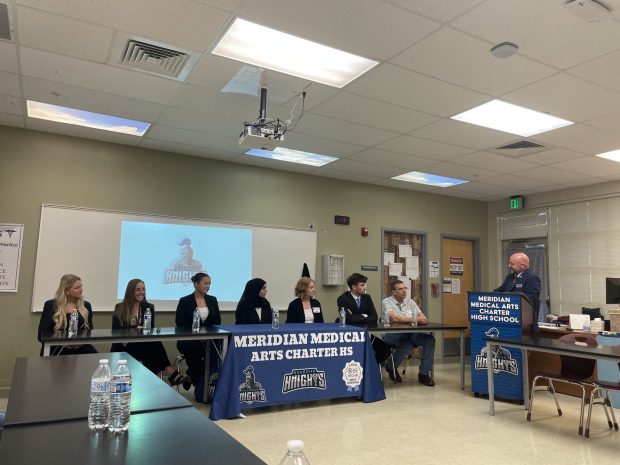
The two schools have even worked together this year on projects that benefit both parties. In the MTCHS Senior Computer Science class, students created software at the request of MMACHS. MMACHS was in need of a program that could work as a mock health record database to enter patient and pharmaceutical data. The program is estimated to be finished by the end of the year, and MMACHS looks forward to adding it to their curriculum.
MTCHS and MMACHS teach vastly different subjects, but share the same sentiment: the student body is engaged, determined, and united. Allowing students to focus on specific areas during their high school experience has led to exceptional post-grad outcomes.

