

A medical education working group appears ready to leave the politically charged questions to the politicians.
The group met for three hours at the Statehouse Monday, for a pivotal meeting, after three months of discussion. Group members again recognized the need to help more Idaho students attend medical school, with expansion plans that could cost Idaho taxpayers several million dollars per year. But the group didn’t recommend where that money should go.
So when the working group’s report goes public, probably in early December, it will probably defer to the Legislature. It will be up to lawmakers to decide whether to grow Idaho’s partnership with the University of Utah medical school, forge a new deal with the Idaho College of Osteopathic Medicine — or expand its longstanding relationship with the controversial, University of Washington-led WWAMI program.
By punting to the Legislature, the working group heeded the suggestion of one of its two co-chairs.
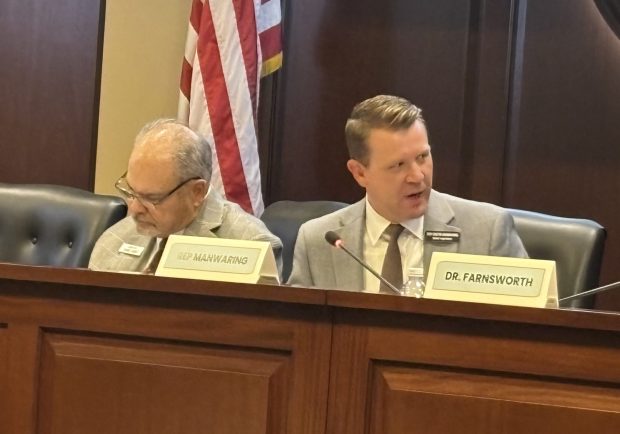
“We don’t need to pick a winner here, necessarily,” Rep. Dustin Manwaring, R-Pocatello, said during Monday morning’s session.
How we got here
At the heart of the debate is a longstanding physicians’ shortage; Idaho ranks last in the nation for physicians per capita.
Since Idaho does not have its own public medical school, it uses taxpayer dollars to subsidize seats at out-of-state medical schools. The subsidies allow Idaho students to pay in-state tuition. Idaho pays for 40 seats a year at WWAMI and 10 seats a year at the University of Utah.
However, the issue has some heavy political overtones — especially when it comes to WWAMI, a regional program that takes in students from its member states of Washington, Wyoming, Alaska, Montana and Idaho. Some lawmakers have been openly disdainful of WWAMI — which has balked in past years at taking on additional Idaho students. The University of Washington has also drawn fire at the Statehouse for failing to sign a declaration saying no Idaho tax dollars are used for abortion training.
The university signed such a document in February — but only after the Legislature floated a bill that would pull Idaho out of WWAMI entirely, severing a partnership that began in 1972.
Support for WWAMI expansion
During Monday’s meeting, several working group members seemed interested in taking up WWAMI on its latest offer — taking on five additional Idaho students in 2026 and five more students in 2027.
They said WWAMI expansion should be part of their recommendations — even if the WWAMI plan falls outside the bounds of a 2025 state law to expand medical education programs.
“I’m just concerned we’re being constrained,” said Senate Education Committee Chairman Dave Lent, R-Idaho Falls, a task force co-chair and a co-sponsor of the medical education law.
“It needs to be somewhere (in the report),” said State Board of Education member Shawn Keough.
Ted Epperly — a working group member and the State Board’s graduate medical education coordinator — put a sharper point on the topic. Idaho is already struggling to recruit doctors to offer on-the-ground clinical training to medical students. If Idaho gives short shrift to WWAMI, its senior partner in medical education, “nonplussed” Idaho doctors will walk away from clinical training, which is essential for medical school students.
“We will hurt all the efforts we have been working on,” he said.
WWAMI and the new law
With its medical education law, legislators created the working group, but they also set out a blueprint.
The law calls for funding and subsidizing an additional 30 medical school seats — 10 seats per year over three years. But none of those seats can be at WWAMI.
That leaves two options that would fall under the law: expanding the University of Utah partnership, or buying seats at ICOM, a for-profit private school in Meridian.
The new law grew out of the Statehouse backlash over WWAMI, replacing the bill that would have ended Idaho’s WWAMI partnership.
But ultimately, the law that passed was far from prescriptive. It doesn’t outright rule out a WWAMI expansion. It also says the state might — or might not — scale back its current WWAMI commitment.
Manwaring said he was worried about confusing the issue. The medical education law, which he co-sponsored, emphasized the need for new partners beyond WWAMI. Presenting WWAMI as a short-term option, on equal footing with Utah and ICOM, runs counter to the law.
A wide-ranging discussion
The medical school partnership issue has been the touchiest issue before the working group, which began meeting in August. But since the outset, the group discussed a range of obstacles that contribute to Idaho’s doctors’ shortage.
And on Monday, the group discussed a range of options — from creating a statewide medical education director, perhaps within the State Board office, to a student loan forgiveness program for medical school graduates.
A loan repayment plan could have an “immediate impact” on the doctor’s shortage, while the state works on short- and long-term remedies, said working group member Brian Whitlock, CEO of the Idaho Hospital Association. And with Idaho seeking $1 billion in federal money for rural health care, this could be within Idaho’s needs.
“I think that’s a worthy use for some of those funds,” Whitlock said.
Epperly is confident that Idaho will get the $1 billion — “We’re a rural red state who needs it” — and urged the working group to work this windfall into its report.
State Board Executive Director Jennifer White reminded the working group to consider this money as a one-time source, not a way to fund long-range programs. “We have to be really thoughtful about that. We can’t be cute there.”
The next move for the State Board, and the working group, is to wrap up its report, which is due to the Legislature and Gov. Brad Little on Jan. 2.
A draft should be available for public comment in early December. The working group is likely to meet in mid-December to go over the comments and approve the report.
“I think we’re going to have something we can be proud of, and the Legislature will look at with credibility,” Manwaring said.
More reading: Click here for our in-depth coverage of the medical education issue.