
Danielle Packard didn’t plan to become an eighth-grade English teacher.
She first thought about politics, studying international political economy at the College of Idaho. Then, after she got a master’s degree in English Literature at Boise State University, she started teaching English 101.
When her husband wanted to move back to his hometown of Sandpoint, where he now edits the weekly newspaper, Packard saw just one problem: The area doesn’t have a college.
So she got her teaching certificate online and started teaching middle school. She was surprised to find how similar it is to teaching college freshman.
“I was wonderfully surprised by how great it was to be at the middle school level and really just make the human connections with kids who are just starting to figure out who they are,” Packard said.
Middle school, eighth grade in particular, can be a tough time in many teens’ lives, but for Packard it’s a sweet spot.
“It’s just absolutely a lovely age, because you do get to have these moments of great questioning and vulnerability among students,” Packard said. “They’re just open. They’re open to thinking about things and talking and questioning and writing. And they’re funny.”
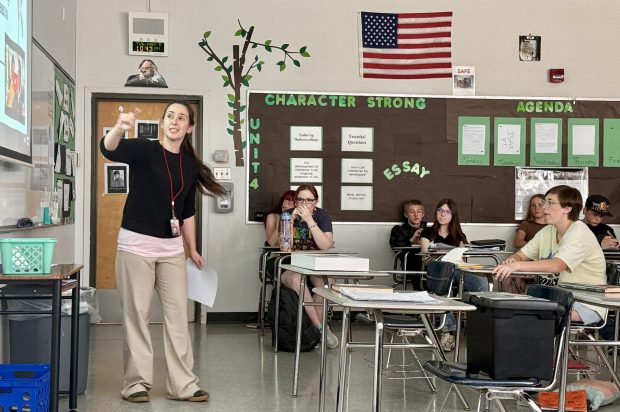
It’s not just Packard that likes middle school, her students love her too, said Geoff Penrose, Principal at Sandpoint Middle School.
“I’m always impressed when I go into her classroom,” Penrose said. ” It is always a calm and focused place, which in a middle school is no easy task.”
Packard sets expectations early on and then sticks to them, he said. That calm and clear environment then helps Packard’s passion shine.
Packard’s favorite book to teach is Maus, a graphic novel, in which the author, Art Spiegelman, interviews his father about his experience as a Holocaust survivor from Poland.
“It’s so incredibly eye-opening for students,” Packard said.
Students come into her class with less knowledge of World War II than Packard and her generation had as children, she said. Students respond to Maus with such “amazing and important questions” every year, Packard said.
Sometimes it’s the first time students are reading a personal narrative from a Holocaust survivor as “The Diary of Anne Frank” fades from curriculums, she said.
Packard will often have students listen to the play version of Frank’s diary as part of her Maus unit, but finds the graphic novel resonates with students who may not be strong readers.
“They will really latch on to this book,” Packard said. “They will just immediately become interested and engaged and be asking questions and learning things on their own.”
There has been a trend in recent years toward reading excerpts rather than full books in English classes but Packard believes there are immense benefits to students reading whole books in class.
“I know that some of that is concern about like attention span,” Packard said. “Some of that is like concern as far as like testing skills.”
She wants her students to walk away with at minimum four books they’ve read all the way through. The “seismic shift” Packard sees between generations is a reduction in homework.
Packard has her students read the books in class, instead of assigning reading at home.
One of Packard’s passions is Positive Behavioral Interventions and Supports (PBIS), which boils down to recognizing students for when they do the right thing.
“It is tough for anybody to come sit in a desk for like, six and a half hours and be cheerful and do all the things that a teacher wants you to do. And not be surly,” Packard said. “I just think that kids should definitely be acknowledged as much as possible for that.”
Packard strolls through her classroom mid-lesson, handing out purple tickets to students as they raise their hand or help a friend.
Then there are schoolwide goals where students earn red cards for being engaged, dependable and respectful. The cards serve as entries into drawings for free ice cream, movie tickets, even ski passes, donated by area businesses.
Penrose said Packard has been their “data queen” helping find moments when students struggle and finding ways to alleviate problem areas.
She discovered through data analysis that fourth period on Wednesday has the most behavioral problems school-wide. Teachers were then able to be proactive during that hour of instruction, he said.
The system helps students work together, Packard said. The current challenge is for 7th and 8th graders to get enough red cards for an extended lunch and recess, she said.
“It’s a weird age and so just trying to make it as pleasant as possible for people,” Packard said. “Making sure that people feel seen and they’re in as kind of an environment as possible.”
Danielle Packard

Years Teaching: 16
Grades Taught: Eighth, college
What do you wish parents knew about teaching?
I wish parents knew that we absolutely have the best intentions for students’ learning. We really, really hope that parents are supporting the learning at home and encouraging them to read.
What advice would you give to newbies?
I would say that, take a weekend or a week to speak with teachers or to think carefully about behavior management plans, it’s something that’s often overlooked but it’s important.
Teacher Feature highlights the diversity, expertise and ingenuity of educators across the state. Submit your suggestions for a teacher to feature to Emma Epperly at emma@idahoednews.org.

