High school classrooms at North Star Charter School were devoid of furniture one week before it would make history as the first Idaho charter to merge with another.
Desk and chairs big enough for high schoolers had not yet arrived just days before school started.
“When furniture is still in the mail and it’s August 1,” said Head of School Andy Horning from his office in Boise last week. “That’s terrifying.”
The stakes were high. People around the state were looking to see if the first-of-its-kind merger would work, Horning said.
“Not only do we want it to work, we want to celebrate it,” he said. “Because this is a major move for North Star, but for charter schools in general.”

Three months into the school year, the merger with the struggling Rolling Hills Charter School in Boise appears to be an initial success. North Star was increasing enrollment and needed more space, while Rolling Hills was declining in enrollment. The former absorbed the latter.
Students like sophomore Annika Brown are happy to have their own space. Last school year, she was sharing the North Star building in Eagle with 1,000 students across grades K-12. High schoolers and middle school students had to work around each other’s lunch and gym schedules.
Now, the 205 high school students have their own building, the former home of Rolling Hills Charter. About 940 K-8 students now occupy the original North Star building.
“I think it was just pretty crowded over there,” Brown said. “So this new school is giving us opportunities for more space.”
Two schools
The idea to merge the K-12 North Star Charter School in Eagle with the K-8 Rolling Hills Charter School six miles away in Boise began in December, eight months before the start of the 2025-26 school year.
Tara Handy, the administrator at Rolling Hills, reached out to Horning and asked to get lunch.
“Tara, just at the end of the day, said, ‘We really just need you to take the school over,'” Horning recalled.
North Star had a long waiting list and academic success, with a 94% percent graduation rate and 91% proficiency on the Idaho Reading Indicator. The board hired Horning four years ago to grow the secondary school. He was actively looking for room to expand.
“We could have doubled the size of our school and still probably had a waitlist,” North Star Board Chair Bryan Wheeler told EdNews. “I mean, it was that silly.”
But Rolling Hills was struggling to bring in students.
Open since 2005, Rolling Hills was once the best-kept secret in the valley, said former board chair Breege Zachary. The charter school with an anti-bullying focus had small classrooms with one class per grade.
Back then, there were just 24 charter schools in Idaho. Today, there are 76. As more charters have opened up, like-minded parents seeking something outside of traditional public schools have more options.

“You’re just competing for those same spots,” Zachary said. “As a parent, as I saw it, the market became saturated with so many charter schools.”
In 19 years, Rolling Hills had never dropped below 200 students, according to Idaho Department of Education data. That changed in 2024. Enrollment dropped by 54 students, from 230 to 176.
“When you open your doors, or a week before school starts, and 50 of those don’t show up, that’s a huge amount you can’t recover from financially,” Zachary said.
Rolling Hills administrator reprimanded
The Idaho Professional Standards Commission in October issued a letter of reprimand to former Rolling Hills administrator Tara Handy for engaging in gossip and derogatory comments toward students and staff. Rolling Hills used the harbor method of discipline, which includes zero tolerance for bullying.
An administrative complaint states Handy:
- Made fun of a former employee’s appearance.
- Called former employees a derogatory term related to their sexual orientation.
- Referred to students generally in a rude and unprofessional manner.
- Engaged in unprofessional name calling related to a specific student.
- Engaged in unprofessional name calling related to a specific colleague.
Handy retired at the end of the school year, but Horning said she is now employed as the registrar in the back office at North Star. He said Handy had not planned on taking the administrator role at Rolling Hills, which did not fit her strengths.
“She’s actually helped us financially in many ways, but I know that her strength is working in the back office,” Horning said. “And I think she was signing up when she was at Rolling Hills to do that, but they put her out in front and try to take on all these changes and these challenges.”
Breege Zachary, former Rolling Hills board chair, said the allegations against Handy are “very separate” from the merger.
“I think that was a personnel issue for her, but definitely did not play into the fact of the merger,” Zachary said.
Over at North Star, board members were excited about the idea of absorbing Rolling Hills. Wheeler said the entire board was in agreement. They had strong finances, good leadership, dedicated teachers and had been planning to expand for several years.
“The merger came about and it checked the boxes,” Wheeler said.
A quick transition
The North Star board initially planned on a slow transition by 2026, but things moved quickly.
“Way quicker than any of us thought,” Wheeler said.
By February, administrators at the two schools appeared before the Idaho Public Charter School Commission seeking approval for the merger.
Rachel Burk, executive director of the IPCSC, told EdNews that the merger reflects the innovative nature of charter schools.
“Since this had never been done in the state, we didn’t really have an example to follow,” Burk said.
Wheeler recalled the North Star legal counsel telling commissioners that there is no law in place regarding charter school mergers.

“Our attorney testified during our presentation, and pretty much told them, ‘Hey, there’s no law on this,'” Wheeler said. “So pretty much whatever you guys decide, you won’t be breaking any laws.”
The commission unanimously approved an amendment to the North Star performance certificate, allowing the charter school to take on Rolling Hill’s assets. Rolling Hills is dissolved and North Star now has two buildings and increased enrollment.
Under the proposal, grades K-8 would be located at the existing North Star building in Eagle and grades 9-12 would move to the Rolling Hills building in Boise.
But that meant high schoolers on the west side of Eagle would have a significantly longer commute.
“It was definitely farther away, which was a factor for everybody,” Brown, the sophomore, said.
The merger was hardest on those students to the west, Horning said. The school runs a shuttle for high schoolers between the two campuses, but that extra trip still added valuable time in the morning.
“That was a group that had elected to not continue,” Horning said.
Even with some losses, there are now more high school students at North Star since 2010, when 220 9-12 students attended the charter. State data shows there were 180 high students last year, which is now up to 205.
The merger also created challenges for electives. Horning tried to limit the number of staff who had to commute between schools, but the 6-12 art teacher was one of the exceptions. Staff tried to maintain the music program through the merger, but about five students signed up for the high school band, which was not enough to keep it alive. The music program is something Horning wants to work on rebuilding.
Financial support
After securing the approval of the charter commission, the next step was securing funding to support the merger.
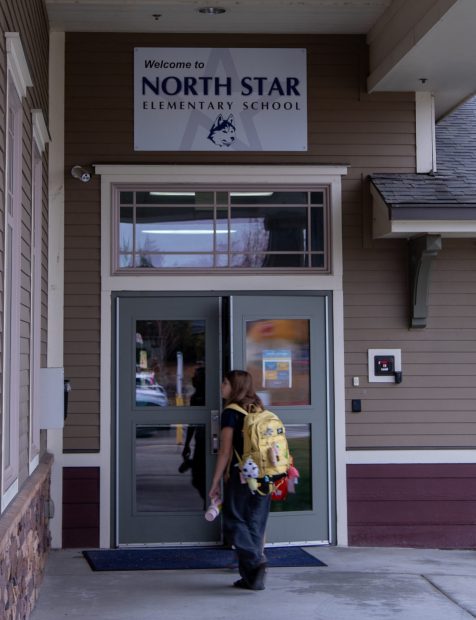
The Rolling Hills building was set up for elementary and middle school students, but had to be reworked for high schoolers. Raising whiteboards was a relatively simple fix, but the furniture was a more significant venture.
Horning met with the nonprofit Bluum in March and in the spring received an $800,000 federal charter school program grant. With that funding in hand, he then started working with furniture companies. He hired the school’s basketball team to move and install the furniture days before school opened.
“The biggest challenge was just making sure we were able to open our doors and be ready to go,” Horning said.
The $800,000 grant had a specific timeline and purpose, but Bluum eventually provided another $1.2 million grant with a longer timeline, for a total of $2 million. Horning said the school has two years to spend the $1.2 million, which will allow them to strategically update technology.
Too early to tell
Just three months into the school year, it’s too early to tell if the merger will ultimately be successful. But the doors are open and board chair Wheeler said he hasn’t heard reports of any playground brawls between North Star and former Rolling Hills students.

“I’ve got two middle schoolers, and the first couple months they’d come home and say, ‘It was great,'” Wheeler said. “‘I met a new friend.’”
Zachary is no longer a board member, since Rolling Hills is now effectively dissolved, but she is still a parent with elementary and middle school kids at North Star. She said it was an adjustment for her kids moving to a larger school building — and there are challenges with different drop off times — but overall it has been positive.
“As a parent, I am happy,” Zachary said.
From the state perspective, Burk said the North Star merger is proof that it can be done in Idaho.
“I see that being a model that others could utilize down the road,” Burk said.
Horning said he often thinks about why the merger worked. The two schools were in close proximity and had complementary needs. One wanted to expand while the other was in decline. And the Rolling Hills building was the perfect place for a high school. It is surrounded by the 51-acre Optimist Youth Sports Complex.
Wheeler said he hopes struggling charter schools in Idaho take notice of the merger and use it as a model. He said parents are happy, kids are educated and North Star has a great product. But they’re not done.
“We’re already talking like, ‘OK, what’s next?’” Wheeler said. “Like, this seems to be going really well, and we’ve done a good job, but I don’t know if we’re done growing yet.”
Disclosure: Idaho Education News and Bluum are both supported by grants from the J.A. and Kathryn Albertson Family Foundation.