
Two music teachers are orchestrating the resistance to artificial intelligence in Idaho.
Boise couple Jack and Cathryn Gardner have organized the state’s first AI protest. They’ve been meeting with federal and state lawmakers to push for regulations on the technology, and they’re seeing firsthand how AI influences young students.
Cathryn teaches music to elementary students in the Boise School District and Jack, who formerly taught music in the Nampa School District, is a freelance bassist teaching private lessons to high school and college students.
“I see it affecting how my students are thinking critically and thinking cognitively,” Cathryn told Idaho Education News in an interview last month. “But I’m seeing, too, that it’s affecting their ability to process and to work independently and to think creatively.”
Jack and Cathryn co-lead the Boise chapter of PauseAI US. The nationwide advocacy group’s goal is to tighten government regulation on AI development to prevent “adversarial superintelligence,” rogue AI agents that disobey humans.
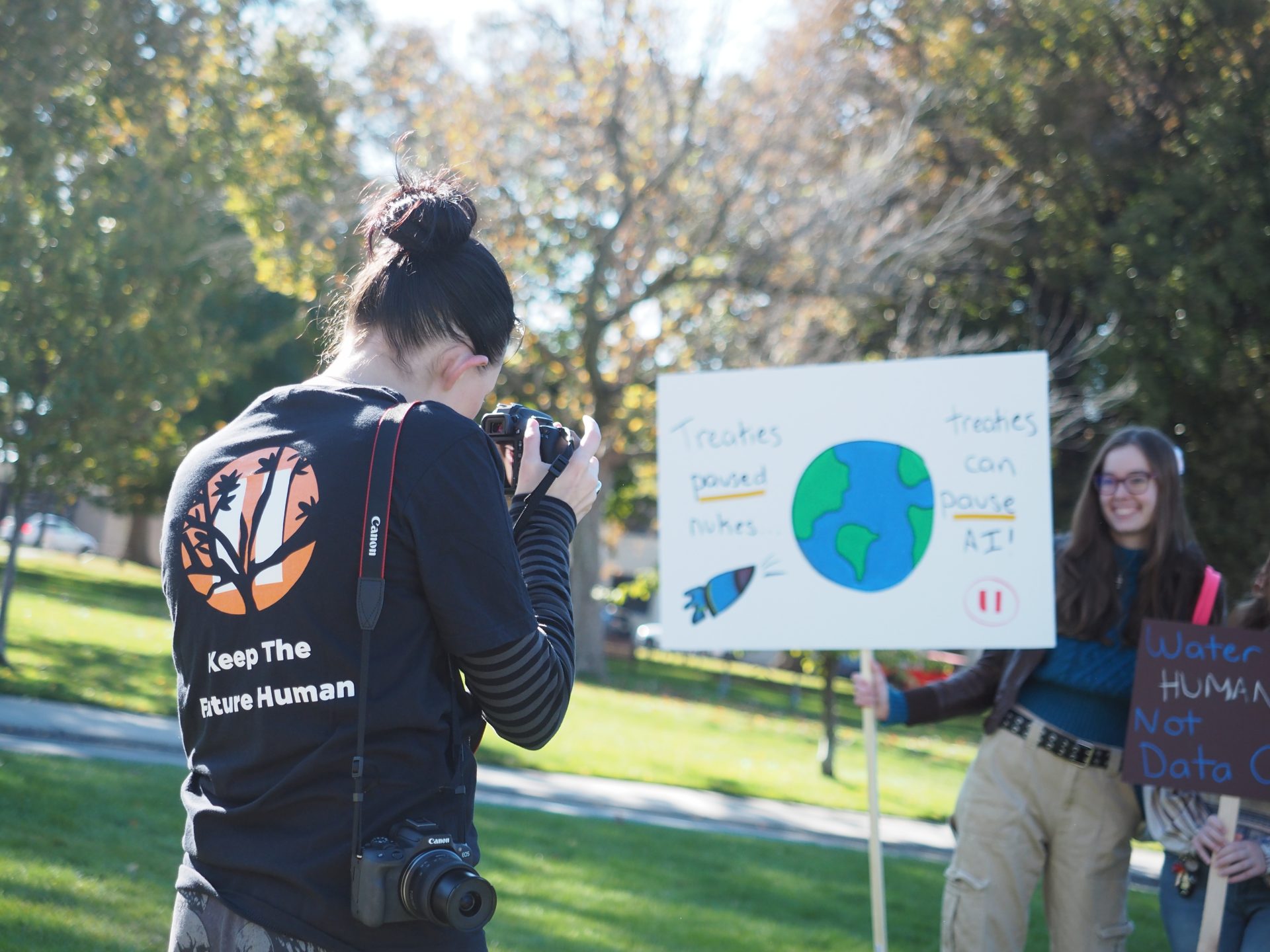
The couple holds monthly meetups and tables weekly at community events. Their first protest, held Oct. 24 in front of the Idaho Statehouse, included speeches from volunteers and signs and flyers advocating for humanism, reported The Arbiter, Boise State University’s campus newspaper.
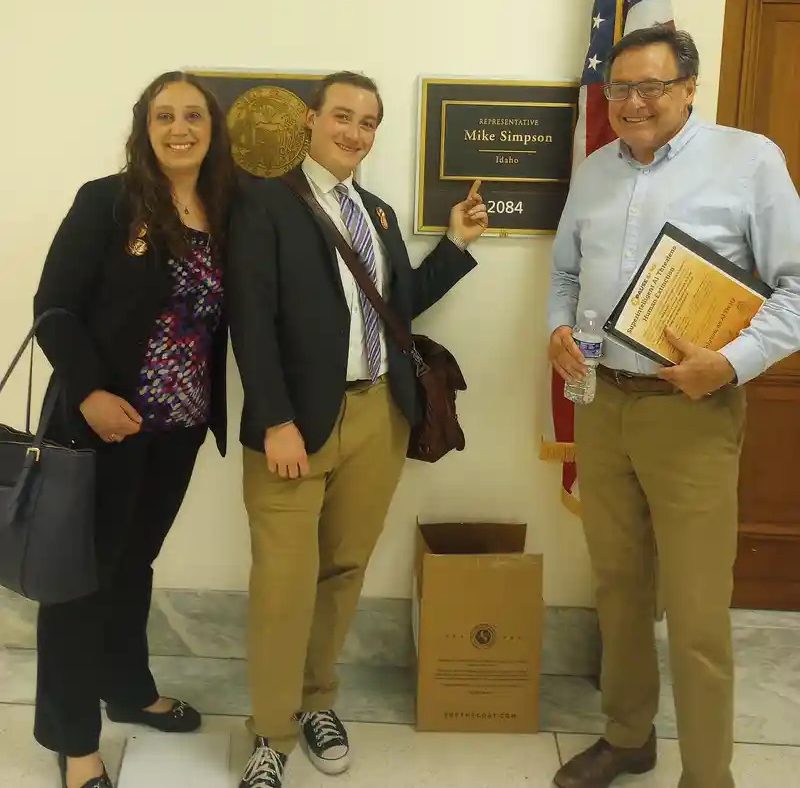
Meanwhile, Jack and Cathryn have been meeting with lawmakers, including U.S. Rep. Mike Simpson and Sen. Jim Risch, to advocate for regulations on AI. They’ve been featured in The New York Times.
PauseAI US leaders consider the couple their “best organizers,” and praise their ability to break down complex AI concerns for people without technical knowledge.
“I think they’re a great example of like, yeah, any person can go meet with the senator, raise the alarm, and propose some good ideas, and together we can solve the problem,” said Alvaro Cuba, associate director at PauseAI.
Music teachers grow concerned with AI
Making music is one of the few remaining activities that only humans can do, Jack said, and as artificial intelligence proliferates education and the workforce, the Gardners are putting humanity at the center of their lessons.
“AI noise isn’t really music,” Jack said. “…Studying an instrument teaches delayed gratification, which is the polar opposite of what AI promises and doesn’t deliver. Being in an ensemble teaches you human interaction skills that they’re not getting in their online lives.”
When it comes to AI’s broader impact on society, Jack had been focused on the technology stealing musicians’ work without credit or compensation. Then, last year, he learned about the hypothesis that AI’s progress could lead to the extinction of humanity.
This summer, rogue AI agents made real-life headlines after OpenAI’s agents breached containment and hacked Hugging Face, an open-source AI development platform.
Jack knew he had to do something about it. He and Cathryn searched for anti-AI organizations and joined Pause AI in August of 2025. They were “voluntold” into founding PauseAI Boise shortly after.

Now, the Gardners work with around a dozen volunteers and have garnered hundreds of signatures on a petition to pause AI development.
“I remember when they first reached out, we were very excited because we’ve got a couple in Boise that has some experience, they’ve been involved, they’re in public education and, you know, they’re teachers,” Holly Elmore, the founder of PauseAI US, told EdNews. “We immediately had a good feeling about them wanting to work together.”
Working toward policy creation
In addition to traveling to Washington, D.C., to meet with federal lawmakers, Jack has also spoken with state legislators, and he found an ally in Boise Sen. Janie Ward-Engelking.
A longtime Democratic lawmaker and former teacher, Ward-Engelking said regulating AI will be one of her top priorities in the upcoming legislative session.
“I am concerned it’s moving so fast,” she told EdNews by phone.

For the senator, it’s not simply a policy issue; it’s personal. After a software update on her smartphone implemented AI, she was bothered to find that her deceased mother was removed from her contact list.
“It knew she had passed away,” she said.
Ward-Engelking teaches at the College of Western Idaho, where she’s heard from students that varying AI policies from class to class are confusing.
She’d like to see some guardrails like those in an Illinois law known as the Artificial Intelligence Safety Measures Act. Signed by Illinois Gov. JB Pritzker in July, the bill is modeled after legislation in California and New York. It places requirements for transparency and accountability on companies developing AI models.
In Idaho, legislators have directed the Idaho Department of Education to establish guidance for K-12 schools on artificial intelligence implementation and started the process of creating standards for K-12 AI curriculum.
“If we could get some sidebars in place, some guidelines in place,” Ward-Engelking told EdNews, “it would help everyone.”
PauseAI Boise’s next event, an “AI reality check,” is at 1:30 p.m. Saturday at Our Lady of the Rosary Catholic Church in Boise.