
An add-on budget for the community colleges survived bipartisan blowback Wednesday — directed at the College of Western Idaho.
House Bill 906 would net another $1.1 million for the community colleges, offsetting some of the cuts the two-year schools have absorbed since last summer.
But two lawmakers took aim at the state’s largest community college — and events that have occurred at CWI over the past several months.
Rep. Brent Crane, R-Nampa, voted against the budget to protest CWI’s recent acquisition of the Ford Idaho Center, and the college’s plans to hire an athletic director. Crane did not mention CWI President Gordon Jones by name, but he said Jones is straying from CWI’s mission of serving students seeking a two-year degree or career training.
“We know exactly where this individual is going to go,” Crane said. “There was never any talk about athletic teams, but that’s where it’s headed.”
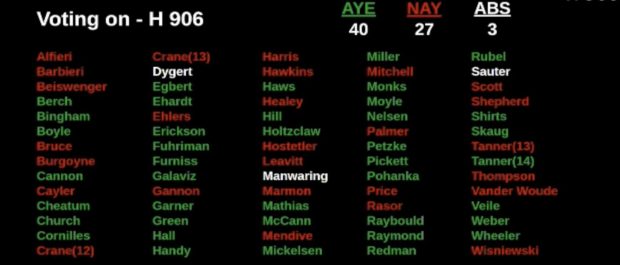 Rep. John Gannon, D-Boise, noted that the city of Nampa is turning over the Idaho Center in a no-cash transfer — but CWI is assuming a facility that has received more than $21 million in city subsidies over the past two decades. He also said CWI needs to focus on education, not entertainment.
“Building an empire at a college is not what we should be doing,” he said.
Rep. Barbara Ehardt lamented that all community colleges, including her hometown College of Eastern Idaho, were being lumped together in one spending bill. “Why do they all have to be treated equal?” said Ehardt, R-Idaho Falls.
Ultimately, Ehardt voted for the budget bill, which passed on a 40-27 vote and now goes to the Senate.
The community college budget bill would net $382,800 for CWI, $322,200 for the College of Southern Idaho, $277,500 for North Idaho College and $140,700 for CEI.
Budgets, funding autonomy, recess: a flurry of afternoon House votes
During a busy afternoon session, the House also ran through five other education-related bills.
All five bills passed, and go to the Senate.
Funding incentives for schools. The state’s highest-performing districts and charters are one step closer to receiving increased spending authority.
House Bill 883 would grant extra autonomy to districts that meet several benchmarks for test scores and graduation rates. Charters would be graded on financial standing, audit results and academic results. (Read more about the benchmarks here.)
“This bill’s about incentives,” said the bill’s sponsor, Rep. Douglas Pickett, R-Oakley. “This sets a bar.”
Seven to 10 districts and about 15 charters would meet the benchmarks, he said.
Rep. Clay Handy, R-Burley, hailed the bill as a step to remake schools and free them of “bookwork.”
Rep. Elaine Price debated against the bill, saying it could sidetrack a rewrite of the school funding formula — something lawmakers have discussed for 10 years.
“It just worries me that when we do this we’re never going to address that funding formula,” said Price, R-Coeur d’Alene.
The bill passed, 58-7.
Rural health committee. The House passed its version of an oversight bill for the state’s $930 million share of rural health transformation grants.
The bill would create a nine-member committee, including four House members, four senators and a non-voting gubernatorial appointee.
“If we don’t have this committee, the executive branch will simply do our job for us,” said Rep. Jordan Redman, R-Coeur d’Alene, the sponsor of House Bill 916.
State officials accepted the five-year grants in December.
Some lawmakers are looking at the rural grants as a way to plug gaps in Idaho’s medical education portfolio.
But one opponent decried the federal grants — saying they simply add to a bloated national debt.
“The reality is this is borrowed money,” said Rep. David Leavitt, R-Twin Falls. “I will not place my children, my grandchildren, under the shackles of debt.”
The bill passed 52-15, over opposition from hardline conservatives.
The Senate has a competing bill, which has been awaiting a vote for more than a month.
Recess, 2.0. A week ago, the House rejected a bill mandating school recess. The outcome was much different this time.
House Bill 915 would require a 20-minute recess in kindergarten through fifth grade, and encourages “daily unstructured activity breaks” in sixth through eighth grade. But the bill changes language that killed the first bill. Teachers would now be able to withhold recess as a disciplinary measure, but they wouldn’t be able to cancel recess for an entire class.
One lawmaker who debated against the first bill seemed to relish having a second chance.
“I don’t want every kid in the state mad at me for opposing their recess,” said Rep. Charlie Shepherd, R-Pollock.
It passed, 68-0.
Career-technical education money. House Bill 907 restores more than $2.8 million for high school CTE budgets for this year and next year. The House passed the budget on a 46-21 vote.
State Board of Education budget. House Bill 905 includes some add-on line items for the State Board. The biggest line item gives the board the go-ahead to spend $4 million for a federal secondary education grant. It passed on a 42-24 vote.
Parental rights cleanup bill heads to the Senate
A bill that would clean up parts of a 2024 parental rights law is headed to the full Senate.
The Senate State Affairs Committee sent House Bill 860 to the Senate floor, where it could be amended. At the sponsor’s request, the committee sent the bill to the amending order.
Senate President Pro Tem Kelly Anthon said one change would strike part of a definition regarding evidence collection in a sex crime. Another change would clarify when health care workers can test “drug babies” without parental consent, Anthon said.
The bill would still clarify that staffers at the state’s 988 suicide and crisis hotline can place a followup call to a minor “experiencing suicidal ideation.” And it would ensure that schools can provide bandaging and other nonemergency care to minors.
“These are not easy matters,” said Anthon, R-Rupert. “They’re complicated, and they need a lot of wordsmithing.”
HB 860 cleared the House on a unanimous vote.
New bill on school abuse reporting, disclosure surfaces
Lawmakers introduced a new version of a bill that would prohibit schools from conducting an internal review of abuse or neglect “in lieu of reporting to law enforcement.”
Sen. Tammy Nichols’ bill replaces Senate Bills 1371 and 1372, which stalled last week in the Senate Education Committee. Nichols said she ran the new version by the Idaho Department of Education, State Board of Education and Office of the Attorney General to ensure it’s “clear and workable.”
The Senate State Affairs Committee introduced the bill Wednesday.
“It creates a clear statewide process for disclosure, reporting and accountability when schools hire educators,” Nichols said. “Simply put, this bill creates a clear, informal process for schools to follow.”
During last week’s hearing on the previous bills, Nichols alluded to the $7 million settlements the Boise School District offered in connection to a series of sexual abuse tort claims.
The new bill would also require that school employers obtain a sworn statement from applicants that they have disclosed any “pending or prior investigations.”
Budget-setting lawmakers hold bill to limit ‘maintenance’ increases
The Senate Finance Committee took no action on a bill that would restrict agency “maintenance” budgets to inflationary increases.
Sen. Dan Foreman was congenial about the committee’s inaction on his bill, which effectively killed it for the session. Senate Bill 1252 was designed as a “statement of intent,” said Foreman, R-Moscow. “It could be a catalyst to just get the wheels turning a little bit.”
Maintenance budgets roll over an agency’s base spending from the prior fiscal year, with some increases built in to cover growth and inflation. Additional spending requests are dealt with in “enhancement” budgets.
Foreman’s Restraint of Government Uncontrolled Expansion (ROGUE) Act would have limited maintenance budget increases to no more than the average percentage increase in the Consumer Price Index, the federal government’s inflation measurement tool.
But Senate Finance said budget-setting lawmakers are still figuring out what qualifies as a maintenance budget. Sen. C. Scott Grow, R-Eagle, and former Rep. Wendy Horman implemented the maintenance-enhancement budgeting model in 2024. And the Joint Finance-Appropriations Committee has debated what constitutes “maintenance” ever since.
“This idea really intrigues me,” Sen. Kevin Cook, R-Idaho Falls, said of Foreman’s bill. “But one thing that I think is missing is the definition of what a maintenance budget is.”
Senate Education moves quickly on online attacks, homeschool counts
It took the Senate Education Committee 10 minutes to ship two bills to the floor for a final vote.
Inappropriate online behavior. House Bill 785 would set the guidelines for schools to discipline students who make an online comment “that harasses, threatens, or bullies any public school employee or other person, whether it occurs during or outside of school hours or on or off school property.”
Homeschool student counts. House Bill 846 is designed to ensure homeschool students are not added back onto public school enrollment counts. Students would fall off enrollment rolls if they are absent for the first 10 days of fall classes.
Both bills have already passed the House unanimously.
Senate passes budget bills
The Senate approved a handful of “maintenance” budget bills Wednesday, including funding for:
General government. This $507 million budget funds a slew of agencies, including the Idaho State Tax Commission, STEM Action Center and Workforce Development Council. It includes an 11.9% reduction in general fund spending from the current fiscal year.
Constitutional officers. This $89.5 million budget funds offices of constitutional officers, including the governor, lieutenant governor, attorney general, state controller, secretary of state and state treasurer. It includes a 4.2% reduction in general fund spending from the current fiscal year.
Legislative branch. This $13.1 million budget funds the Legislative Services Office and Office of Performance Evaluations. It includes a 3.5% reduction in general fund spending.
The bills already cleared the House and now go to the governor’s desk.

