President Donald Trump’s endorsement of incumbent Gov. Brad Little says a lot about the state of the race, 11 months before the GOP primary.
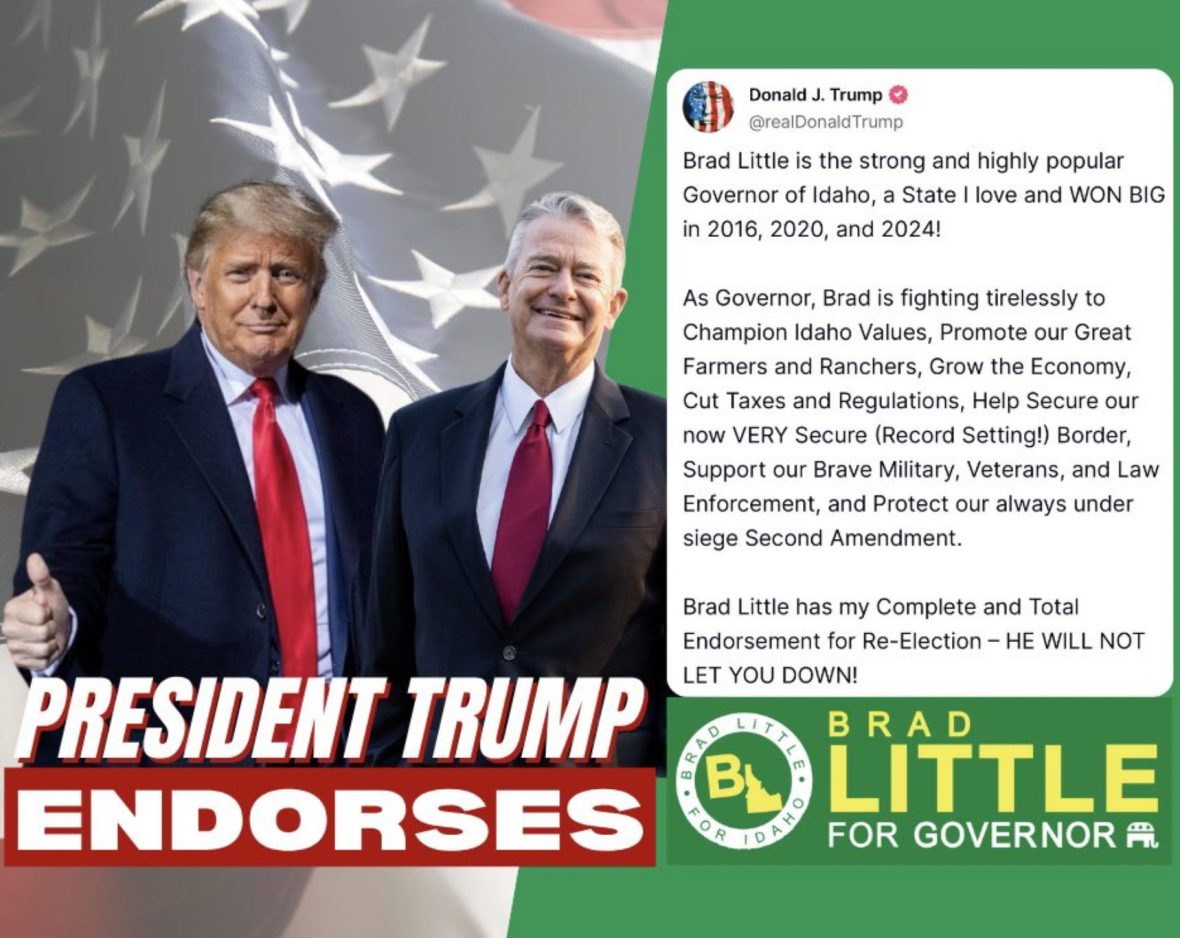 On one level, Tuesday’s endorsement isn’t much of a surprise. It’s fair to say Little has been currying Trump’s favor for months — with repeated trips to the White House, a pre-inauguration dinner at Mar-A-Lago, and a steady stream of news releases and social media posts hailing the president’s agenda.
So Trump’s endorsement is maybe the predictable payoff at the end of the courtship.
The timing is interesting, though, especially as it relates to the history.
- In 2018, Little was embroiled in a no-holds-barred, multimillion-dollar primary battle with then-U.S. Rep. Raúl Labrador and physician and developer Tommy Ahlquist. Trump was evidently close to endorsing Labrador — but according to a report from The New York Times, the Little campaign managed to scuttle the pick. Trump sat out the Idaho governor’s primary. (More from the 2018 endorsement intrigue from James Dawson of Boise State Public Radio.)
- In 2022, Little faced a hardline foe, then-Lt. Gov. Janice McGeachin, whose scorched-earth campaign focused largely on Little’s pandemic response and claims of indoctrination in K-12 and higher education. Then-former President Trump endorsed McGeachin in November 2021, and while his choice generated headlines, it didn’t translate into groundswell. Little cruised to an easy, 58,000-vote primary victory, a prelude to a general election landslide.
On Tuesday, Trump waded into a governor’s race that, right now, isn’t. And certainly compared to recent election cycles.
Eight years ago at this time, Little, Labrador and Ahlquist were already furiously running for governor. (Little had actually jumped into the open race in the summer of 2016). Eight years ago, it was game on.
Four years ago at this time, McGeachin’s challenge was already well underway. She had already taken full advantage of a Little trip to a GOP governors’ conference in Tennessee; in his absence, she issued an executive order rescinding local mask mandates. McGeachin’s education indoctrination task force, a de facto arm of her campaign, had already held its first meeting. Again, game on.
In June 2025, the silence is deafening.
Yes, it’s noteworthy that Trump endorsed an incumbent governor who hasn’t actually publicly announced his re-election campaign. And yes, Little’s re-election campaign is pretty low-key at this point. A campaign website is mostly sparse — except for a link for campaign contributions and, wait for it, a popup video featuring Little seated next to Trump.
Little hasn’t formally launched his bid for a third term. As an incumbent, he’s in no hurry. The $193,000 in his campaign war chest is a down payment; if and when he needs a cash infusion, fundraising is probably not going to pose much of a challenge.
Little has a Democratic opponent, Boise attorney Terri Pickens — a 2022 candidate for lieutenant governor, who is sitting on barely $5,000 for her 2026 campaign. But the GOP primary, which proved to be Little’s biggest obstacle in 2018 and 2022, appears to be a non-election so far.
For all practical purposes, we now know that Little is probably running again. The bigger question is who else runs, especially in a Republican primary that is barely 11 months away.