
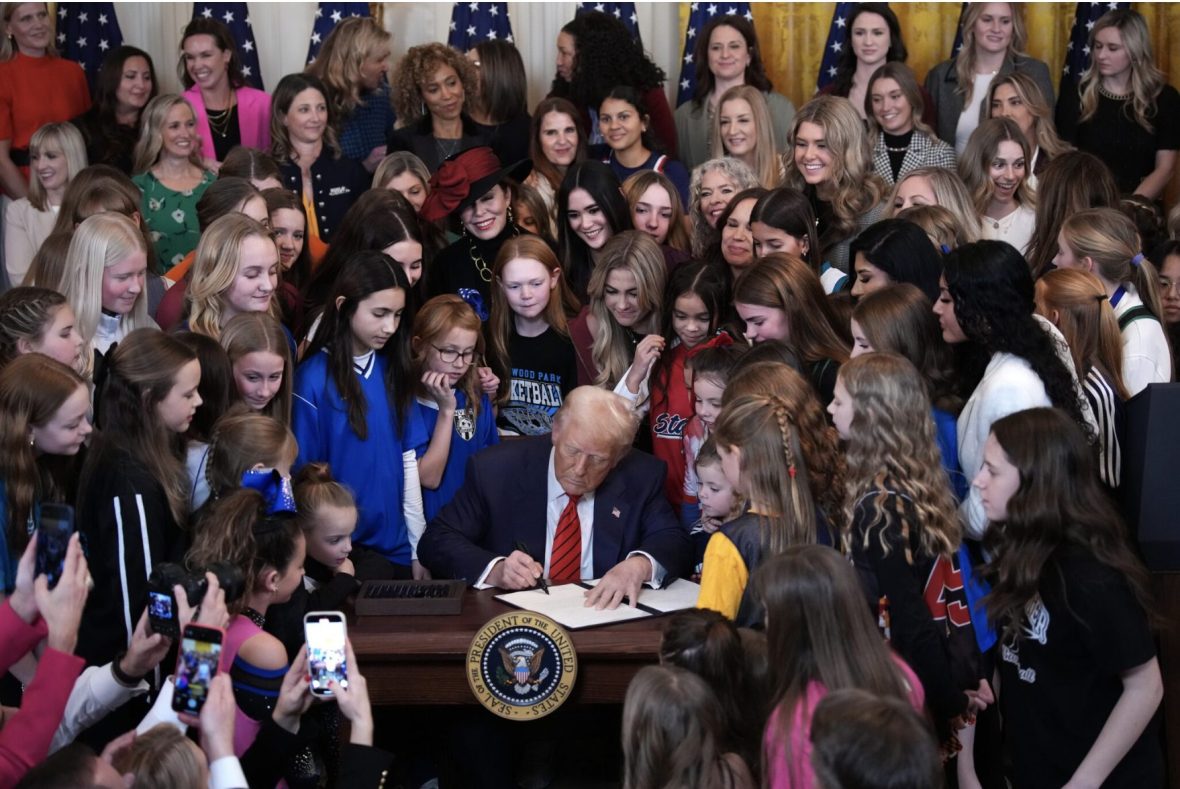
Through a whirlwind churn of executive orders, President Donald Trump is trying to remake American education.
In an Idaho Republican image.
Trump wants to defund schools that embrace, in his words, “discriminatory equity ideology.” He wants to peel off federal money into “educational alternatives,” such as private and religious schools. Most recently, on Wednesday, Trump banned transgender athletes from competing in women’s sports.
While Trump has been churning out the executive orders, an Idaho legislative task force has worked up a bill banning DEI (which, actually, stands for diversity, equity and inclusion), while working their way through an array of competing private school choice bills. And one thing is undebatable. Trump’s orders have ratcheted up the Statehouse debates over DEI and private school choice.
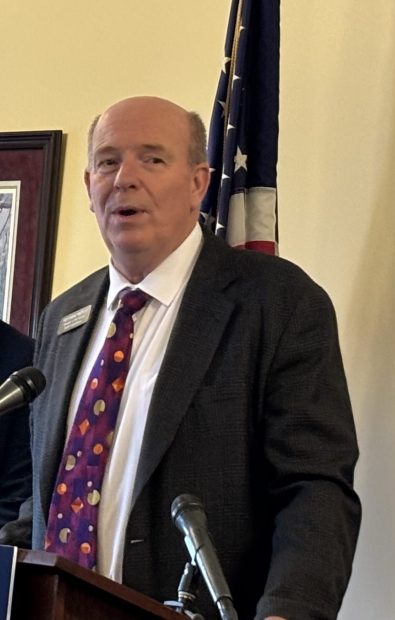
“I think they go together,” said House Speaker Mike Moyle, R-Star. “I think they actually help get that stuff done.”
“It has put fuel on the fire,” said Rep. Soñia Galaviz, D-Boise. “This session feels different than anything else. … The type of legislation we’re seeing is targeting schools.”
Not everyone is talking about the Trump effect.
Gov. Brad Little had ample time this week to travel to Washington, D.C., for the signing of the transgender athletics executive order — getting a shoutout from Trump for Idaho’s first-in-the-nation state law on the issue. But Little had no time to talk about Trump’s education agenda. He declined an interview request, and spokespersons Joan Varsek and Emily Callihan did not respond to repeated requests for comment.
The State Board of Education, Little’s education policymaking arm, isn’t saying much more. Idaho Education News submitted a list of written questions, at State Board Executive Director Joshua Whitworth’s request, and received a terse statement.
“The board has not met to discuss this, and therefore we aren’t going to speculate,” the statement read. “We are waiting for more information from our federal partners to gain a better understanding before we can consider making any comments.”
State superintendent Debbie Critchfield was willing to talk about what she knows — and, maybe more to the point, what she doesn’t yet know.
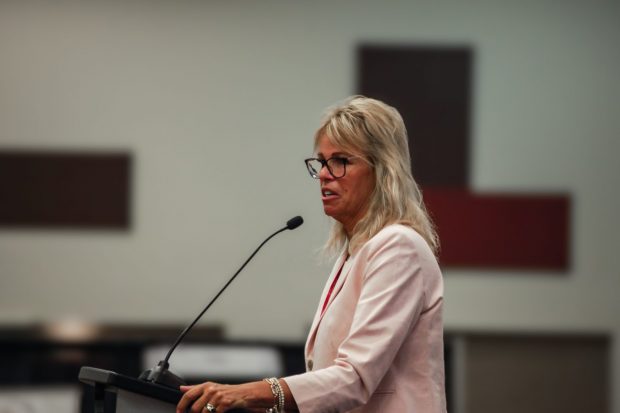
Critchfield doesn’t think the DEI order overrides the state, and its 2021 law banning critical race theory in K-12 and higher ed classrooms. Arguably, Trump’s order injects the federal government into school curriculum, an area where the state has historically deferred to local school districts. Critchfield doesn’t read it that way.
“I felt like the order was informing the decisionmaking at the local level,” she said in an EdNews interview Wednesday. “I didn’t see anything that took that control away from the local district.”
The school choice executive order could get complicated, and in a hurry. It could quickly affect federal funding, like the $260 million incorporated into next year’s K-12 spending blueprint.
The order instructs the U.S. Department of Education to find funding sources for a school choice program. But it doesn’t say where the money might come from, or how it might be used, Critchfield said. “That’s the ‘we don’t know’ part.”
Based on what she knows, Galaviz is worried. She points to an Education Week article that suggests the school choice money could come from Title I, a federal fund that provides $78 million for Idaho’s low-income schools. She is also worried about the state’s chronically underfunded special education program, which receives $80 million from the feds.

Title I is personal to Galaviz, a nationally recognized public school teacher. The federal dollars fund her interventionist’s position at Whittier Elementary School in Boise. Title I helps cover staffing, mental health supports and professional development for teachers who are working with students from other countries, and sometimes war-torn countries.
The school choice executive order aside, Title I is already under a microscope. On Jan. 28, Critchfield co-signed a letter with 11 other state superintendents; the wish list to the feds included the latitude “to pilot alternative spending approaches for Title I.”
“As long as flexibility still means serving the population. … I’m in favor,” Galaviz said Wednesday. “Flexibility in my world doesn’t mean eliminating programs entirely.”
But in Trump’s world — charted via executive order — anything could be on the map. A president who is determined to eliminate the U.S. Department of Education seems to want to reshape the education landscape first.
Critchfield says she wants the Idaho Department of Education to provide a “steady hand” amidst the uncertainty. She says her staff is trying hard not to get into a spiral of reacting to the ever-changing news cycle. But ultimately, Critchfield believes the new administration wants to have less influence over education, not more.
“They want to put it to the states,” she said. “I’m not worried.”
In the meantime, the Trump effect is rippling through the Statehouse. Sometimes subtly, but still noticeably.
Late Monday afternoon, Sen. Dave Lent, R-Idaho Falls, set up the debate for his private school choice bill by noting the changing political momentum. Citing Little’s $50 million private school choice budget earmark — and the Trump executive order — Lent said he was at a point where he had to reconcile his own skepticism with “what I see as a growing movement, not only in my state, but nationally.”
As afternoon turned to evening, a longtime private school choice opponent also recognized the reality.
“I heard the expression, ‘I’m not interested in going down this road,’” said Sen. Jim Woodward, R-Sagle. “I also am not interested in going down this road, but I think we’re on the road.”
In the end, the Senate Education Committee sent Lent’s bill to the floor on a 5-4 vote. Woodward cast one of the two swing votes in favor.
Kevin Richert writes a weekly analysis on education policy and education politics. Look for his stories each Thursday.