BALLOT BEAT
North Idaho lawmaker pours $250K into new PAC backing legislative candidates
Sean Dolan | 05/04/2026
Rep. Jordan Redman, R-Coeur d’Alene, last week contributed $250,000 of his own money to a new political action committee and has spent nearly $200,000 in independent expenditures to support like-minded Republican primary candidates running for the Legislature.
Registered on April 26, the “36-18-1 Inc. Political Action Committee” has spent $199,393 to buy advertisements to support 20 candidates from around the state. The name appears to reference the 36 House votes, 18 Senate votes and one governor’s signature needed to pass legislation. Redman’s father, former state Rep. Eric Redman, is the PAC’s treasurer.
The $250,000 donation was reported on April 30. Redman did not immediately respond to a phone call or email from EdNews on Monday morning.
According to Redman’s campaign website, he is an entrepreneur who in 2005 purchased his parents’ insurance agency, Redman & Company Insurance in Coeur d’Alene. He has also been involved in real estate development since 2018 and purchased several local pharmacies in 2021.
While direct contributions to legislative candidates are capped at $1,000 per election, there are no limits on independent expenditures in Idaho. But PACs cannot coordinate with campaigns when making independent expenditures.
Election Day is two weeks away, on May 19.
Here’s the full list of candidates the 36-18-1 PAC has supported so far, in alphabetical order:
District/seat Candidate Level of support Primary opponent(s) D6 House A Colton Bennett $16,478 Cindy Agidius D23 House A Rep. Chris Bruce $17,939 Melissa Durrant D29 House B Rep. Tanya Burgoyne $13,751 Jennifer Miles D35 House A Chad Christensen $3,250 Rep. Mike Veile D33 House A Rep. Barbara Ehardt $14,699 Connor Cook D32 House A Kelly Golden $1,755 Rep. Stephanie Mickelsen D7 House A Rep. Kyle Harris $17,383 Michael Collins D1 Senate Scott Herndon $5,362 Sen. Jim Woodward D24 House A Rep. Clint Hostetler $1,463 Alexandra Caval D25 Senate Sen. Josh Kohl $11,198 Casey Swensen D25 House B Rep. David Leavitt $4,480 Cherie Vollmer D32 House B Brian McKellar $1,755 Rep. Erin Bingham D25 House A Andrew Messer $1,725 Grayson Stone, Zaine Newberry, Josh Callen D24 House B William Mostoller $1,463 Rep. Steve Miller, Chance Requa D4 House B Rep. Elaine Price $16,732 Christa Hazel D1 House B Rep. Cornel Rasor $5,362 Chuck Lowman D1 House A Jane Sauter $16,192 Rep. Mark Sauter D13 House B Rep. Steve Tanner $15,374 Kody Daffer D28 Senate David Worley $15,883 Sen. Jim Guthrie D30 House B Julianne Young $16,848 Rep. Ben Fuhriman Unaffiliated voters can choose which primary to participate in on May 19
Sean Dolan | 05/01/2026
Some voters will have a decision to make on Election Day, and it’s not just who to vote for — but which party’s primary to participate in.
Idaho is one of 13 states with partially closed primaries. Since 2011, each political party in Idaho can set its own rules on who can participate in its primary.
To view sample ballots for each primary in your area, visit VoteIdaho.gov. There are four sample ballots for this election: Republican, Democrat, Libertarian and Unaffiliated.
The Idaho Republican Party primary is closed. Only registered Republicans can participate in the GOP primary. The deadline to change party affiliation passed on March 13.
But unaffiliated voters can change their affiliation at the polls on Election Day and register as Republicans to participate in the primary, as explained by Joe Parris, public information officer for the Idaho Secretary of State’s Office.
“If you’re clean slate and you’re unaffiliated, you can pick whatever party you want and register at the polls that day,” he said.
In a Republican stronghold like Idaho, Parris said a lot of the outcomes are determined in the GOP primary.
“We know that a lot of voters, whether they’re Republicans or not in true practice, they do affiliate as Republicans, so they can be a part of that primary,” Parris said.
The Idaho Democratic Party is open. Any registered voter can participate in a Democratic primary in Idaho, even registered Republicans.
There’s no need to change party affiliation to vote in a Democratic primary.
Unaffiliated voters who wish to remain unaffiliated have a separate ballot, which mostly consists of state and local judges.
The ability to change affiliation opens back up the day after Election Day on VoteIdaho.gov.
Police, firefighter unions endorse Little after he lost teachers’ union support
Sean Dolan | 04/29/2026
Gov. Brad Little’s campaign announced Wednesday that he has secured endorsements from the Idaho Fraternal Order of Police and the Professional Firefighters of Idaho.
While the two public safety unions are supporting Little, the governor earlier this month lost the support of the state’s largest teachers’ union, the Idaho Education Association.
As EdNews reported, IEA members issued a vote of no confidence in Little after he signed a “union busting” bill. HB 516 heavily restricts how school districts can accommodate “union activities.”
“Our members have spoken clearly,” IEA President Layne McInelly said in the news release. “They are angry and frustrated with the governor. They feel his choice to sign House Bill 516, when there were so many reasons to veto it, is a betrayal of his claims to be a supporter of Idaho’s educators and public schools.”
According to the Wednesday news release from the governor’s campaign, Little is the “definitive public safety candidate.”
“The Idaho Fraternal Order of Police stands with Governor Brad Little,” FOP President Bryan Lovell stated. “Governor Little consistently backs the blue and supports Idaho’s police men and women.”
Little said it is an honor to receive the two endorsements.
“Together, we’ll continue to protect Idaho communities,” Little stated.
The governor is running for a third term this year. He faces seven other Republicans in the May 19 primary.
A national school choice super PAC targets two legislative challengers
Sean Dolan | 04/27/2026
A national school choice super PAC is taking a particular interest in two Idaho legislative races.
The American Federation for Children’s AFC Victory Fund on Friday reported $50,000 in broadcast advertising to oppose District 23 House Seat A candidate Melissa Durrant and District 8 Senate candidate Megan Blanksma.
Durrant is running against Rep. Chris Bruce, R-Kuna, and Blanksma is running against Sen. Christy Zito, R-Mountain Home.
The AFC Victory Fund’s ad blitz comes shortly after its parent organization reported $45,000 in lobbying expenses to support Bruce and Zito.
With the lobbying totals and Friday’s independent expenditure report, it is clear which race is most important to the American Federation for Children: The group wants to re-elect Bruce and fight off Durrant.

Chris Bruce and Melissa Durrant Durrant took the brunt of the $50,000 in broadcast ads, with a total of $27,500 in opposition, and Bruce lead the lobbying spending, with a total of $33,422 in support through direct mailings, social media and text messages.
Their May 19 primary is a rematch, and it was close two years ago.
Bruce, a fervent school choice supporter, beat Durrant by just 83 votes in the 2024 primary. The Idaho Federation for Children PAC in 2024 played a big role in that election, spending $80,655 in independent expenditures to oppose Durrant.
In the District 8 Senate race, Zito told EdNews in March that she is in favor of increasing the $50 million cap on the Parental Choice Tax Credit, which offers $5,000 per student to cover non-public school tuition, or $7,500 for students with disabilities.
“There have been over 6,000 families apply for that tax credit,” Zito said in March. “And it’s a tax credit, and it’s less than it costs to educate a child in public education.”
Blanksma is one of two candidates challenging Zito. In a March interview, Blanksma said the tax credit primarily benefits families in the Treasure Valley and not those who live in the expansive rural district Zito represents.
Friday’s independent expenditure report is confirmation that the American Federation for Children will still be pouring money into Idaho’s elections this year, even after the group in early April terminated the Idaho Federation for Children PAC.
AFC national press secretary Brian Jodice told EdNews that shutting down its Idaho fundraising arm and instead using its national super PAC, the AFC Victory Fund, makes for a more “clean operation.”
“We’re active in a lot of states across the country,” Jodice told EdNews in early April. “Obviously, Idaho we’ve cared deeply about over the last few years, specifically, over the last year getting that school choice program stood up.”
Prediction markets blur the line between gambling and elections in Idaho
Sean Dolan | 04/23/2026
Tens of thousands of dollars are on the line in Idaho’s elections this year.
But we’re not just talking about campaign contributions or PAC spending.
We’re talking about gambling.
The recent rise of online prediction markets has spread, allowing anyone with a smartphone to bet money on the outcome of a Phillies game, the top Netflix show of the week, when the Iran conflict will end, or who will win the Idaho Democratic primary for governor.
But these are not random events, said Jonathan Krutz, a Boise State University professor emeritus. Krutz, board chairman of the nonprofit Stop Predatory Gambling, has studied gambling since the 1990s.
“You’re betting on events that other people may have information on,” Krutz said. “You’re betting on events that can be manipulated.”
In a strange turn of events, one prediction market has reported over $35,000 in trading volume for an Idaho Democratic candidate that never even filed to run this year and won’t be on the primary ballot.
The lack of oversight on prediction markets, the possibility of corruption and the risk of gambling addiction are all issues that need careful consideration, Krutz said.
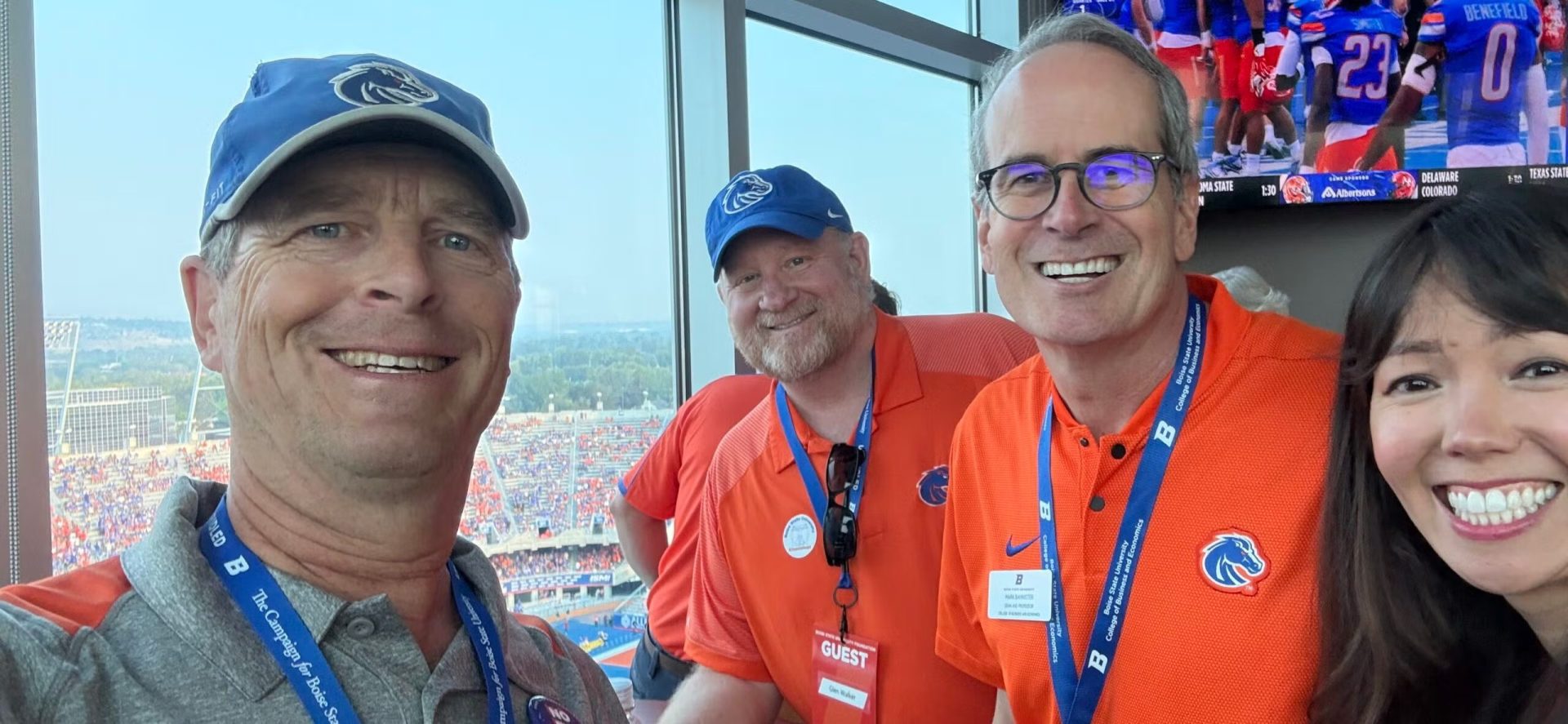
From left, Boise State professor emeritus and alum Jonathan Krutz, alum Glen Walker, College of Business and Economics Dean Mark Bannister, and Executive Director of Development Perrine Blakley attend a Boise State football game. (Photo courtesy of Boise State University) ‘Easily manipulatable’
Krutz gave an example. A hypothetical candidate named Rusty Baker is running for the Idaho Legislature. He’s raising money, putting up yard signs and talking to folks on the campaign trail.
Krutz said someone could go on a prediction market and bet that Baker will lose. And then they could do everything they can to derail his campaign.
“How much would it cost me to spread rumors about Rusty Baker, such that he drops out of the race or that he loses the race, versus how much do I stand to gain?” Krutz said.
In another example, Krutz said candidate Baker could file to run, launch a campaign and then bet on himself to lose. Baker could then drop out of the race.
“People are playing in this ‘quote-unquote’ market, thinking it’s a level playing field, that it’s a fair thing,” Krutz said. “It is absolutely not. It’s easily manipulatable, and there is no federal oversight. And the feds are saying that states aren’t allowed to regulate this either.”
Recent crackdowns
Several developments this week suggest the tides may be turning.
The two biggest players in the prediction market game are Polymarket and Kalshi.
Kalshi on Wednesday announced it had fined and suspended three congressional candidates who wagered on their own elections.
A day later, federal prosecutors released an indictment of a U.S. Army soldier who made $400,000 on a Polymarket bet on the military operation to capture Venezuelan President Nicolas Maduro. As several media outlets reported, the soldier was involved in the planning of the operation.
Idaho election markets
For a comedian’s take on prediction markets, check out John Oliver’s recent episode of Last Week Tonight.
The Idaho election with the biggest trading volume on Polymarket is the Idaho Democratic primary for governor, with a total of $80,000 in “predictions.”
“We won’t call them bets, but they’re bets, right?” Krutz said. “That’s what they are.”
Candidate Terri Pickens is the front-runner, according to predictions on Polymarket, with a total of $43,221 in bets for and against her.
But the candidate with the second most trading volume is not even a candidate. Stephen Heidt won the Democratic nomination in 2022, but he never filed to run for governor this year and is not on the primary ballot.
Still, there’s $35,601 in bets for and against him.
According to filings on Idaho Sunshine, Heidt in March of 2024 appointed a campaign treasurer for the 2026 governor race but has since terminated his campaign. The first Polymarket bet on his campaign was placed on Dec. 6.
When the Idaho Democratic Party learned of the Polymarket bet, the organization adopted a policy prohibiting staff members from betting on elections, according to a statement from spokesperson Avery Roberts.
“Idahoans deserve an open and transparent election process and representation, free from the financial self-interest of political insiders,” Roberts wrote in a message to EdNews.
On Kalshi, the Idaho election with the highest volume is the race for U.S. Sen. Jim Risch’s seat, with a total wagering of $42,211. Users can “predict” if a Republican or Democrat will win the seat in November.
State officials know about the markets
When reached for a comment on prediction market betting on Idaho elections, a spokesman for the Idaho Secretary of State’s Office said they are “aware of the existence of the platforms” but will defer to the Idaho attorney general’s office.
A spokesperson for Attorney General Raúl Labrador did not immediately respond to a request for comment this week, but Labrador last month addressed sports betting on prediction markets.
He said in a news release that Idaho has joined a 39-state coalition to challenge the Commodity Futures Trading Commission’s attempt to claim authority over sports betting and override state gambling laws.
“States like Idaho that choose to ban sports betting would be prevented from enforcing those bans under the CFTC’s theory,” Labrador said in the release.
A history of regulation, or lack thereof
Krutz provided some background and history on the CFTC and prediction markets in general.
Prediction markets and futures trading are not a new phenomenon.
“As a concept it’s been around for a while in a very tightly controlled box,” Krutz said. “With Kalshi and Polymarket, that box has exploded.”
In 1988, staff members at the University of Iowa — where Krutz earned a master’s degree in business — created a market to predict election outcomes for academic purposes.
“It was under threat multiple times because of very legitimate concerns that once you start allowing people to bet on elections, you create opportunities to corrupt those elections,” Krutz said.
But there are legitimate uses for futures trading. Krutz explained that a farmer in Idaho can sell a crop in advance and lock in a price to make farming a much less risky activity.
“To say that that situation is the same as me betting on whether a free throw is going to be made or missed — it’s absurd to say that those are the same thing,” he said.
When Kalshi and Polymarket began taking bets on elections during the Biden administration, Krutz said the CFTC attempted to investigate and regulate the markets. But things changed when President Donald Trump returned to office.
As Politico reported, Trump dropped the investigations into prediction markets. The president’s son, Donald Trump Jr., is now a strategic advisor to Kalshi and an investor and unpaid advisor to Polymarket.
“When the Trump administration came in, they just blew the doors off of it,” Krutz said.
There’s one factor that is often lost in these discussions on prediction markets, Krutz said. Betting is driven by addiction, and these companies are spending millions to promote their markets.
“Because of the massive promotion of it, people are trying it out and some of those people are getting addicted,” he said.
As board chair of Stop Predatory Gambling, Krutz said he thinks the prediction markets should be stopped until there are regulations in place and staff to enforce the regulations.
“There’s a reason why that has never been allowed before,” Krutz said. “It’s highly corruptible, and it shouldn’t be allowed now.”
Primary challengers are outraising incumbents in these legislative races
Sean Dolan | 04/22/2026
Money doesn’t win elections, but it certainly helps.
Most incumbents running in the May 19 primary have outraised their challengers, but that’s not the case in nine legislative races, according to an EdNews analysis.
Of those nine races where challengers are outraising incumbents, five are members of the hardline conservative Gang of Eight. The coalition opposes new government spending.
The most stark example of a challenger outraising an incumbent is in the District 8 race for House Seat B, between Gang of Eight member Rep. Faye Thompson, R-McCall, and Brian Beckley.
Beckley, who resigned in January as board chair for the Idaho Department of Parks and Recreation, has raised more than three times that of his opponent. Beckley has drummed up $47,617 to Thompson’s $15,730.
Meanwhile, folks in districts 24 and 25 are speaking with their wallets and siding with the challengers of three other Gang of Eight members, all Twin Falls Republicans.
- Brent Reinke is outraising Sen. Glenneda Zuiderveld.
- Alexandra Caval is outraising Rep. Clint Hostetler.
- Cherie Vollmer is outraising Rep. David Leavitt.
Another Gang of Eight member, Sen. Christy Zito, R-Hammett, falls behind former House Majority Leader Megan Blanksma by a $3,100 margin.
Here are all nine races where challengers have outraised incumbents, according to data on Idaho Sunshine as of 11:30 a.m. on April 22:
District/Zone Incumbent Challenger(s) D7 House A Rep. Kyle Harris: $13,919 Michael Collins: $14,557 D8 Senate Sen. Christy Zito: $16,940 Megan Blanksma: $20,100 D8 House B Rep. Faye Thompson: $15,730 Brian Beckley: $47,617 D24 Senate Sen. Glenneda Zuiderveld: $51,117 Brent Reinke: $52,763 D24 House A Rep. Clint Hostetler: $28,598 Alexandra Caval: $35,187 D24 House B Rep. Steve Miller: $4,000 Chance Requa: $6,350
William Mostoller: $4,540
D25 House B Rep. David Leavitt: $21,855 Cherie Vollmer: $30,960 D28 House A Rep. Rick Cheatum: $25,645 James Lamborn: $27,301 D31 House B Rep. Rod Furniss: $25,710 Karey Hanks: $32,481 Here’s how to see your Idaho sample primary ballot before Election Day
Sean Dolan | 04/15/2026
Idahoans can view their specific sample ballots at VoteIdaho.org ahead of the May 19 primary election.
Secretary of State Phil McGrane laid out the three-step process to view a sample ballot in a Wednesday social media post:
- Go to VoteIdaho.org and click “Find Your Sample Ballot.”
- Enter your voter information.
- View, save or print your sample ballot.
“Sample ballots list all candidate races and measures that will appear on a voter’s specific ballot, so voters can make informed decisions before casting their ballot,” McGrane posted on X. “In Idaho’s primary election, a voter’s party affiliation determines which ballot they are eligible to receive.”
Bookmark EdNews’ Elections webpage for in-depth election news ahead of the election. For more breaking news and updates, follow our Ballot Beat blog.
New fundraising totals reveal biggest legislative war chests
Sean Dolan | 04/13/2026
Idaho legislative candidates have raised a combined $2.38 million and have a combined cash balance of $3.57 million, according to campaign finance data in Idaho Sunshine as of Monday.
Idaho candidates must submit campaign finance reports on the 10th of each month for the previous month. The March reports show that seven of the top 15 fundraisers for legislative races don’t have a primary opponent. They are amassing war chests for less competitive general election races.

Rep. Steve Berch, D-Boise, on the House floor on Wednesday, March 4, 2026. Berch has the largest war chest among all legislative candidates. (Sean Dolan/EdNews) In the seven statewide races, only Gov. Brad Little has primary challengers. Mark Fitzpatrick has the largest war chest among Republican challengers, but independent candidate John Stegner has outraised him. Democrat Terri Pickens is the top Democrat in terms of money raised.
Here are the top 15 legislative fundraisers and all of the gubernatorial candidates who have reported contributions.
Top legislative fundraisers
Candidate Total contributions Total cash balance Opponent(s) Rep. Steve Berch (D-Boise) $157,435 $164,855 No primary. General: Steve Keyser (R) Rep. John Shirts (R-Weiser) $91,255 $102,714 Heidi Smith-Takatori (R) Scott Herndon (R, District 1 Senate Candidate) $74,078 $36,946 Sen. Jim Woodward (R) Sen. Kelly Anthon (R-Rupert) $72,022 $50,464 No primary. General: Margo Saunders (D) Sen. Jim Woodward (R-Sagle) $67,101 $60,785 Scott Herndon Rep. Mike Moyle (R-Star) $63,549 $74,479 No primary. General: Michael Hofferber (D) Sen. Scott Grow (R-Eagle) $57,950 $134,658 Mac Raslan (R) Sen. Melissa Wintrow (D-Boise) $55,793 $55,963 No primary. General: Melissa J. Christian (R) Sen. Treg Bernt (R-Meridian) $54,411 $105,984 No primary. General: Brenda H. Quick (D) Sen. Glenneda Zuiderveld (R-Twin Falls) $51,117 $35,864 Brent Reinke Sen. James Ruchti (D-Pocatello) $46,275 $27,406 No primary. General: John Crowder (R) Sen. Lori Den Hartog (R-Meridian) $44,850 $63,961 Josh Haver (R) Rep. Jason Monks (R-Meridian) $44,600 $50,790 No primary. General: Amanda Easley (D) Sen. Camille Blaylock (R-Caldwell) $43,011 $33,246 Chris Trakel (R) Brent Reinke (R, District 24 Senate Candidate) $42,763 $27,606 Sen. Glenneda Zuiderveld (R) The governor’s race
Candidate Total contributions Total cash balance Gov. Brad Little (Republican) $1,646,197 $1,330,312 John Stegner (Independent) $149,483 $148,497 Mark Fitzpatrick (Republican) $112,979 $44,211 Terri Pickens (Democrat) $88,847 $26,257 Maxine Durand (Democrat) $4,911 $1,557 Justin Plante (Republican) $3,668 $146 Jill Christina Kirkham (Democrat) $755 $755 Paul Sand (Libertarian) $310 $2 Melissa Sue Robinson (Libertarian) $300 $0 Chanelle Torrez (Democrat) $0 $300 Key: Incumbents in bold, Republicans in red, Democrats in blue, Libertarians in yellow and unaffiliated candidates in green.
Out-of-state money pours into Idaho legislative races
Sean Dolan | 04/09/2026
An Idaho political action committee funded by a massive out-of-state donation has spent $135,291 to support 15 legislative candidates ahead of the May 19 primary.
The Citizens Alliance PAC filings give Idaho voters a first glance at how the PAC, registered in Hayden, is spending some of its $450,000 in contributions from the Citizens Alliance super PAC based in Virginia.
All incumbents the PAC is supporting voted in favor of the $50 million Parental Choice Tax Credit last year. All of their opponents who were in office last year voted against the bill.
Here’s the list of who the PAC supports:
Supported candidate Independent expenditure support Primary opponent(s) Rep. Josh Keyser $36,653 Russ Spencer, Richard Marsh Rep. Barbara Ehardt $25,165
Connor Cook Kelly Golden $15,117 Rep. Stephanie Mickelsen Brian McKellar $15,117 Rep. Erin Bingham Rep. David Leavitt $7,925 Cherie Vollmer Sen. Josh Kohl $7,925 Casey Swensen Andrew Messer $7,925 Grayson Stone, Zaine Newberry, Josh Callen David Worley $5,348 Sen. Jim Guthrie James Lamborn $5,348 Rep. Rick Cheatum, Mike Saville Rep. Elaine Price $3,404 Christa Hazel Karey Hanks $2,682 Rep. Rod Furniss Julianne Young $1,269 Rep. Ben Fuhriman Rep. Rob Beiswenger $707 Sean Hall Rep. Faye Thompson $354 Brian Beckley Sen. Christy Zito $354 Megan Blanksma, Terry Gestrin Click here to view our previous reporting, detailing the PAC’s funding and the pledge it asks candidates to sign.
Idaho attorney general endorses challenger in race against Sen. Guthrie
Sean Dolan | 04/08/2026
Idaho Attorney General Raúl Labrador has endorsed David Worley, a District 28 Senate candidate, in his Republican primary bid against Sen. Jim Guthrie, who is seeking a ninth term in the Legislature.
Worley is a major in the Idaho National Guard. He ran for Senate in 2022 but lost in the general election to Sen. James Ruchti, D-Pocatello.

Idaho Attorney General Raúl Labrador In a press release, Labrador said Worley will fight for Idaho families, support strong border security and hold government accountable.
“Voters are tired of politicians who campaign one way at home and govern another when they are in Boise,” Labrador stated. “David is different. He’ll bring integrity, courage, and common sense to the Senate. I encourage Republicans in District 28 to support David Worley on May 19.”
Guthrie, R-McCammon, was first elected in 2010. He chairs the Senate State Affairs Committee and has faced criticism this session from hardline Republicans for not allowing hearings on immigration bills. Guthrie tops the Stop Idaho RINOs PAC list of Republicans who vote with Democrats.
In response to an EdNews candidate survey, Worley wrote Idahoans deserve honest government where bills are heard in public.
“In Boise, too many decisions are controlled by procedure and closed-door gatekeeping, and that undermines trust,” Worley wrote. “I am running to uphold immigration law, defend Idaho family values, and restore integrity and transparency so the people’s business happens in daylight.”
Worley submitted responses to the EdNews candidate survey, but Guthrie has not. Neither Worley nor Guthrie have responded to multiple requests for phone interviews for an election profile.
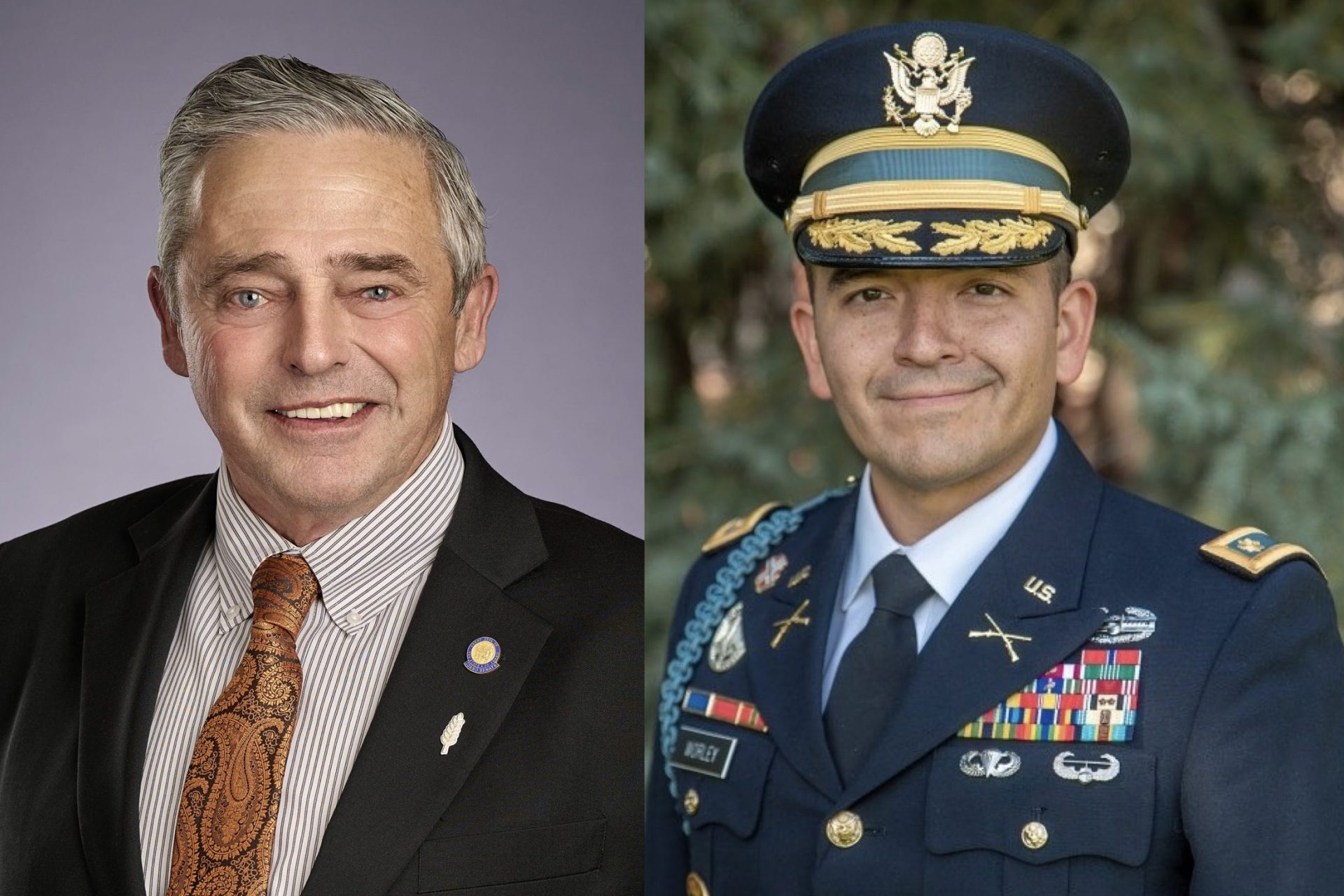
Jim Guthrie and David Worley On his campaign website, Worley stated that he believes “Cultural Marxism” has no place in public schools, and schools should not “promote hatred of their nation.” He is committed to driving “radical Leftist ideology” from Idaho’s education institutions.
Also on his website, Worley said Christian morality is the “foundation of Western Civilization” and the state plays a legitimate role in supporting public and private morality.
If elected, Worley has committed to banning the use of government resources to “advance the LGBTQ agenda or support sexual immorality generally,” according to his website.
Worley in January 2025 filed a religious discrimination lawsuit against leaders of the Idaho National Guard. U.S. District Court Judge David C. Nye dismissed the suit in February.
According to the lawsuit, Worley claimed leaders of the Idaho National Guard affirmed a “No Christians in Command” policy.
Nye, in a memorandum and order to dismiss the case, wrote that it’s not clear to the court that such a policy exists.
Click here to read Worley’s lawsuit and here to read Nye’s order to dismiss.
Guthrie’s history
Guthrie is a former trustee for Marsh Valley School District and former Bannock County Commissioner. According to his website, he champions the principle that local governments know their communities best.
He voted against the $50 million Parental Choice Tax Credit last year and prioritizes “robust funding and support” for Idaho schools, according to his website. That means pushing for “restored and increased” education budgets.
In 2023, he was a legislative co-sponsor of the bill that established the Idaho Launch grant program for graduating high school seniors.
On social issues, Guthrie was the sole Senate Republican who voted last month against a bill that regulates which bathrooms transgender people can use.
The Latest
-
Teachers’ union endorses Critchfield for state superintendent
-
PAC spending reveals top three battleground seats for Republicans
-
Rep. Redman has contributed over half a million dollars to his PAC this year
-
Complaints prompt McGrane to remind political advertisers to follow campaign finance rules
-
Jerome gadfly questioned Valley School District levy. We fact checked his argument.
-
Prediction market platform gives Labrador campaign $5,000 amid Idaho betting dispute
-
See who has the most cash ahead of Election Day
-
School choice super PAC endorses Gov. Little
-
Democratic National Committee chair to visit Idaho for weekend campaign events
-
Moyle PAC supports Republican incumbents