Editor’s note: EdNews received more than 1,200 emails — sent to and from West Ada district leaders and teacher Sarah Inama between March 10 and March 25 — via a public records request. West Ada trustees and administrators have declined interview requests on the classroom sign controversy, but the emails provide new insight on what transpired behind the scenes.
A bulletin board at Seven Oaks Elementary — featuring rainbows, international flags and different skin tones — became ground zero for a controversy that would soon engulf the West Ada School District.
At least one parent took to social media to criticize the bulletin board, then complained about it to a trustee and a principal, and soon it came down.
It could have ended there.
Instead, West Ada district leaders decided that such displays should come down across the district, based on a policy that was created in 2022 that says classroom flags, banners, posters, signs or photos should be “content neutral and conducive to a positive learning environment.”
In a March interview on The Ranch Podcast, West Ada Trustee Dave Binetti said the policy was created amid patron concerns about politics in the classroom. The goal, he said, was to “maintain the focus on education” and “protect our teachers so they can teach. The last thing we want to do is have our teachers become the center of a controversy, right?”

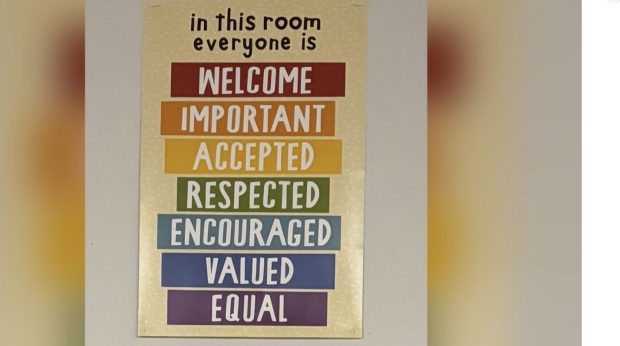
But that’s exactly what happened when Sarah Inama, a sixth-grade teacher at Lewis and Clark Middle School in Meridian, defied her principal’s order to remove a sign saying “Everyone is Welcome Here,” which featured hands of different skin colors.
Inama went to the media with her story, which ballooned and garnered national attention, spawned protests, and inspired hundreds to write to her and district leaders. Nearly all the communications were in support of Inama, according to emails obtained by Idaho Education News through a public records request.
But still, district leaders have not publicly backed down from their position, even as they have become embroiled in the exact type of controversy they sought to avoid.
Parent pressure sparked classroom sign controversy
In January, a bulletin board promoting inclusivity was taken down at Seven Oaks Elementary after parents criticized it on social media, as the Idaho Statesman reported.
Images of the bulletin board were circulated online “in an effort to stir controversy and pressure the district,” Niki Scheppers, West Ada’s spokesperson, told EdNews in an April email.
Concerns about the display were also shared with Binetti and Seven Oaks administration.
“These incidents reflect the growing scrutiny placed on schools for decisions regarding educational materials and classroom environments,” Scheppers said.
Because of the Seven Oaks incident, Marcus Myers, West Ada’s chief academic officer, asked school principals to “open your eyes to what’s hanging on the wall,” according to an interview Myers gave on The Ranch podcast. Myers has declined all other interview requests about the classroom signs, including from EdNews.
Monty Hyde, the principal at Lewis and Clark Middle School, then asked Inama to take down her signs, which promoted inclusivity and included multiple colors and hands with different skin tones.

Emails reveal back and forth between Inama and principal about sign removal request
On Feb. 5, Inama emailed Hyde, asking for further explanation on why she was asked to remove the signs, and whether it was sparked by a complaint.
Hyde said that nobody complained and she was “not the only person … visited with.” He shared policy 401.20.
West Ada leaders have repeatedly said all are welcome at their schools. Still, they found Inama’s sign inappropriate. An administrator explains why
Note: Myers has declined EdNews’ requests for interviews. He has only consented to one media interview on the sign controversy, which was with The Ranch Podcast.
Myers, West Ada Superintendent Derek Bub, and other district leaders have reiterated multiple times privately and publicly that West Ada does welcome all students. However, Myers maintains that Inama’s sign violates school policy.
In an interview with The Ranch Podcast, Myers said the main issue with Inama’s sign was not the “spirit of what’s on the poster” but the “interpretation of the visual images.”
Myers said if Inama’s sign said simply “Everyone is welcome here” without the image of hands of different skin colors, that likely would have been acceptable.
Myers reiterated multiple times that the determining factor on the sign’s appropriateness came down to this question: “Is it tied to curriculum?” In this case, he said it was not.
In an April interview with EdNews, Inama acknowledged that the sign doesn’t have strong ties to her sixth grade world civilizations curriculum. But she pointed out that school policy allows for motivational posters, and felt hers fit into that category.
Plus, she said teachers are evaluated on their classroom environment, including whether students know “that their teacher embraces their different backgrounds and lives outside of school.” Inama said she has earned a distinguished score in that category — the highest possible evaluation — multiple times.
Teachers are evaluated according to the Charlotte Danielson Framework for Teaching. You can take a look at a version of the rubric here.
Inama asked for further clarification on which part of the policy it violated. Hyde did not write back. With the issue still on her mind, Inama went into school on a Saturday and decided to put the sign with the hands of different skin colors back up.
She emailed Hyde to let him know.
“I’ve lost quite a lot of sleep over this matter and have struggled with it deeply,” she wrote.
Inama said she deeply regretted taking down the sign because of the message it could send to her students: “I would die to know that any student felt like I had changed my stance on that.”
The request to remove her sign “goes against everything that we work towards and the type of community that we dream to have at our school. Is not everybody welcome here?” she wrote.

“We (help students learn) by making them feel safe,” Inama wrote. “We do that by making sure they have food. We do that by building relationships with them. And, most importantly, we do that by making sure that they know that they are all welcome there and we want them here … With that being said, I have put my sign back up.”
The following Monday, Hyde told her putting the sign back up was an act of insubordination, Inama said in a phone interview. Still, she declined to remove it. Hyde said he would have to get others involved.
On Feb. 13, Inama met with Hyde and Myers about the sign and shared her viewpoint. That same day, Hyde forwarded Inama’s Feb. 8 email — written the Saturday she put back up her sign — to Myers, who sent it to Amy White, the district’s legal counsel, and Renee Senander, the district’s chief human resources officer.
Myers then emailed Inama and asked her to share her perspective with White on “the poster, its purpose” and its alignment with school policy.
“Interpreting the policy to suggest that posters promoting inclusion should be taken down inadvertently conveys a message that the district prioritizes the protection of exclusionary views over the celebration of diversity,” Inama wrote in her statement, which can be read in full here.
She said her sign didn’t clearly violate district policy, which allows for “displays that aid in creating a positive learning environment.”
If the district policy said something more clear, Inama wrote, such as “‘We believe that messages of inclusion & diversity with an emphasis on marginalized groups/ those of different races constitute as a political or personal view and not the overall view of the district, and therefore are not allowed.’ …then this poster would be a clear violation of policy, and I would have never applied to work at this school district in the first place.”
On Feb. 25, Myers wrote back to say that the district’s general counsel and administration reviewed the poster and determined it conflicted with “the intention” of school policy and Idaho Code — a 2021 state law banning critical race theory in K-12 and higher ed classrooms.
Myers instructed her to work with Hyde to “find a replacement (for the sign) before the beginning of next school year.”
Hundreds write in to district, opposing sign removal request
On March 11, KTVB aired reporter Brian Holmes’ interview with Inama about the incident. In the days and weeks to follow, the story was picked up by statewide and nationwide news outlets.
And emails began raining down on district-level administrators. The overwhelming majority supported Inama and called on the district to change its stance. At least 240 emails, sent to district administrators and/or trustees between March 10 and March 25, opposed the sign removal request.
The emails ranged from angry name-calling to level-headed calls for change. Many asked for the policy to be reconsidered, and for explanations about how the sign violated policy or why administrators sought its removal. Others called on Myers to resign, or said that they would not vote for current trustees in the future.
The emails came from students, parents and community members, as well as individuals nationwide. Many were from Idaho residents with connections to education and/or West Ada School District.
West Ada administrators received emails from hundreds of people. Here’s what some of them said.
“I am a sixth grader attending IFAA,” one email said. “I am disappointed to hear that an inclusive sign is taken down. I don’t think it should be against district policy. All races should be welcome.”
Tracy Roberts, a Meridian resident whose three children went to West Ada schools, said she had been happy with the district in the past but was “heartbroken” over recent actions.
“Opposing this sign is giving validation to the idea that racism is okay and tolerated,” she wrote. “Schools should be safe places for all children, not just white children.”
Bonnie Reed, a West Ada parent, said she has stood up for the districts in conversations “many times over the years,” but said the recent controversy was “hugely disappointing and embarrassing to me.”
“I am embarrassed that my kids are in a school district that is willing to imply that some are not welcome here,” she wrote. “I am embarrassed that the leaders in this school district are so worried about political opinions here locally that they would stoop this low to avoid ‘anything questionable’”.
Reed urged the district to “do the right thing” and said she stood by Inama.
Derek Bub, the district superintendent, trustees, and district-level administrators all received emails. But Myers, who was mentioned by name in the KTVB coverage, received the most.
Myers answered the emails with two boilerplate responses — you can read them here. A handful of people complained about the impersonal, form responses they received.
“Thank you for the form letter,” Tim Ward wrote to Myers. “I imagine you’re much too busy to care to respond to individual comments. However, I already knew what Policy 401.20 said, so there was probably no point in me writing to you or you shovelling out electronic form letters in an attempt to show that you care.”
About a dozen emails offered support to the district amid the media coverage and ensuing fallout. Most were from West Ada staff members and most went to Myers.
“I’m so sorry for the nasty storm going on presently,” wrote Glenna Newby, an assistant principal intern at Lowell Scott Middle School. “Know that you are a remarkable leader — and delightful to work with … Know that all will be well.”
“I can’t tell you how much I appreciate this,” Myers wrote. “It means the world to me.”
“Hey Marcus, just wanted to uplift you and say—keep pushing forward good change is always hard work! Keep up the great work!” wrote Ro Golden, an assistant principal at Meridian Middle School.
“This means the world and I appreciate you so much,” Myers replied.
In his interview on The Ranch Podcast, trustee Binetti said that parents of West Ada students “as best as we can tell, are largely saying ‘Yeah, that’s the right policy.’”
Ed News saw three emails from West Ada parents that indicated support for the sign removal or opposition to the message “Everyone is Welcome” among the hundreds of emails reviewed.
Inama receives 140 plus messages of overwhelming support — and only one that’s critical
Inama was getting emails, too.
In the two weeks following the KTVB story, Inama received at least 140 emails, and all but one were supportive. Many came from teachers and other school staff — including some from West Ada School District, other districts in Idaho and nationwide.
“Teachers at our school appreciate you!” wrote Dan Vincent, a teacher at Seven Oaks Elementary, where the inclusive bulletin board was taken down. “We recently went through a similar situation not too long ago. Way to go!”
“As a retired teacher and administrator (elementary principal) in the West Ada School District for 25 years, I stand with you in your response to district and school administrators,” wrote Jackie Meyer. “They are so wrong on this issue … Had I been your principal, I would have stood with you to the end.”
Current and former students sent her messages of thanks, as did local parents and grandparents, and strangers from around the world.
“I remember being in your classroom on the first day of 6th grade just looking around the class, looking at those posters, and feeling welcomed and safe,” wrote Sadie Morales Lopez, a student at Renaissance High School and former student of Inama’s. “Your attitude and welcoming energy have never been met in another classroom I’ve stepped foot in. I am glad you stood your ground and decided to put the posters back up.”
“Thank you for standing up against bigotry and hate,” wrote Hannah McNamee, a former Lewis and Clark Middle School student. “Your students see your fight, and there are many who will never, ever forget what you’ve done for them.”
“I wanted to take the time to thank you for your advocacy and inclusion efforts,” wrote Tara Dennis. “As a black mom of two daughters in (West Ada School District), I am afraid of what could be coming down the pike not only in this school district but with this state as far as discrimination and hate. Take care and be safe.”
Alaisa Phithak said she grew up in Boise and went to public schools. “Without teachers like you, I would have felt like I never belonged in a room full of predominantly white children,” she wrote. “As a minority student, teachers like you helped me feel safe, included, and comfortable in the classroom.”
Inama also received an email from Trustee René Ozuna.

“I hope this email is buried in a pile of support,” she wrote. “I’d love to meet with you about why I supported our policy … Thanks for all you do for our students.”
As public outrage grew, feedback magnified from emails to protests.
Chalk the Walk protest flared tensions among Seven Oaks Elementary parents
On March 13, just days after KTVB’s interview with Inama aired, dozens of students and stakeholders participated in a walkout to “spread the word that kindness is not political,” Finn Angelopoulos, a senior at West Ada’s Renaissance High School, told EdNews.
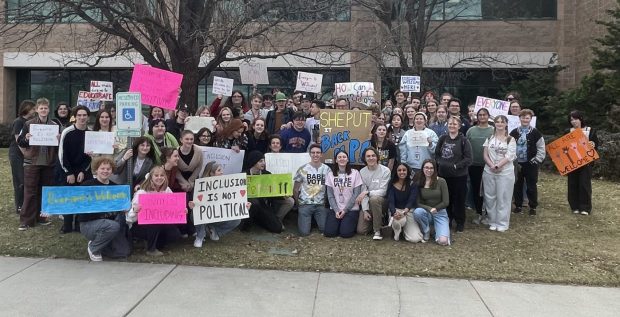
Then on March 23, community members and stakeholders participated in a “Chalk the Walk” protest that involved writing messages on sidewalks and in parking lots at schools throughout West Ada with messages supporting inclusivity and using language from Inama’s signs.
At Seven Oaks Elementary, where a bulletin board on inclusivity was taken down after parents criticized it online, the chalk messages fueled tensions among parents and patrons at the school.
On March 24, April Maniscalco emailed Allie Jacobs, the principal at Seven Oaks, Bub, Binetti and several City of Eagle officials to complain about “unauthorized spray painting” at the elementary school.
“It has come to my attention that two parents sprayed “Everyone is Welcome Here” and rainbow symbols on the sidewalk in front of the school,” she wrote. “I am concerned about the legality of the act, as it involves unauthorized spray painting on public property.”
She requested clarification on “whether these local laws will be enforced in this case, and whether the parents who carried out the act may be held liable for any potential violations.”
Later, Maniscalco wrote that she had called the police and they were heading to the school.
Brittany Bieghler, who said she has two children at Seven Oaks, also wrote in to complain.
In an email to Bub, Jacobs, and trustees, she said that when she dropped off her children she couldn’t help but notice the message “Everyone is Welcome” written in large letters. She said the message represented “political ideology” and should not appear on school grounds.
“The ‘Everyone is Welcome’ slogan is one filled with marxism and DEI, there is no need for those statements because anyone with a brain knows that everyone is welcome to attend school, so there is no need to have it posted, written or worn on school grounds,” she wrote. “My family and I relocated here from a state that did not align with our beliefs and we expected it to be different here, but it seems as time goes by, its becoming more like our former state, which is extremely disheartening.”
Bieghler requested the chalk writings be removed “just as the teacher was asked to remove her sign.”

Three other Seven Oaks Elementary parents also wrote in with complaints to the district, but theirs were about two adults upset about the chalk writings who were yelling insults to other adults as they were dropping off children.
Myesha Tegen wrote in an email to Myers, Bub and Binetti that she was dropping off her children at Seven Oaks on March 24, when she saw two mothers “loudly and aggressively berating other parents for wearing ‘Everyone is Welcome Here’ shirts.”
Tegen said the mothers called others a series of names, including “moron” and “dyke.”
“I took out my phone to record, not to escalate, but because I was genuinely afraid. I didn’t know what they were capable of,” she wrote. “And honestly, I still don’t.”
Tegen said she is a mother of non-white children at the school, and is now “deeply concerned for the safety of my family.”
She called on the district to break its silence, address her concerns and lead.
Kate Winegar also wrote in to share her concerns about the patrons yelling in front of the school that day. Winegar said three of her children attend Seven Oaks, and when she went to drop them off, two women were yelling insults at others.
“I left the school feeling very concerned for our school community, and more importantly the children at our school,” she wrote. “I think we can all agree these women were out of line … I worry that they feel they are justified because of the district’s recent orders for a teacher to remove her classroom sign.”
She urged the district to reconsider its decision regarding Inama’s sign.
The controversy didn’t end there
While some patrons complained that some chalk messages remained Monday, others were unhappy that district staff had washed off many.
The situation made headlines. “Chalk markings on sidewalks on our campuses were washed off intentionally to prevent the material from being tracked inside and potentially damaging carpets and other interior surfaces,” Scheppers, the district spokesperson, wrote in an email to EdNews at the time. “Chalk art in parking lots and parking stalls was not removed and remains in place, along with any paint markings.”
Kevin Starcher wrote in, unhappy with the district’s response.
“While I’ve not agreed with your decision about this situation from its conception, today is the first time I’ve felt embarrassed by the West Ada School District,” Starcher wrote. “You are quickly losing the trust of common-sense, moderate voices in our community who simply want our children to succeed in a dynamic social environment that has, since the inception of our nation, valued the freedom of speech. “
Starcher said the negative press the district was receiving was “entirely self-inflicted.” He criticized the district’s public relations staff and process, and said it would have long-term impacts.
“The reputation of our district is being called into serious question with ramifications that will be felt for the next decade or more (losing quality teachers, forcing people like me who have long-historically supported public schools to consider alternatives, etc.),” he wrote. “Public schools need all the help they can get in this current political climate, yet the actions of this administration are not helping this common good.”
On March 24, when the district’s erasure of Chalk the Walk messages was making headlines, many were wearing “Everyone is Welcome” shirts in support of Inama and inclusivity — including administrators at the neighboring Boise School District.
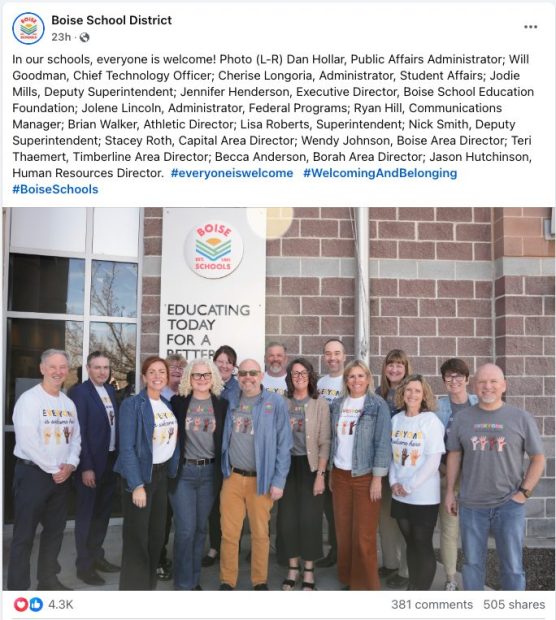
Some teachers at West Ada’s Eagle Middle did as well, according to parent Tabitha Butler who wrote to Bub with a list of their names.
“This is completely unacceptable for teachers to be wearing anything that shows their political or personal views,” she wrote. “I would like these teachers wrote up.”
Amid all this, district leaders were saying very little — at least publicly.