
When leaders learned North Idaho College returned to good standing with its accreditor last month, one word summed up their feelings: relief.
It’s the first word Board of Trustees Chair Tarie Zimmerman and Vice Chair Mary Havercroft thought of. Even President Nick Swayne felt it.
And while the moment last month was technically when the college was pulled from the precipice of closure by the Northwest Commission on Community Colleges and Universities, many faculty, students, and staff believe the fate of the college was decided more than a year earlier, on Nov. 7, 2024.
That’s when three new trustees were elected to replace a group of trustees that fired multiple university presidents, tripled the college’s athletic budget, and received a series of no-confidence votes from campus groups.
“Immediately after the November election, we knew everything was going to be fine,” Jonathan Gardunia, chair of the college’s faculty assembly. “It was just like a sigh of relief that you could almost feel as you walked down the halls.”
A year of probation later, and the college is back in good standing with its accreditor, enrollment is up 17% over the last two years, 120 new staff members have been onboarded, and new initiatives like a classical general education program are about to launch.
The college is back on track, but did the community learn a lesson?
“I’m leery,” Gardunia said. “There’s no guarantees that it couldn’t happen again.”
Chaos culture
The NWCCU first began investigating the college in 2021, after a complaint by local human rights groups.
A conservative group of trustees — including Greg McKenzie, Mike Waggoner, and Todd Banducci — fired former president Rick MacLennan without cause the year before.
In February 2022, the board was described as “dysfunctional” by the NWCCU, and by April, the college was sanctioned with a warning.
What followed was years of explosive meetings, trustee resignations and lawsuits.
For a full recounting of the issues, see the Coeur d’Alene Press’s timeline of events.
“Things were pretty bad for me for two and a half, three years. That doesn’t go away overnight,” Swayne said. “So I think just as things have restored, you know, calm has restored, good governance has been restored.”
For Swayne, the year of probation was scary because there was no backup plan. The college legally had to be back in good standing this fall.
“This year, if we didn’t get put back in good standing, we were done,” Swayne said.
But Swayne felt like the college was largely on the right track, so he didn’t want to spread his anxiety.
“We tried not to make it a big pressure thing with anybody, staff and faculty, or with the trustees, because everybody was doing what they were supposed to be doing,” he said. “So there’s nothing else you can do.”
Elements of a normal mid-cycle review were included in the college’s October visit from the NWCCU, an encouraging sign, Swayne said.
Then, when Zimmerman, Swayne, and Trustee Brad Corkill were in Washington, D.C., for an Association of Community College Trustees conference earlier this month, they logged into a Zoom trustee meeting and heard the words they’d been waiting for — NIC was back in good standing.

Colleagues connected
Gardunia, who has worked as the program director at the Idaho Consortium for Physical Therapist Assistant Education since 2017, took on a leadership role in faculty assembly because of the board’s behavior back in 2022.
“I felt like we had this out-of-control board of trustees that was trying to take away my livelihood and for me it was personal,” Gardunia said. “I felt like my only option was to step into a role on the front lines protecting my college and my job.”
For years, a constant cloud of uncertainty hung over the college, he said.
Gardunia and his colleagues tried hard to shelter students from the uncertainty. They wrote NWCCU-required teach-out plans, so students could go to another accredited school to finish their program.
The sheltering worked, said Blake Sanchez, 20, who serves as the NIC student body president.
“I don’t even think I heard anyone mention it my first semester here,” said Sanchez, who started at the college in the spring of 2023.
He joined the student government days after the group made a vote of no confidence in the trustees.
In the months that followed, Sanchez and his colleagues attended meetings on teach-out plans and moderated trustee candidate forums. During that time, he learned more about the college and accreditation.
“Talking to everyone and just learning how vital and important this college is and everything we provide to the community and the economy around us, to lose that everything we have here for the reasons that it was in danger just was ridiculous in my mind,” Sanchez said.
After the 2024 election, the issue was viewed on campus as largely resolved. The average student in 2026 likely knows very little about the accreditation issues, he said.
The lasting mark on the college is evident to students, though, in how connected their professors are, Sanchez said.
“We know who we trust. They call it trauma bonding,” Gardunia said. “We’ve been through something as a faculty where we had to come together to unite, and we did. It’s actually really nice.”
Future focus
Part of moving forward is learning from the past.
Zimmerman serves on the public policy and advocacy committee for the Association of Community College Trustees. She said the role is part of a turnaround — from governance issues to recognition for strong policies that other colleges can use as a model.
As the new board chair, Zimmerman’s focus has been “making sure that everybody has an opportunity to speak and to be heard.”
The trustees moved public comment back to the beginning of their meetings and set expectations for civility and structure, she said.
That has allowed Swayne to focus on his goals for NIC, which were paused during the heat of the accreditation issues.
“We basically were in a holding pattern,” he said.
He wants to increase the college’s enrollment to 5,000 students. When his staff was able to start recruiting in the fall of 2024, there was a 15% jump in enrollment.
Fall 2025 enrollment, 4,666 students, marks a 17% increase over the last two years.
During the accreditation issues, it was a struggle to hire for most positions at the college.
“Particularly for senior positions, where you’ve got to move across the country to come, you look in the paper and people Google, you know, ‘What’s going on at NIC?’” Swayne said. “And they see it’s like a dumpster fire.”
There were 40 applicants for provost this fall, compared to five applicants a few years ago. Salaries are back up to competitive levels, Swayne said, after an 8% increase in 2023 and cost-of-living raises the following two years.
Since May, the college has hired 120 new staff members.
There have also been painful cuts. Under the prior board majority’s leadership, the college left the regional Northwest Athletic Conference and joined the larger, National Junior College Athletic Association.
“That was a pretty expensive transition,” Swayne said.
The budget went from $2 million per year to $6 million. Coaches were offering unlimited scholarships, including for international students.
To right-size the budget, trustees cut the college’s golf teams last fall and reduced coaches’ scholarship budgets to get back down to a $4 million-per-year budget.
Swayne said the cuts were painful, but he hopes the result is more regional athletes playing for NIC.
“As a community college, our athletic programs should support our community,” he said.
‘Can’t take your eye off it’
Why all this happened is still partially unclear to Swayne but he wants the community to know the crisis was real.
“It was not a manufactured problem,” Swayne said.
Former trustees and Kootenai County Republican Central Committee Chair Brent Regan have argued that the accreditation issues were a pushback to the former board majority ridding the college of diversity, equity, and inclusion practices.
The KCRCC endorsed candidates who lost last fall ran under a slogan of “Make NIC Great Again.”
But Swayne sees the issue differently.
The former board majority “created an incredible amount of turmoil that was unrelated to any of the national issues,” Swayne said. “It was not DEI, it was not woke, it was not any of that.”
The former trustees never brought specific systemic issues to his attention, Swayne said. That perception remains out there in the community, though, Swayne acknowledges, and two trustee seats are on the ballot in November.
“I think the community has learned they can’t take their eye off of it,” Swayne said.
They don’t plan to, according to Christa Hazel, who helped found the nonprofit Save NIC.
“We will always be around to provide information,” she said.
That information might look different, like the celebratory Facebook post earlier this week featuring stickers that read “straight outta show cause” and “NIC Endured.”
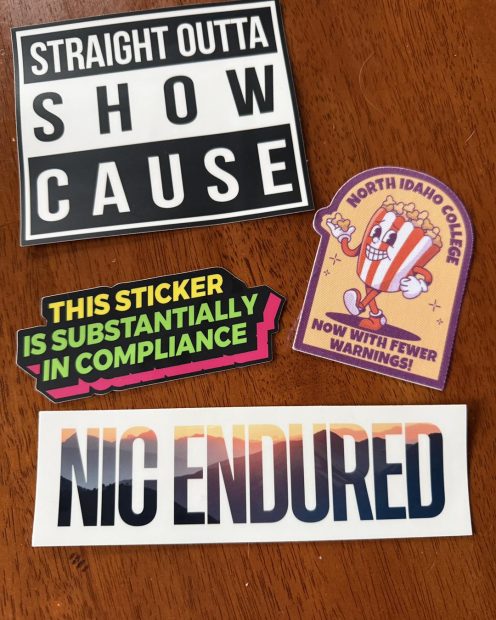
“If there is an attempt to try this again, to take the college in a different direction, then I would imagine there would be a desire to engage,” Hazel said. “Right now, it’s just more sharing the good news that’s happening at the college.”
Havercroft hopes the community can maintain its momentum of taking an interest in the college.
“We’ve all worried about who might run or what that might look like and what their motives might be,” Havercroft said. “I hope we’re able to work together to convince the voters that they need to choose people who have the college at the heart of their service.”

