
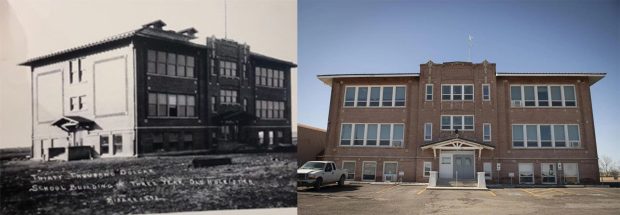
In the remote ranching community of Hollister, Idaho, 20 miles southwest of Twin Falls, the local public school has served as an anchor for the community since its construction in 1912.
In many ways it’s the community center, hosting monthly hoedowns, Fourth of July picnics, and Christmas gatherings that draw every resident within miles.

When the Filer School District faced budget pressures that threatened to close this vital community institution, one woman’s determination to preserve the school that had educated her family for generations sparked an innovative solution: converting the district-run Hollister Elementary School into an independent public charter school.
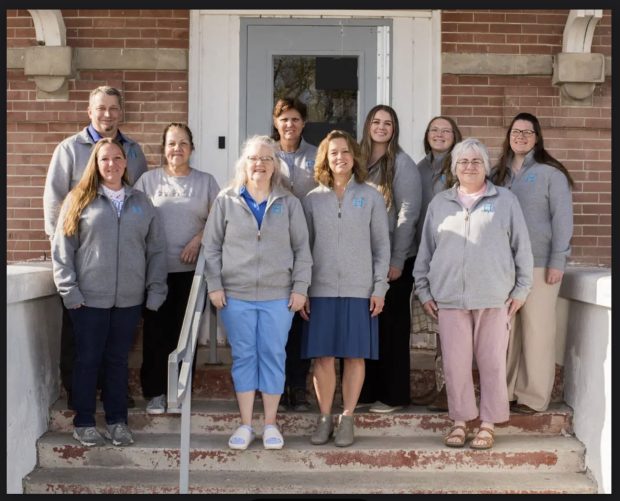
The kindergarten through sixth grade Hollister Charter School opened as a public charter school in early September with about 65 students, thanks in large part to Julie Koyle’s persistent efforts and advocacy. Koyle’s family was among Hollister’s original homesteaders, and generations of her family, including her father, aunts, uncles, and grandmother, attended Hollister Elementary.
After raising her own children in nearby Filer and spending years immersed in education as a para-educator, coach, and school board member, Koyle couldn’t stand by and watch the school that defined her community face closure.
“I have deep roots there,” Koyle said. “I know how important the school is to Hollister.”
A partnership born of necessity
The conversation about Hollister’s future began in 2020, when Koyle was serving on the Filer School District board. With enrollment hovering between 50 and 60 students, the economics of maintaining the remote school (15 miles from Filer) were increasingly difficult for the district.
“We were just trying to think of how to run our district more efficiently,” said Kelli Schroeder, Filer’s superintendent. “It would have been more economically advantageous to just absorb those kids into our district.”
But economics couldn’t capture what closing Hollister would mean to the community it served. Schroeder had observed something unique about Hollister during her tenure. “When we have events at our elementary school in town, parents come to them,” Schroeder said. “In Hollister, the entire community would come to events at the school.”

Indeed, the school hosted events that brought together ranchers, retirees, young families, and everyone in between. These weren’t mere school functions; they were community celebrations, and even residents without a direct connection to the school regularly showed up.
Koyle stepped down from the school board in 2021 to pursue alternative solutions to save Hollister Elementary. Her search led her to Terry Ryan, president and CEO of Bluum, Idaho’s education nonprofit focused on expanding quality school options.
Ryan saw in Hollister exactly the kind of opportunity Bluum was designed to support.
“This is the type of work people say Bluum should do more of,” Ryan said. “We recognize a small rural school is inherently fragile, and the investment is risky. But the need is real and great and the kids there deserve a great opportunity.”
Bluum manages a competitive $25 million federal Charter School Program (CSP) grant that is committed in part to supporting “rural students.” The school was awarded a $1.2 million CSP subgrant to help make the conversion possible. Koyle also participated in Bluum’s 2024 Idaho New School Fellowship, which provided her with a stipend to work on developing a plan for the Hollister charter. The school has also received significant pro bono technical assistance from Bluum.
Finding the right model
As part of her fellowship research, Koyle embarked on an educational odyssey across Idaho, visiting charter schools from Emmett to Soda Springs to Island Park. She was searching for an instructional model that could work with Hollister’s small numbers while maintaining the community-centered approach that made the school special.
Her journey eventually led her to Idaho Falls, where she discovered Alturas International Academy public charter school.
There, founder Michelle Ball’s unique multi-age, small-group instructional model struck a chord with Koyle. Instead of traditional grade-level classrooms, Alturas groups students by their actual learning level, regardless of age.
“Julie came up to the school several times and observed classrooms,” Ball said. “She felt like that community sense of what we create in our classrooms would really fit in Hollister.”
The model seemed tailor-made for rural schools, and was used for years by a public charter school in rural Upper Carmen Idaho. “In a rural school, you can have eight first-graders, 25 second-graders, 10 third-graders. If you put first, second, third graders together, you’re not giving one teacher eight kids and another teacher 20,” Ball said.
Under this system, a first-grader reading at a second-grade level joins a second-grade reading group, while a third-grader who needs to catch up might work with second-grade materials until ready to advance. Each classroom operates with multiple small groups, allowing teachers to provide targeted instruction at each student’s actual level.
“I took this idea back to the advisory committee and explained how it worked,” Koyle said. “I took Hollister parents there, I took potential board members there, and we just all felt like it was a great fit.”
A year of building
Filer School District took the unusual step of allowing Koyle to serve as building director at Hollister Elementary during the 2024-2025 school year while the school remained under district oversight. This transitional year enabled teachers, students, and parents to experience the new instructional model while still enjoying the security of district backing.
“The way they did their grade level combination and teaching the curriculum that they use, we did a lot of that so that the parents and the staff and the students would get a feel for what it was going to be like as a charter school,” Superintendent Schroeder said.
The arrangement showcased strong cooperation between institutions that might typically see themselves as competitors. Instead of attending district professional development days, Hollister teachers traveled three hours each way to Alturas or hosted Ball’s team for intensive training sessions. All funded through the CSP grant.
“At the beginning of the year it was a lot for (the Hollister staff),” Ball said. “They had never had much instructional coaching. We met with them, we sat with them, we lesson planned with them, we came into their classrooms. We helped them set it up, and it was a struggle at first.”
The transformation didn’t happen overnight. Teachers who had spent careers in traditional classrooms suddenly found themselves managing multiple learning groups, facilitating peer collaboration, and rethinking fundamental assumptions about grade-level instruction.
Community investment takes concrete form
As Hollister Public Charter School prepared to open its doors as a standalone charter school this summer, the community’s investment in its success became tangible. In an unusual gesture of support, Filer School District gifted the school building and grounds back to the City of Hollister, which leased them to the charter school for a nominal fee.
“The board felt it was only fitting to then give it back to the city, for them to use it as they see fit,” Schroeder said. The building had originally been donated to the district by the Hollister community in the 1950s, making this return a full-circle moment in the school’s history.
The charter’s focus reflects its rural roots: civics and agriculture, with project-based learning centered on the local community. Plans include a community garden, greenhouse, and partnerships with area dairies. The school is adding sixth grade to its previous K-5 configuration, with older students continuing to be bused to Filer for middle and high school.
This agricultural focus reflects the economic realities of the area. In a community where many families make their living from the land, connecting classroom learning to local industry creates relevance that urban schools often struggle to achieve.
The challenges ahead
The partnership between Hollister and Alturas will be ongoing. As Koyle discovered, running an independent public charter involves countless administrative tasks previously handled by the district. Alturas committed to ongoing support: Teachers visiting every six weeks for coaching, professional development via Zoom on alternate Fridays, and help navigating the bureaucratic requirements of charter school operations.
The federal grant covers startup costs and pays for Alturas’ support, roughly $50,000 per year for the intensive coaching and professional development over two to three years.
For Koyle, who spent 30 years running a hardwood flooring business with her husband before taking on this challenge, every day brings new learning. “The whole position is kind of building the plane while we’re flying it,” she said.
A model for rural Idaho
The stakes extend beyond Hollister’s projected 65 to 70 students. Other rural Idaho communities are watching closely as they face similar pressures. Lava Hot Springs in rural southeast Idaho has already begun its own conversion process, working with Bluum and Michelle Ball and her team to transform a small district school into a public charter.
And multi-age classrooms in small rural schools makes sense as well. In a sense it harkens back to the frontier days of the one-room schoolhouse. ”It just makes sense,” Ball said. “You save a lot of money, and you can put that money into curriculum and student support.”
For Superintendent Schroeder, who supported the conversion despite the loss to her district, the outcome justified any challenges. “The school is such an integral part of that community that I think it’s going to be successful. As long as there are families out there and kids out there the school will continue to survive and thrive.”
Preserving what matters
As Hollister Charter School prepared for its first truly independent year, the community is embracing the new school, despite some initial reservations. “Change is really hard for small towns,” Koyle said. “Even as a local, I had to really work hard to get the information out and be accepted. But as we’ve gone through the process, I realized that everyone owns this.”
In a state where rural schools face mounting pressures from declining enrollment, tight budgets, and geographic isolation, Hollister’s story offers both a template and an inspiration. The school that began as a homesteader’s dream in 1912 has found a way to honor its past while embracing innovation, proving that sometimes the best way to preserve tradition is to reimagine it.
Ryan acknowledged the challenges these schools face. “We recognize a small rural school is inherently fragile,” he said. Yet Hollister’s successful conversion suggests that with the right support, community commitment, and innovative approaches, even the most vulnerable schools can find new life as charters.
Editor’s note: Idaho Education News and Bluum are both funded on grants from the J.A. and Kathryn Albertson Family Foundation.

