
A Coeur d’Alene courtroom was packed Thursday morning, not just with an unusual number of judges but also with a horde of teenagers, a sight rarely seen during court arguments.
About 55 Coeur d’Alene Charter Academy seniors scrawled notes during an hour of oral arguments in front of Idaho’s highest court.
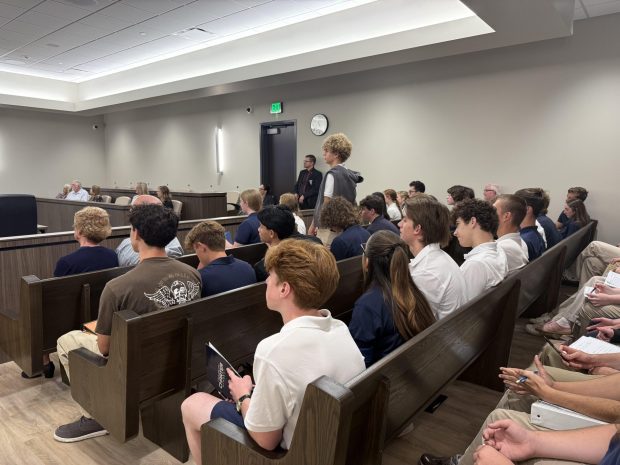
It wasn’t just an opportunity for the students to see government in action. It was a chance for Justice Gregory Moeller to do the best parts of his job, all in one day.
Responding to a question from a student about his favorite part of the job, Moeller listed three things:
- First, hearing oral arguments. “I know I was having a good time,” he said of the morning’s proceedings, with a chuckle.
- Second, traveling across Idaho.
- Third, educating people about the court.
“My ultimate favorite thing is I love talking to young people,” Moeller said. “I really do enjoy the opportunity to meet all of you, hear your questions, understand what’s important to you, and maybe help you understand why our job is so important to us, and why each of us here really believe in the system that we’re part of.”
Jennifer Pytlewski, 17, said hearing the oral arguments was really interesting. She thought the attorney for the respondent made the best argument. The justices, Pytlewski said, seemed to agree. She based her opinion on the way the justices questioned the appellant.
“I thought they really cooked him,” Pytlewski said. “I kept looking at the justices, they really were like … this is not it.”
For Pytlewski, however, the most interesting part of the day was hearing the justices’ candor about their job.

Justice Robyn M. Brody, who helps manage the court’s schedule, told students the court hears about 115 cases a year but sometimes that stretches up to 135. That means about 15 cases per month.
“The court is super busy,” Brody said.
The court hears just a fraction of the approximately 1,000 cases appealed each year, and an even smaller fraction of the 10,000 or so motions received per year.
The job requires a lot of reading, the justices said.
For Pytlewski, that candor made her rethink potentially becoming an attorney.
Seaton Luce, 17, said he was shocked to learn it can take justices months to issue an opinion, sometimes more than a year.
“The justice system is a lot more complicated than I thought,” Luce said.
That realization was one of the goals government teacher Sandy Midgley had for bringing her students to the hearing.
She hoped they’d see the system in action, see civil debate as a core principle of the criminal justice system, and see that while the system may have problems, it isn’t broken.
“I think it was really inspiring to them,” Midgley said after the hearing.
The justices also hoped to enlighten and inspire Idaho’s youth.

