
(UPDATED, 7:41 p.m., with evening developments.)
A late-session push to extinguish diversity, equity and inclusion in colleges and universities is nearing its final hurdle.
The House approved Senate Bill 1198 after a passionate debate Thursday. The legislation would bar DEI-based discrimination in hiring and college admissions, diversity training programs and DEI offices. It would also prohibit colleges and universities from requiring DEI classes, unless they’re part of a chosen degree program.
Legislature nears adjournment — but doesn’t get there
Both houses were working through their final calendars Thursday, in hopes of wrapping up the 2025 session. But the session did not adjourn Thursday.
After some fits and starts, the House gaveled out for the day shortly after 7 p.m. Both houses will reconvene Friday, and the House and Senate state affairs committees have meetings set for Friday morning.
It appears likely that legislators will wrap up their work Friday, the 89th day of the session.
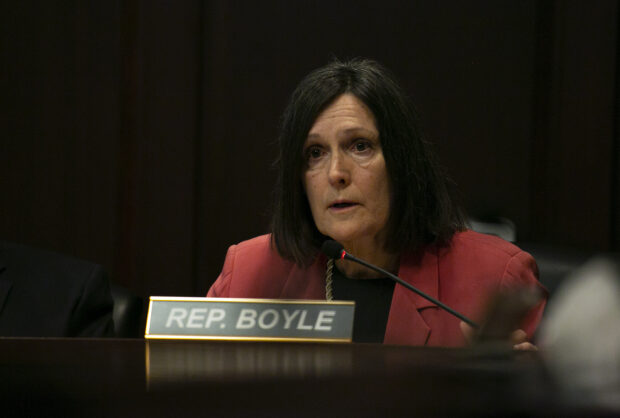
During a House floor debate Thursday, sponsoring Rep. Judy Boyle said students don’t like “being forced” to take “DEI classes,” which have caused “huge division and anger.” She framed DEI as a reversion to discriminatory politics.
“I’m from Irish descent, and my ancestors, when they came over, were treated terribly, as were the Chinese, the Blacks, the Italians, the Catholics,” said Boyle, R-Midvale. “This (bill) does not allow our universities to divide the kids up, force them into this critical theory of oppressor and oppressed.”
Rep. Kyle Harris, who supported the bill, said it wouldn’t limit what can be taught in classrooms, but it does prohibit colleges and universities from requiring DEI-related classes as part of a medical or math degree.
“You can still teach about racism, you can still teach about inequality,” said Harris, R-Lewiston. “DEI is no longer about diversity, equity and inclusion. It doesn’t do any of that anymore, because all it does is divide, exclude and isolate people into little groups so they can be angry at each other.”
SB 1198 faced some bipartisan opposition but ultimately passed 51-16 with overwhelming GOP support.
One of the Republicans who opposed it, Rep. Britt Raybould, said the bill would set a precedent for the government censoring college classrooms. Governments that rely on censorship — in China and Soviet-era Russia, for instance — suppress ideas because they’re “ill-equipped” to defend their own, she said.
“What’s the threshold that we are setting for establishing within law the idea that we should be censoring ideas?” said Raybould, R-Rexburg. “We are capable of standing up to ideas that we disagree with, and countering those arguments in a way that is showing respect to those who disagree with us.”
The bill also instructs the attorney general to investigate potential violations of the DEI restrictions. If proven, a violation can carry fines of up to $50,000, or 10% from the college or university office where it occurred.

Rep. Chris Mathias, the Legislature’s only Black member, said this provision creates a double standard for discrimination protections on campus. Most discrimination claims come from marginalized groups, he said, and claimants must go through “the Olympics” of paperwork and “jump through hoops” to be “heard and seen.” Appeals of university decisions on discrimination claims end at the State Board of Education, he said.
“But if you’re a white student who feels like you were discriminated against because you had to learn about white fragility, well, we’ve got to call in the state’s top law enforcement officer for you,” said Mathias, D-Boise.
SB 1198 headed back to the Senate, which agreed to the House amendments Thursday evening — after a rancorous debate and in a narrow 20-15 vote.
The debate centered on the House’s centerpiece amendment — the proposed fines.
“If there’s no DEI, there will be no fines,” said Sen. Ben Toews, R-Coeur d’Alene, the bill’s Senate sponsor. “So I would say, ‘What is the concern?’”
Sen. Kevin Cook, R-Idaho Falls, questioned why the Legislature wanted to punish the universities again — days after passing a higher education budget that cut budgets for the University of Idaho and Boise State University by $2 million apiece. “We can’t keep kicking them and we can’t keep growing government.”
“How long do we keep punishing people?” countered Sen. Brian Lenney, R-Nampa. “For as long as people keep doing it.”
The vote to agree to the amendments is not the final step. The Senate would still need to pass the bill, before it goes to Gov. Brad Little’s desk.
House approves amended Empowering Parents repeal
An amended bill that would repeal the Empowering Parents program easily cleared the House Thursday.
The new version would fully defund the program in 2028, rather than this year, guaranteeing awards that were already promised. Public, private and home-school families would be eligible for $1,000 per child or $3,000 per household, and would have three years to spend the money.
Supporters of repealing the program argued that it has outlived its purpose. Empowering Parents’ predecessor — Strong Families, Strong Students — was enacted in 2020 as the COVID-19 pandemic moved schooling online. Now, much of the state funds are going toward laptops and other technology.
“This was trying to get us through the times when we actually had COVID,” said Rep. Josh Tanner, R-Eagle, who sponsored the repeal in the House.
The House voted 56-13 to approve Senate Bill 1142.
Rep. Soñia Galaviz, D-Boise, voted against it. A public school teacher, Galaviz said students like hers are the primary beneficiaries of the program; 86% of Empowering Parents recipients are public school students, she said. If the Legislature is concerned about the money buying laptops, lawmakers can reign that in, she said.
“I have to go back to the families that I serve, parents that I love, the kids that I teach, and say ‘You no longer can get that additional math tutoring that you need, but the state is willing to support other programs for other groups of kids,’” she said, referring to House Bill 93’s private education tax credit.
Tanner said that only 5% of Empowering Parents funds paid for tutoring, and the program has turned into a “technology slush fund. …We are funding the technology into schools drastically already.”
SB 1142 now goes back to the Senate. Senators must approve changes made in the House before the bill goes to Gov. Brad Little’s desk.
House, Senate continue staredown over ‘medical freedom’ bills
With the clock ticking on the 2025 legislative session, a House-Senate “medical freedom” showdown took a few more turns Thursday.
The Senate Thursday afternoon passed its own version of a “medical freedom” bill — less than 24 hours after the House passed its own version.
The House appears poised to make the next move. The House State Affairs Committee has scheduled a Friday morning hearing to take up the Senate bill — a signal that House leadership has signed off on the Senate’s wording. Since both houses have passed similar last-minute bills, Republican leaders on both sides of the rotunda have signaled that they want to pass something on “medical freedom” before adjourning for the year.
Both of the new bills — Senate Bill 1210 and House Bill 472 — contain similar language affecting K-12 schools and colleges and universities. Schools “shall not mandate a medical intervention” for a student to attend school, for anyone to go on a campus or enter a school building, or as a condition of employment. And it’s identical to language in Senate Bill 1023, the original version Gov. Brad Little vetoed last week.
Both bills try to address Little’s stated concerns: that SB 1023 would jeopardize “the ability of schools to send home sick students.”
The new Senate bill cites existing state law — which allows to turn away sick or unvaccinated kids, or close schools outright, during an outbreak. The House bill does likewise.
The Senate debate barely mentioned the impact on schools. Instead, the debate focused on matters of personal liberties and public health.
“I do believe this bill advances individual rights and freedoms in this state,” said Sen. Ben Adams, R-Nampa, a supporter.
“We don’t even know what the next pandemic’s going to be, what the next disease is going to be,” said Sen. James Ruchti, D-Pocatello, an opponent.
The bill passed 22-13, over opposition from an odd bipartisan mix of lawmakers, including all six Democrats and some of the Senate’s hardline conservatives. But it passed by a wider margin than the original “medical freedom” bill, which received a 19-14 majority. And the new bill fared better than a Senate attempt to override Little’s veto; without debate, the Senate voted 20-14 for an override, falling short of the needed two-thirds supermajority.
Senate OKs State Board ‘enhancement’ budget
Without debate or fanfare, the Senate passed a much-reduced budget for the State Board of Education.
The “enhancement” budget includes $360,700 for a variety of State Board line items. It completely omits one of Gov. Brad Little’s education priorities: a $15 million grant program that would fund public-private partnerships in career-technical education and job training. After legislative budget-writers scaled this line item to $5 million, the House killed it entirely.
The Senate passed the State Board budget, 22-13. It goes to Little’s desk.
House approves tobacco settlement programs, literacy coaching
The House approved two education spending bills Thursday, sending both to Gov. Brad Little’s desk.
Senate Bill 1213 appropriates $5 million annually — or $15 million over three years — to coach K-12 teachers on the science of reading. The House approved the bill 42-27.
Senate Bill 1215 divides the state’s tobacco settlement fund for the upcoming fiscal year. The bill would spend $2.5 million on youth assessment centers, $2 million on school resource officers, $1.5 million on after-school programs and $500,000 on a fentanyl campaign. The House approved it 59-9.

