After an hour of debate — a wide-ranging airing of fiscal issues — the House Friday easily passed an immediate spending cut.
The 2026 Idaho Rescissions Act, Senate Bill 1331, cuts this year’s general fund spending by $131.3 million. Most of the cuts were already in place; Gov. Brad Little cut 3% from most agency budgets last summer. But the bill also includes an additional $15.3 million in cuts, beyond Little’s recommendations.
The cuts would affect the current budget year, which ends June 30. Legislative supporters say the additional cuts provide more breathing room in a tight 2026 budget as lawmakers turn their attention to next year’s budgets.
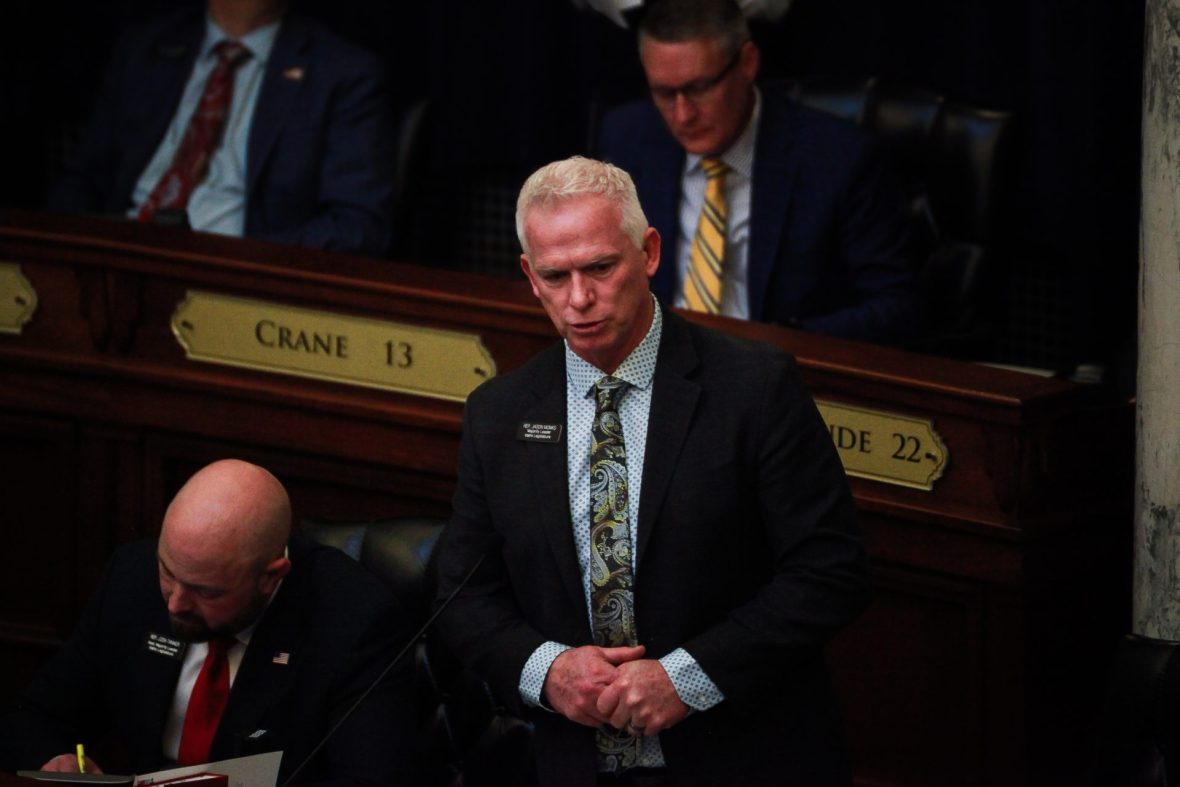
“It’s a crappy bill that we have to vote on,” said House Majority Leader Jason Monks, R-Meridian, minutes before the House vote.
K-12 is exempt from all of this year’s cuts. The Legislature’s cuts also leave Medicaid, prisons and Idaho State Police untouched. Higher ed is subject to the cuts, however, and is bracing for a disproportionately large share of the hit.
Friday marked the House’s first vote on a spending bill — eight weeks into a 2026 session dominated by budget issues. Lawmakers used the noon-hour debate as a vehicle to discuss years of tax and spending decisions.
Opponents questioned the need for the additional cuts, especially when the state has $1.3 billion in various reserve accounts. Critics also said the Legislature has put itself in a budget box, after passing $450 million in tax cuts and credits a year ago. “That is extremely frustrating to me,” said Rep. Lori McCann, R-Lewiston.
House conservatives said the cuts were past due. Rep. Joe Alfieri, R-Coeur d’Alene, said the cuts didn’t go far enough. Rep. Clint Hostetler, R-Twin Falls, said the cuts reverse years of “irresponsible spending decisions.”
McCann rose to object, saying Hostletler was maligning other lawmakers. Hostletler walked his comment back, slightly. “We are moving back in the right direction.”
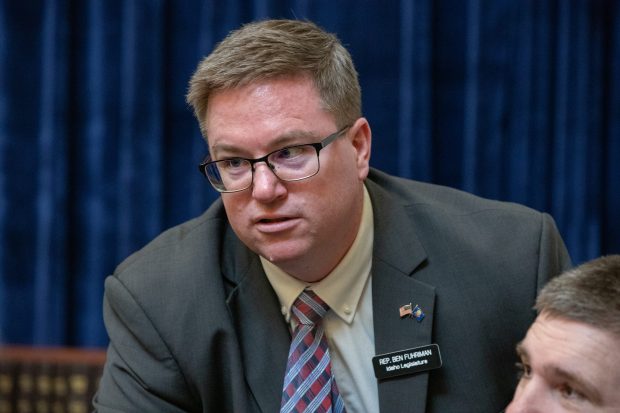
Another opponent, Rep. Ben Fuhriman, R-Shelley, said his trust in the complicated process used by legislative budget-writers has “eroded.”
The Joint Finance-Appropriations Committee is working on two sets of budget bills. First, 10 far-reaching “maintenance” budget bills would roll this year’s spending into next year — but the bills include Little’s 3% cuts and an additional 2% cut from the Legislature. Second, the committee will work on “enhancement” bills that could reverse some cuts.
Furhiman noted that JFAC has deadlocked on restoring $190,000 in scholarships for Idaho National Guard members, leaving him skeptical about the enhancement process. “I’m just supposed to vote for this and trust that this is what we’re going to do?”
JFAC’s House co-chair defended the process.
Rep. Josh Tanner noted that JFAC approved the National Guard scholarships Friday. (Click here for full coverage from Clark Corbin of Idaho Capital Sun.) And he said the committee is responding to concerns about cuts to community colleges and career-technical education, with plans to restore spending.
The 2026 cuts are a hedge, as state tax collections lag behind projections. “We’re really pretty thin on the bottom line right now,” said Tanner, R-Eagle.
Despite the lengthy debate, Friday’s House vote wasn’t close.
The budget bill passed on a 48-22 vote, a marked departure from Monday’s narrow 18-17 Senate vote to pass the measure. And while four of JFAC’s 10 Senate members opposed the bill — and two debated against it — JFAC’s 10 House members generally held the line. Only two of these 10 lawmakers opposed the cuts: Reps. James Petzke, R-Meridian, and Brooke Green, D-Boise.
Senate Bill 1331 now goes to Little’s desk.
Boise State leaders call for reforms to college athletics ‘insanity’
Boise State University ran out its first string Friday morning — urging a Senate committee to stand up for the state’s athletic programs.
And after the pep talk, the Senate State Affairs Committee unanimously approved a nonbinding proposal urging Congress to reform college athletics.
Senate Joint Memorial 114 argues that wealthier and more established athletic conferences are squeezing out competitors such as Boise State. The memorial says it is up to Congress to provide “a level playing field for institutions to compete at the highest level, driven not by conference affiliation.”
Boise State interim President Jeremiah Shinn, Athletic Director Jeramiah Dickey and football coach Spencer Danielson were part of the lineup before Senate State Affairs.
“Status in this system is largely inherited,” said Shinn, who added that athletics accounts for about $350 million of the university’s estimated $2.2 billion economic impact.
“When an industry is unwilling or unable to govern itself, we are forced to ask for Congress to step in before it’s too late,” Dickey said.
The focus of the memorial is Boise State football — and a national structure that Danielson labeled “insanity.” But State Board of Education executive director Jennifer White said the current model is “unsustainable for everyone.”
Boise State women’s golf coach Kailin Downs and Lewis-Clark State College Athletic Director Jim Klemann also spoke in favor of reform.
“We are hearing of sports being dropped at different levels across the country,” Downs said. “It is unnerving to know that we cannot sustain this path that we’re on.”
The movement to define student-athletes as employees poses a financial threat, Klemann said. “Applying these employment models would cost many institutions significantly more than … their current scholarship model.”
The memorial — co-sponsored by Sen. Ben Adams and Rep. Brent Crane, both R-Nampa — now heads to the Senate floor.
Committee OK’s STEM Action Center reorganization plan
A STEM Action Center reorganization bill is headed to the House floor.
With little discussion, the House Education Committee quickly endorsed House Bill 761. It would formally turn the center — now a standalone agency, under the governor’s office — into a wing of the Workforce Development Council.
This council, which administers the Idaho Launch postsecondary aid program, also operates under the governor’s office.
The merger would fuse K-12 STEM programs with postsecondary programs, creating “a single, clear talent development through line,” Workforce Development Council executive director Wendi Secrist told the committee. Secrist has also headed the STEM Action Center since August 2024 at Gov. Brad Little’s urging.
The reorganization would eliminate two full-time positions and save $329,400 in taxpayer spending.
With the committee’s unanimous support, HB 761 now heads to the House floor for a vote, possibly next week.
Revised homeschool student count bill heads to House
The House Education Committee also quickly passed a bill designed to remove homsechoolers from state enrollment data.
The rewritten bill would require districts and charter schools to remove students from their enrollment rolls if that student doesn’t show up during the first 10 days of the school year.
Schools would be able to add students back to their enrollment rolls, if the student comes back to the classroom later in the year, said Rep. Barbara Ehardt, R-Idaho Falls, the bill’s sponsor.
In a unanimous vote, the committee sent the rewritten bill straight to the House floor, for a possible vote in the next few days.