
The debate over medical education, and the longstanding but embattled WWAMI partnership, took another twist Wednesday.
An East Idaho lawmaker unveiled a new bill that would require the state to forge new medical education partnerships, and send fewer Idaho students into WWAMI.
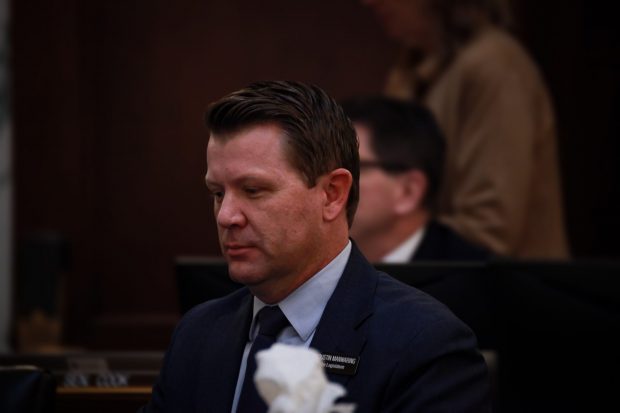
“We need to do something different than we’ve been doing,” Rep. Dustin Manwaring, R-Pocatello, told the House Education Committee Wednesday.
Co-sponsored by House Speaker Mike Moyle, R-Star, the new bill represents a second attempt to rework Idaho’s relationship with WWAMI — a multistate medical school program, named for the member states of Washington, Wyoming, Alaska, Montana and Idaho. WWAMI has been accepting Idaho students since 1972, and the $7.5 million program accepts 40 new students each year.
But Moyle, Manwaring and other lawmakers have grown impatient with WWAMI and its parent institution, the University of Washington. They want WWAMI to accommodate 50 new Idaho students per year, but UW has balked at an increase. The UW also held off on stating, in writing, that it spends no Idaho tax dollars on abortion. The UW signed such a statement on Feb. 14, the same day House Education passed a bill that would permanently sever Idaho’s ties to WWAMI.
This first proposal — House Bill 176, co-sponsored by Moyle, Manwaring and Senate Education Committee Chairman Dave Lent — remains on the House floor, awaiting a possible vote. That bill remains in play, but Manwaring said the new bill offers an alternative to ending the WWAMI partnership.
“(I’ve) tried to take a thoughtful approach … and have a different discussion,” Manwaring said.
Here’s how the new bill would work:
- Starting in 2026-27, the state would subsidize additional medical school seats. The state would add 10 slots per year for three years.
- Ten of these 30 new medical school seats would be Idaho-based. Idaho has no public medical school, so this requirement is an apparent reference to the Idaho College of Osteopathic Medicine, a private, for-profit medical school in Meridian. ICOM has close ties to Idaho State University, but currently, the state does not subsidize student seats at ICOM.
- While Idaho adds 30 new medical school seats, the state would also drop at least 10 WWAMI seats. This would occur in 2027-28.
- The State Board of Education would “appoint a working group to develop a medical education plan for the state of Idaho.” This idea is essentially in the works; State Board President Linda Clark in February announced plans to form a medical education study committee.
House Education voted to introduce the bill, setting the stage for a full hearing at a later date. But during Wednesday’s brief discussion, several committee members signaled their concerns.
“I haven’t received a single email from anyone telling me they’re unhappy with WWAMI,” said Rep. Chris Mathias, D-Boise.
“It makes no sense to burn things down with WWAMI when we need more docs,” said Rep. Jack Nelsen, R-Jerome.
One committee member opposed printing the bill, and he criticized colleagues for their push against WWAMI.
“We need to have some leadership in the building … and recognize that there are things we don’t know,” said Rep. Mark Sauter, R-Sandpoint.
JFAC finally settles on a budget bottom-line
After two months of internal battles, budget-writers finally have a budget bottom line.
The Joint Finance-Appropriations Committee approved a revenue forecast for the fiscal year that starts July 1 — a number that serves as underpinning for the Legislature’s spending and tax decisions.
The revenue projection has a familiar ring, coming in at an even $6.4 billion. It’s the same number a House-Senate committee recommended to JFAC on Jan. 9, the fourth day of the session. A week later, JFAC members discussed the forecast, but couldn’t agree on a number.
Since then, JFAC has started writing budget bills while leaving the revenue issue unresolved. And meanwhile, the Legislature has considered a raft of tax relief bills totaling $450 million.
On Wednesday — the 59th day of the session — JFAC settled on the $6.4 billion figure.
Discussion was brief.
Sen. Melissa Wintrow, D-Boise, opposed the revenue forecast, noting that state revenues have lagged behind projections for the past two months.
JFAC’s co-chair, Rep. Wendy Horman, said the state is still expecting a 2.9% revenue increase for the current budget year. “I think this is a very reasonable number for us to adopt,” Horman, R-Idaho Falls, said of the $6.4 billion forecast.
But adopting this number has been a long slog — as House members united behind the $6.4 billion forecast, while Senate members favored a more conservative forecast. Committee members have spent weeks discussing the revenue numbers, trying to quietly find a consensus, said Sen. C. Scott Grow, the Senate’s JFAC co-chair.
“We try to get folks to agree to things,” Grow, R-Eagle, said before Wednesday’s vote. “We haven’t had any success.”
JFAC approved the forecast on a 16-2 vote. Wintrow and Sen. Janie Ward-Engelking, D-Boise, cast the dissenting votes.
Little signs mask mandate prohibition
Idaho schools are now prohibited from requiring face masks to curb the spread of infectious diseases.
Gov. Brad Little signed House Bill 32 on Tuesday. The new law bars schools, colleges and universities — as well as other government bodies and public agencies — from implementing mask mandates.
The House passed the bill 52-16 and the Senate approved it 27-6.
Little has not publicly commented on the decision to sign it, but his support is a turnabout from his stance during the COVID-19 pandemic, when he resisted statewide policies on masking.
The Republican appealed to Idahoans to wear masks, but he didn’t issue a statewide mask mandate. And he sharply criticized former Lt. Gov. Janice McGeachin in 2021 when she issued an executive order banning mask mandates while Little was out of state. Little quickly rescinded the order.
“(McGeachin’s) executive order unilaterally and unlawfully takes away authorities given to the state’s mayors, local school board trustees, and others,” Little said at the time. The order was “contrary to a basic conservative principle — the government closest to the people governs best.”
Joan Varsek, Little’s press secretary, did not respond to a request for comment.
New bill would give bond proceeds to rural schools
A new bill would give needy rural school districts bond proceeds that exceed $1 billion from a state facilities fund.
Senate President Pro Tempore Kelly Anthon introduced the legislation Wednesday. It’s a follow up to House Bill 521, which allowed the state to issue bonds worth $1 billion and divide the proceeds between Idaho’s 115 traditional school districts.
“One of the concerns that I had in that package was that rural schools were not receiving enough funding to really make a meaningful change,” said Anthon, R-Rupert.

HB 521 dished out bond proceeds through an attendance-based formula, meaning larger districts got a bigger share, and only a handful qualified for enough money to build a new school building.
In January, the Idaho Department of Education announced that bond proceeds came in $86.5 million higher than anticipated, thanks to a “favorable bond market.” Anthon’s bill would give the extra cash to rural schools.
The Senate State Affairs Committee voted to introduce the bill, paving the way for a future public hearing.
Committee approves bill banning sexual orientation, gender identity instruction
After tussling over definitions Wednesday, the House Education Committee advanced a bill barring public schools from teaching about sexual orientation and gender identity.
Sponsored by Rep. Dale Hawkins, House Bill 352 would allow parents to sue school districts that fail to implement or enforce a policy prohibiting instruction on sexual orientation or gender identity from kindergarten through 12th grade.
“This provision reinforces parental rights in determining how and when their children will be introduced to these subjects,” said Hawkins, R-Fernwood.
The committee voted along party lines to send the bill to the full House.


Boise Democrat Rep. Chris Mathias honed in on the lack of definitions in the bill. The legislation doesn’t explain what qualifies as instruction about sexual orientation or gender identity. This means courts will have to decide, Mathias argued.
“Why can’t we maintain our own legislative authority and power and put definitions in this?”
Hawkins responded that he thought the definitions were “clearly understood.”
“I feel that I’m in a difficult position here, because I believe that you know the definition. The definition is what you are born to be,” Hawkins said. “Last night, we heard the president of the United States proclaim that America is a country that has men and women. That’s what we have. That’s what we’re talking about here.”
House OK’s rural facilities funding
Without debate Wednesday, the House unanimously approved a bill to rejuvenate a rural school facilities fund.
House Bill 338 would increase the “school facilities cooperative fund” from $25.5 million to $50.5 million. The fund gives gap financing for school construction projects.
The bill would also remove an existing requirement that recipients answer to a state supervisor for the duration of a construction project — if they ask for $5 million or less.
The bill now heads to the Senate.
Curriculum transparency bill advances
The House Education Committee advanced a second bill from Hawkins Wednesday — also along party lines.
House Bill 351 would direct school districts to post supplemental curricular materials, textbooks and course syllabi online.
The bill now heads to the full House.
Cursive bill heads to House floor
A House committee put its signature on a bill that would strengthen cursive instruction.
Senate Bill 1044 would require the state to set up a proficiency test for fifth-graders. Idaho’s academic standards already call for cursive instruction, beginning in third grade.
Committee discussion focused on how long it might take for teachers to administer and grade a handwriting test — and how much time they might need to find to help students learn cursive.
“Where in the world in a grade school schedule do teachers have time for this?” said Rep. Jack Nelsen, R-Jerome.
The bill’s House sponsor, Rep. Tony Wisniewski, R-Post Falls, said teachers can work cursive into day-to-day instruction. “I don’t see that we have to block out a period of time to have a penmanship class.”
The Idaho Department of Education endorses the bill. Cursive is already part of the academic standards, and a proficiency test should not create a “major imposition,” said Kristine Moriarty, the department’s policy and procurement director.
The House Education Committee sent SB 1044 to the floor on a voice vote. If the House passes the bill, it goes to Gov. Brad Little’s desk.
Senate passes classroom flag bill
The Senate passed a bill banning political or ideological flags in classrooms.
“What we want to do is make sure that education is the focus,” said Sen. Tammy Nichols, R-Middleton, who sponsored House Bill 41 on the floor. A flag restriction, she said, would ensure a “neutral and inclusive” learning environment.
Senate Minority Leader Melissa Wintrow was unconvinced, and said a ban on Pride flags would hurt LGBTQ students.
“Not everybody does feel included,” said Wintrow, D-Boise.
The Senate passed the HB 41 on a 29-6 vote. The Senate amended the bill, so the House will have to approve the changes and vote on the bill a second time. If that happens, the bill goes to Gov. Brad Little.
Public school ESA proposal on hold, again
For the second time, the Senate Education Committee punted on a bill to offer education savings accounts to public school families.
Senate Bill 1068 would encourage schools to adopt a “parent-supported instruction model”— which blends at-home and in-school instruction, and gives parents a say over their children’s curriculum.
About 11,000 Idaho students are already in a parent-supported instruction model, and on Wednesday, the committee heard from parents and students who are using the approach.
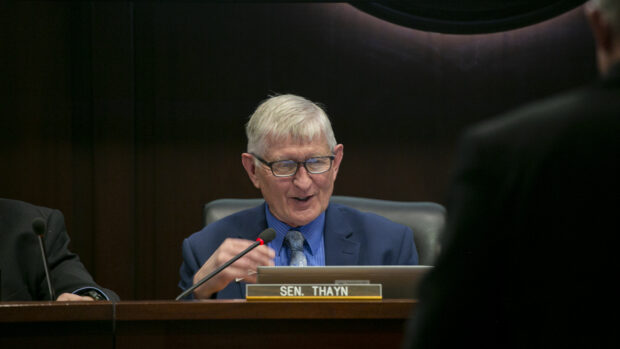
“Part of the purpose of this bill is to let you know what’s going on,” said Steven Thayn, a former chairman of the Senate Education Committee, and SB 1068’s author.
SB 1068 would also offer families an ESA to cover their out-of-school learning expenses.
This model is similar to one used by the Idaho Home Learning Academy, a massive online charter school based in Malad, Thayn said Wednesday. In January, IHLA officials outlined their $1,800 ESA program during House and Senate hearings, and the model received a chilly response from lawmakers.
SB 1068 wouldn’t cap the payments to parents, Thayn said. Schools that adopt the parent-supported instruction model could offer less money, or more.
Financial questions proved to be a snag Wednesday.
Sen. Kevin Cook, R-Idaho Falls, said he liked what he heard about the instructional model.
“I need to be able to know where the money’s going better,” Cook said.
The committee voted to hold the bill for one week, and requested more details about the ESA program.
Senate Education held its first hearing on SB 1068 on Feb. 25.
Senate passes increased grocery tax credit
After lengthy debate — and a procedural detour — the Senate overwhelmingly passed an increase in the sales tax credit on groceries.
House Bill 231 increases the credit to $155 per person. Currently, the credit is $120 per person, and $140 for seniors 65 and older.
The increased credit has a price tag of $50 million. It is one of three tax cut bills working their way through the Legislature, totaling about $450 million.
Hardline conservatives made a failed attempt to open the bill to amendment — hoping to instead repeal the sales tax on groceries entirely. That motion failed on a 5-29 vote. The Senate then passed HB 231, in its original form, on a 30-3 vote.
The bill now goes to Gov. Brad Little’s desk.

