
For the second consecutive year, House Republicans passed a bill that would prohibit school districts from deducting union dues from payroll systems and from offering employees paid leave for union activities, among other restrictions.
House Bill 745 passed on a 45-23 vote Tuesday.
“It does not prevent people from joining unions or having activities through their unions,” said sponsoring Rep. Judy Boyle, R-Midvale. “It just prevents taxpayer money being spent on that union activity.”
Forty-five Republicans supported the bill. This included Rep. Clint Hostetler of Twin Falls, who argued that teachers’ union dues support the National Education Association’s “very leftist” ideology.
“Taxpayer dollars belong in the schools for the children, for the purpose of learning, not for the association,” he said.

Rep. Soñia Galaviz, a public school teacher and member of the Boise Education Association, argued that teachers’ unions save taxpayer money. They conduct professional development and conflict mediation while helping teachers navigate their rights, said Galaviz, D-Boise.
“All of that is provided for free to the school district,” she said. “I literally pay dues so I can do that work for other educators and my colleagues in the building and help out my school district.”
Under the bill, public school districts would be prohibited from:
- Deducting union dues from paychecks.
- Covering union dues in employee wages.
- Providing personal information about employees, including contact information, to the union.
- Requiring employees to meet with union representatives.
- Communicating on behalf of the union.
- Offering employees paid leave for union activities – although the union could still reimburse districts for paid leave, as it does now, or employees could use their own sick leave or paid time off.
The bill applies to government labor unions broadly, but police and fire unions are exempt. Boyle said during a committee hearing last week that “law enforcement and firefighters are not included here to make them happy.”
Rep. Megan Egbert, D-Boise, argued that the bill should have made changes to the section of code that applies to teachers’ unions. “I fear for our firefighters and our police officers that all we are going to do is come for them next,” she said.
HB 745 now goes to the Senate. 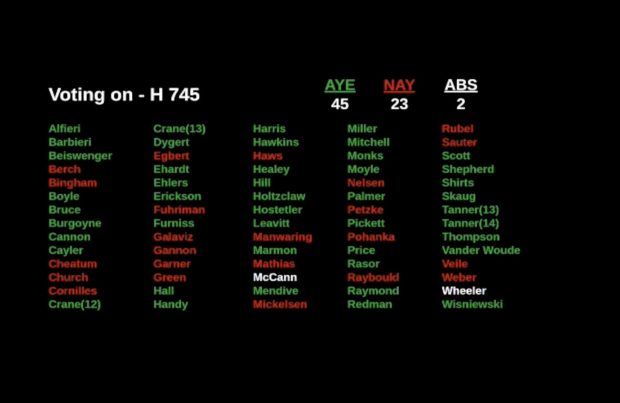
Is the LC State name change bill dead or alive?
A bill to rename Lewis-Clark State College unanimously passed the Senate three weeks ago, and has been mired in the House Education Committee ever since.
On Tuesday, House Education chairman Dale Hawkins, R-Fernwood, declined to say whether he plans to give the bill a hearing.
The bill would rebrand LC State as the state’s fourth four-year university. LC State officials say the rebrand would not change the school’s mission or focus. However, officials say the new name would differentiate LC State from the state’s two-year colleges and aid in student and athletic recruiting.
In a Monday letter to the campus community, LC State President Cynthia Pemberton voiced optimism for the bill’s prospects in the House.
“We have had informative followup meetings with various legislators as well as the House Education Committee chair,” Pemberton wrote. “We remain hopeful that the name change bill (S1234) will be placed on the House Education Committee agenda soon.”
Committee chairs have wide latitude to hear – or shelve – any bill sent to them.
Bill to rework career ladder introduced
Career-technical teachers – and pupil service staffers – can get stuck on the state’s career ladder, the framework that helps to set salaries.
A new bill seeks to address both issues.
CTE teachers would be able to advance on the career ladder “after receiving one qualifying year of a proficient or higher professional evaluation,” according to the bill’s statement of purpose. CTE teachers now need four years of proficient evaluation scores to advance on the career ladder.
The bill would apply the same one-year threshold to school therapists, nurses and other pupil service employees who move from the private sector into public schools.
The bill – co-sponsored by Reps. Shawn Dygert, R-Melba, and Soñia Galaviz, D-Boise – would carry a possible price tag of $150,000. However, according to the statement of purpose, “The exact fiscal impact of this legislation cannot be determined.”
The House Education Committee voted unanimously to print the bill, which could come back for a full hearing at a later date.
New bill would boost bus funding for a single school
A narrow busing bill would provide $40,000 for a “beloved” Garden City charter school, sponsoring Rep. Soñia Galaviz says.
The bill has cleared its first hurdle.
Galaviz, D-Boise, wants to close a funding loophole for Anser Charter School. Anser’s share of state transportation funding is based on its first foray into busing, a small grant-funding program for physical education.
“Now they have a real transportation program where they are picking up and dropping off students,” Galaviz said.
However, Anser gets about a 50% funding match, unlike the 70% to 90% match most districts and charters receive from a $114 million transportation program.
The House Education Committee introduced the bill Tuesday, setting the stage for a full hearing.
Replacement library bill introduced
The House State Affairs Committee introduced a replacement bill that would update the state’s “harmful materials” library law.
The new bill supplants House Bill 796.
The previous version would have prohibited stores from selling material that’s harmful to minors “or” sexually explicit. The new bill would prohibit stores from selling material that’s harmful to minors “and” sexually explicit.
Sponsoring Rep. Jaron Crane, R-Nampa, said the attorney general’s office recommended the change.
It’s one of two bills introduced last week that are aimed at incorporating wording from a U.S. District Court ruling on the harmful materials law.
Facilities fund cleanup bill heads to governor
The Senate quickly passed a bill that would make it easier for districts to tap into a state school facilities fund.
Under the current law, districts must rerun an unsuccessful bond issue before they can apply for money from the state’s $50.5 million Public School Facilities Cooperative Fund.
House Bill 608 would remove that requirement.
With the Senate’s 35-0 vote, the House-passed bill now goes to Gov. Brad Little.

