
The House zeroed out one of Gov. Brad Little’s education priorities.
On a narrow 33-37 vote, the House killed House Bill 443, a State Board of Education budget bill that included $5 million for workforce training grants.
The money would have gone into expanded or new training at the technical colleges, through public-private partnerships.
Little had requested $15 million in one-time money.
But even before Wednesday’s vote, the Joint Finance-Appropriations Committee had scaled Little’s request back to $5 million. JFAC was attempting to find a middle ground between lawmakers who wanted full funding, and lawmakers who opposed the program, said Rep. James Petzke, R-Meridian, the bill’s floor sponsor.
Debate was brief. Only one lawmaker, Rep. Clint Hostetler, R-Twin Falls, rose to argue against the bill, pointing out that the $5.3 million State Board “enhancement” budget constituted a 9.5% spending increase. Petzke said the one-time grants accounted for nearly all of this increase.
In the end, 37 of the House’s 59 Republicans opposed the budget. All four members of House GOP leadership voted no.

House committee rejects a Launch revamp — for now
An odd alliance of Idaho Launch supporters — and some diehard Launch opponents — banded together to spike a bill to rework the job-training program. But the issue might not be settled yet.

Reps. Steve Miller and Lance Clow proposed a series of fixes to Launch, which provides high school graduates up to $8,000 to pursue an in-demand career.
The bill would have emphasized short-term training in trades, rather than four-year degrees. But it also would have allowed some money to go to students pursuing graduate degrees in health care, and it would have opened some money to adult learners, instead of just recent high school graduates. It also would have turned over the job of identifying in-demand careers to a new nine-person panel, including six legislators.
There was enough in the bill to cause across-the-board heartburn in committee.
Several committee members questioned the need for the new panel, which would supplant the existing state Workforce Development Council. “We’re running roughshod right over the top of the people who know what they’re doing,” said Rep. Jack Nelsen, R-Jerome.
Rep. Tony Wisniewski, a longtime Launch opponent, objected to branching into graduate programs and aid for adult learners. “There is never going to be an end to high-demand careers,” said Wisniewski, R-Post Falls. “Once you start down this road, there is no going back.”
Miller, R-Fairfield, and Clow, R-Twin Falls, said their bill would refocus Launch on job training. Miller said his objective was to help young people find a path to their first good job. “It changes the trajectory of their whole life.”
The debate cut across ideological lines, and some of the bill’s most vocal supporters were Launch opponents.
“You can’t just go in and kill something,” said Rep. Kyle Harris, R-Lewiston, who labeled Launch “student loan forgiveness on the front end.” However, he said, the bill would put the Legislature “a step closer to control” over Launch.
On Wednesday morning, the committee voted 8-5 to return the bill to its sponsors — a move that normally signals a bill’s death. But late Wednesday afternoon, House Education scheduled a Thursday morning meeting to reconsider its Wednesday vote. That suggests that some committee members might switch their vote, bringing the bill back to life.
Senate swiftly passes WWAMI bill
It took the Senate only 10 minutes to vote on one of the year’s most heated education issues: the fate of the WWAMI medical school program.
Senators quickly passed a bill that would require the state to find and subsidize new medical school seats for Idaho students.
The debate over House Bill 368 has centered on WWAMI, a medical school partnership named for the member states of Washington, Wyoming, Alaska, Montana and Idaho. The House-passed version of the bill would have required Idaho to eliminate at least 10 WWAMI seats, while adding 30 medical school seats with other partners.
But last week, the Senate amended the bill to make the WWAMI cuts optional — which means Idaho might continue to fund 40 seats a year through the program. That change has appeared to take a lot of the sting out of the WWAMI debate. For weeks, supporters of the University of Washington-led program have questioned why Idaho would walk back its 53-year WWAMI partnership.
HB 368’s sponsor said the bill represents an attempt to find long-range solutions to Idaho’s longstanding doctors’ shortage.
“What’s our next 50 years look like?” said Sen. Dave Lent, R-Idaho Falls, who also led the Senate’s efforts to amend the bill.
The bill passed on a 26-8 vote, with opposition coming from Republican Sens. Cindy Carlson of Riggins, Dan Foreman of Moscow, Phil Hart of Kellogg, Josh Keyser of Meridian, Joshua Kohl of Twin Falls, Brandon Shippy of New Plymouth, Christy Zito of Mountain Home and Glenneda Zuiderveld of Twin Falls. None of the eight debated against the bill.
The bill now goes back to the House, which will have to pass the amended version.
JFAC scales back proposed U of I, Boise State cuts
Lawmakers made a quick do-over on a bill to cut budgets at Boise State University and the University of Idaho.
The Joint Finance-Appropriations Committee made the $2 million budget cuts a one-time change — not an ongoing cut that would roll into future budget years.
The committee made this change unanimously, but not without a little heartburn.
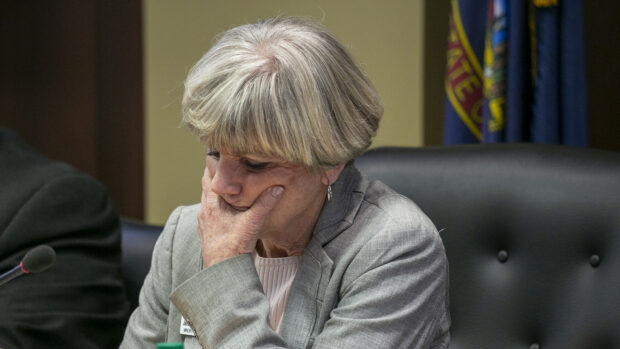
“I think these reductions are harmful to kids and harmful to businesses,” said Sen. Janie Ward-Engelking, D-Boise, who said her colleagues were cutting budgets simply because they’re “irritated” with the colleges and universities.
JFAC Tuesday included the budget cuts in an “enhancement” budget for the four-year schools, after a protracted discussion of diversity, equity and inclusion issues. Even with the cuts to the U of I and Boise State budgets, the enhancement budget adds up to a net increase of nearly $3.2 million across the higher ed system.
The budget now must pass the Senate and the House.
JFAC co-chair Rep. Wendy Horman attributed the error to confusion over the proposed cuts. “This is an oversight on my part,” said Horman, R-Idaho Falls.
In legislative parlance, Wednesday’s editing is known as a “technical correction.” But the printed budget spreadsheet JFAC members used Tuesday clearly labeled the cuts as ongoing. And during Tuesday’s JFAC debate, Sen. Jim Woodward, R-Sagle, specifically mentioned the proposed ongoing cuts, and the long-term implications for U of I and Boise State.
New anti-DEI bill introduced
A new anti-diversity, equity and inclusion bill debuted Wednesday.
Sponsored by Sen. Ben Toews, R-Coeur d’Alene, and Rep. Judy Boyle, R-Midvale, the new bill is a replacement for Senate Bill 1048.
The updated version is largely the same as the original with a few exceptions.
It would bar colleges and universities from opening diversity, equity and inclusion offices or hiring DEI officers. And it would prohibit discrimination in campus hiring or admissions.
The revisions deal with penalties and attorney general enforcement actions. The attorney general would first have to investigate a complaint that a college or university violated the anti-DEI provisions, then give the college or university 30 days to cure the violation. If the violation isn’t cured within 30 days, the attorney general can seek a court order.
The attorney general could also seek civil penalties. The original bill called for a 2% cut in the institution’s overall state budget, but the new proposed penalty is less severe. Instead, it calls for a 2% cut in “operating expenses for the offending division, office, center or unit … where the violation occurred.”
The Senate State Affairs Committee quickly voted to introduce the new bill Wednesday. Toews didn’t discuss the changes.
The bill could return to State Affairs, or another Senate committee, for a public hearing in the coming days.
House rejects transportation software funding
The House approved a handful of K-12 public school budgets Wednesday — with one exception.
House members narrowly rejected a bill that would have given the Idaho Department of Education $2.2 million to develop a new transportation funding software. House Bill 449 failed by one vote.
Rep. James Petzke, R-Meridian, said the software involves GPS routing that would make school bussing more effective and efficient. “Less gas costs, less money, less paperwork for the people administering the travel routes. … It actually saves money for school districts.”
Wednesday’s debate devolved into a discussion about a pledge that eight hardline conservatives have taken. Rep. Faye Thompson said that she and seven others — a group she called the “Gang of Eight” — have promised to oppose any enhancement budget that adds new employees or increases spending by more than 1.2%.
The transportation software represented a 15% increase from last fiscal year’s enhancements — spending beyond an agency’s base budget — for IDE’s Central Services Division.
“This is way too high, so I’m going to have to be a ‘no,’” said Thompson, R-McCall, “and I hope everybody else will be too.”
The House approved four other education budgets Wednesday. Each now goes to the Senate. The budget enhancements included:
- $504,000 for two new positions and funding for recruitment and retention at the Idaho School for the Deaf and Blind.
- $3.6 million for a 6,000-student enrollment increase at the Idaho Digital Learning Academy.
- A $1.6 million reduction in public school facilities money to account for a downturn in lottery revenue. Overall, schools are set to get $194.3 million for facilities next fiscal year.
- $1.6 million for statutory adjustments to teacher salaries. A separate budget bill includes funding for 5% teacher, administrator and staff raises.
Senate approves same-sex dorm bill
On a party-line vote Wednesday, the Senate approved a bill barring transgender college students from using same-sex college and university facilities that align with their gender identity.
House Bill 264 would direct colleges and universities to designate multi-occupancy restrooms, changing rooms and dorm rooms “for the exclusive use by either females or males.” The requirement would also apply to prisons and domestic violence shelters.
“The state has a compelling interest to protect women in their most vulnerable spaces, and House Bill 264 does just that,” said sponsoring Sen. Cindy Carlson, R-Riggins.
Democrats questioned the necessity of the bill. Sen. James Ruchti said it’s another example of “poor drafting of legislation” amid the state’s “effort to take on these social warfare issues against the LGBTQ community.” But he also noted that the bill goes beyond LGBTQ+ issues — it would bar college students from inviting someone from the opposite sex into their dorm rooms.
“We have very literally entered the bedrooms of 18-, 19-, 20-, 21-year-olds,” said Ruchti, D-Pocatello. “We should not designate ourselves the moral police. I think the citizens of Idaho are perfectly capable of making those sorts of decisions.”
Sen. Tammy Nichols countered that lawmakers wouldn’t have these discussions if “biological men” didn’t “invade our spaces.”
“That is the era which we live in,” said Nichols, R-Middleton. “We have bills now that are being ran in all sorts of states, to be able to stand and protect women, so that they can feel safe within the spaces that are designated for them.”
Rep. Barbara Ehardt, R-Idaho Falls, crafted the bill with the Alliance Defending Freedom, a Christian legal advocacy group.
HB 264 now heads back to the House, where members must concur with a Senate amendment before the bill goes to Gov. Brad Little’s desk.
Sex education opt-in bill heads to governor
A bill that would require parental consent for classroom instruction on “human sexuality” is heading to Gov. Brad Little’s desk.
The House voted nearly along party lines to approve House Bill 239 Wednesday. This was the House’s second vote on the bill, after it was amended before clearing the Senate Tuesday.
Opponents seized an opportunity to debate against the bill again. Rep. Steve Berch, D-Boise, drew objections from GOP leaders when he said voting for the proposal would be an endorsement of “more sexually transmitted diseases and more unwanted pregnancies.”
House Majority Leader Jason Monks, R-Meridian, objected to this suggestion, and House Speaker Mike Moyle agreed that it was out of line. “I think that’s probably your opinion,” Moyle, R-Star, told Berch.
Berch said, “That is the consequence of young adults not getting proper sexual education…When you turn it into an opt-in, you’re going to see the participation in these classes drop…This is a really careless bill that, really, can put our young adults in danger.”
Rep. Kyle Harris, R-Lewiston, who supported the bill, said it’s a parental rights issue. “I hope less kids attend classes that deal with human sexuality. It’s not public schools’ job to teach human sexuality.”
‘Severe behavior’ enrollment bill heads to governor’s desk
A bill that would give school boards more leeway to deny enrollment for students with “severe behavior issues” is heading to Gov. Brad Little’s desk.
The House voted Wednesday to concur with Senate changes.
If signed by the governor, House Bill 236 would allow trustees to deny enrollment to students who disenrolled from prior schools rather than face expulsion.
It would also allow school boards to deny enrollment to students with convictions and adjudications for certain violent crimes, including murder, assault and sex crimes. Parents would have to disclose these convictions or adjudications to a school board where their child is seeking enrollment or is currently enrolled.

