
After limited debate — and despite bipartisan opposition — the House passed a budget-cutting higher education bill.
In Statehouse parlance, House Bill 876 is known as a “maintenance” budget. In other words, it rolls this year’s base spending into the next budget year, which begins July 1. But this year’s maintenance budgets also roll spending cuts into next year — a 3% base cut proposed by Gov. Brad Little, and an additional 2% cut proposed by legislators. As EdNews has previously reported, higher education stands to take a disproportionate hit from the proposed budget cuts.
“This budget does long-term structural damage to our economy,” said House Minority Leader Ilana Rubel, D-Boise. Rubel noted that the budget crunch has already forced layoffs at Idaho State University, a restructuring at Boise State University and looming job cuts at the University of Idaho.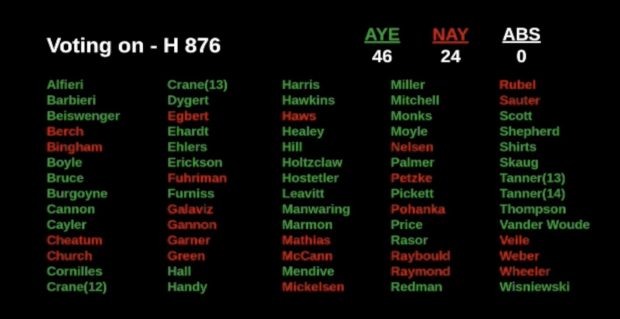
Rubel was the only legislator to debate the bill, which passed on a 46-24 vote.
The spending bill now goes to the Senate — which last week killed a “maintenance” budget for health and human services.
HB 876 covers several agencies under the State Board of Education umbrella, including the two- and four-year colleges and universities.
House passes bill criminalizing bathroom violations
A bill to criminalize violations of Idaho’s bathroom law is headed to the Senate.
The House-passed bill would make it a misdemeanor to use a bathroom “that is designated for use by the (user’s) opposite biological sex.”
The bill would apply to schools and any government or public buildings. A 2023 law already requires schools to regulate bathrooms and locker rooms, based on gender assigned at birth.
“(This is) consistent with Idaho’s recent policy direction,” said the bill’s sponsor, Rep. Cornel Rasor, R-Sagle. “Single-sex facilities have long existed to safeguard females.”
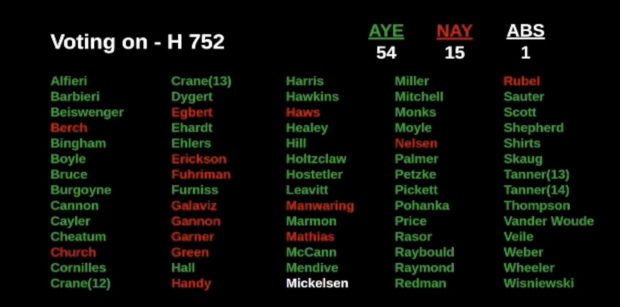
The bill would apply to anyone who “knowingly or willfully” uses a bathroom not aligned to their “biological sex.” A first offense would be a misdemeanor, but a second offense would be a felony.
“We are about to criminalize fear as opposed to actual harm,” said Rep. Chris Mathias, D-Boise. Mathias added that the bill poses a threat to transgender people, who would have to use bathrooms and facilities that make them uncomfortable.
Rep. Dale Hawkins said the rest of the population should not have to accommodate transgender Idahoans, who make up 0.4% of the population. “I don’t know how we got here,” said Hawkins, R-Fernwood. “This is about men in women’s spaces.”
With the 54-15 vote, House Bill 752 now heads to the Senate.
Senate sends moment-of-silence bill to Little’s desk
The Senate narrowly passed a school moment-of-silence bill, sending it to Gov. Brad Little.
House Bill 623 would require schools to being the day with a one-minute period to allow students to “reflect, meditate, pray, or engage in another silent activity.” No other activities can take place during the moment of silence.
The bill’s sponsor said the short silence will allow students time to gather their thoughts before the day begins, the bill’s floor sponsor said Monday afternoon.
“Government is not directing that moment,” said Sen. Tammy Nichols, R-Middleton. “The student is.”
Roll call
The Senate’s 18-15 vote to pass the moment of silence bill:
Yes: Adams, Bjerke, Burtenshaw, Carlson, Cook, Foreman, Grow, Hart, Keyser, Kohl, Lakey, Lent, Nichols, Okuniewicz, Shippy, Toews, Zito, Zuiderveld.
No: Bernt, Blaylock, Den Hartog, Galloway, Guthrie, Harris, Lenney, Ricks, Ruchti, Semmelroth, Taylor, Ward-Engelking, Wintrow, Woller (Rabe), Woodward.
Absent: Anthon, VanOrden.
The bill ran into bipartisan resistance, with lawmakers questioning the need for a mandate.
Sen. Mark Harris, R-Soda Springs, said his wife, a teacher, recently tried the moment of silence with her second-grade class.
“It was the longest 60 seconds of their little lives,” he said. “They went absolutely bonkers.”
Sen. Janie Ward-Engelking, a retired teacher, questioned the logistics of beginning the day with a moment of silence. “This is one more thing we’re going to ask teachers to do,” said Ward-Engelking, D-Boise.
The bill passed on an 18-15 vote. The House passed the bill last month.
House OKs cleanup bill that addresses access to 988 suicide hotline
The House unanimously passed a bill designed to fix parts of a 2024 parental rights law — and ensure teens have access to the state’s suicide hotline.
The bill would make it clear that staffers at the state’s 988 suicide and crisis hotline can place a followup call to a minor “experiencing suicidal ideation.” During a committee hearing last week, two teens said their calls to the hotline were cut short because they called without parental consent.
The bill also contains a “Band-Aid” provision of sorts — ensuring that schools and other entities can provide bandaging and other nonemergency care to minors.
A co-sponsor said the cleanup bill has been two years in the making. “We have worked hard, we have worked in good faith,” said Rep. Barbara Ehardt, R-Idaho Falls.
With Monday’s 68-0 vote, House Bill 860 heads to the Senate.
New resolution declares support for community schools
A new resolution would express the Legislature’s support for community schools.
The Senate State Affairs Committee introduced Sen. Dave Lent’s proposal Monday, the 64th legislative day of the session.
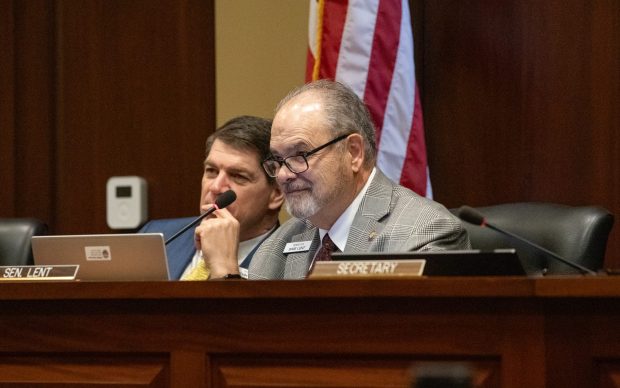
The resolution would declare that the Legislature recognizes community schools as “a proven, community-based framework for strengthening student success and supporting families across Idaho.”
Community schools act as neighborhood hubs, partnering with local organizations to offer health services, after-school programs and other resources beyond classroom learning.
“Through integrated student supports, expanded learning opportunities, family engagement, and collaborative leadership, the community school model helps ensure that students are healthy, supported, and prepared to succeed in school and in life,” reads the resolution’s statement of purpose.
In December, the U.S. Department of Education canceled $45.9 million in federal grants to Idaho community schools. State superintendent Debbie Critchfield pressured the Trump administration to reinstate the funding.
The concurrent resolution — which must be passed by both the Senate and House — could return to the Senate State Affairs or Education committees for a hearing in the coming days.
Library bill bound for amendments
A bill that would align Idaho’s “harmful material” library law is bound for amendments. Sponsoring Rep. Jaron Crane moved House Bill 819 from the House calendar to the amending order.
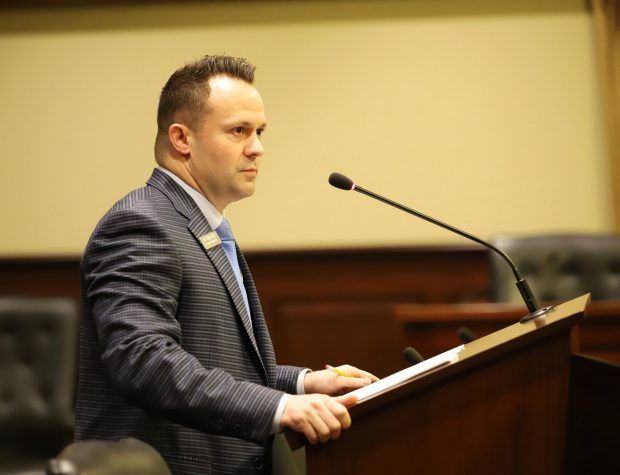
The bill would align Idaho’s law with recent federal court rulings, including a Texas decision that found regulating library books is a form of government speech — not a regulation of private speech.
Crane, R-Nampa, didn’t explain what changes will be made to the bill, which is backed by Idaho Attorney General Raúl Labrador’s office. Library leaders opposed the bill during a public hearing last week.
Meanwhile, the House unanimously passed a second, less controversial bill updating the “harmful material” law.
House Bill 795 would remove a phrase in the law in response to a recent decision from the U.S. Court of Appeals for the 9th Circuit, which partially reversed a district court decision upholding Idaho’s law.
The bill now heads to the Senate.
Senate approves bills on ethics reporting, career ladder
The Senate quickly passed two education-related bills Monday.
House Bill 635 requires that the Idaho Professional Standards Commission, the state’s educator ethics panel, report allegations of criminal behavior to law enforcement.
“Right now that reporting is usually expected and assumed, but it needs to be clear in statute,” said sponsoring Sen. Cindy Carlson, R-Riggins.
The Senate voted 34-1 to approve the bill. Senate Minority Leader Melissa Wintrow, D-Boise, opposed it.
The House passed the bill on a 66-3 vote.
It now heads to Gov. Brad Little.
Senate Bill 1358 would count years of service as a public school administrator toward the career ladder — allowing administrators to move up the state’s salary allocation model if they return to the classroom.
To qualify, administrators would have to earn “proficient” or higher ratings on their performance evaluations in three of the past five years. “They can’t slack off. They have to do good things,” said sponsoring Sen. Mark Harris, R-Soda Springs.
The Senate unanimously approved the bill, which now heads to the House.
Senate committee advances bills on civics seal, STEM Action Center merger
The Senate Education Committee unanimously approved two bills — one creating a new seal for high school diplomas and the other consolidating two education agencies.
Both bills head to the Senate.
House Bill 712 would create a new seal on high school diplomas recognizing achievement in civics. It’s sponsored by Rep. Michael Veile, R-Soda Springs, and Sen. Jim Guthrie, R-McCammon, and supported by state superintendent Debbie Critchfield.
Students would qualify for the “State Seal of Excellence in Civics” by obtaining a 3.25 grade point average or higher in social studies courses and by scoring 90% or higher on the state’s civics assessment. They would also have to complete a civics research project and participate in volunteering.
Guthrie pointed to his granddaughter’s interest in government and history after she served as a Senate page last year. “It was remarkable, her being involved in state government and the spark that it created,” Guthrie said.
Advocates from the Idaho Family Policy Center and Idaho Freedom Foundation spoke in support of the bill Monday.
The bill cleared the House unanimously.
The committee also advanced House Bill 761, which would consolidate the STEM Action Center and the Workforce Development Council.
Endorsed by the Legislature’s DOGE Task Force, the merger would eliminate two full-time positions, saving $329,400, and return $2.9 million in “dedicated fund spending authority,” according to the bill’s fiscal note.
The Workforce Development Council would continue to support STEM initiatives, including teacher training, community and school activities and work-based learning, said Wendi Secrist, who’s serving as executive director for both agencies.
“We will continue to do almost all of the responsibilities that currently exist within the STEM Action Center, with a tighter connection to careers,” Secrist said.
Bills on digital funds, CTE teachers, school building projects pass quickly
Three other school-related bills cleared on unanimous votes Monday.
- The Senate passed House Bill 599, which would distribute school digital curriculum funding based on need. The funds now go out on a first-come, first-served basis. The bill now goes to Gov. Brad Little’s desk.
- The House passed House Bill 832, which would eliminate work-hour requirements for career-technical teachers — allowing the Division of Career Technical Education to set new minimum standards. This bill goes to the Senate.
- The House also passed House Bill 721, which is designed to streamline permitting for school building projects. Districts would no longer need to obtain plan approval before going out for bids, and a local government would need to complete an initial review of a school building project within 30 days. This bill also goes to the Senate.

