
(UPDATED, 6:03 p.m., to correct that House Bill 368 would not make annual cuts to state-funded WWAMI seats.)
Another bill that would scale back Idaho’s WWAMI medical education program is headed to the House floor.
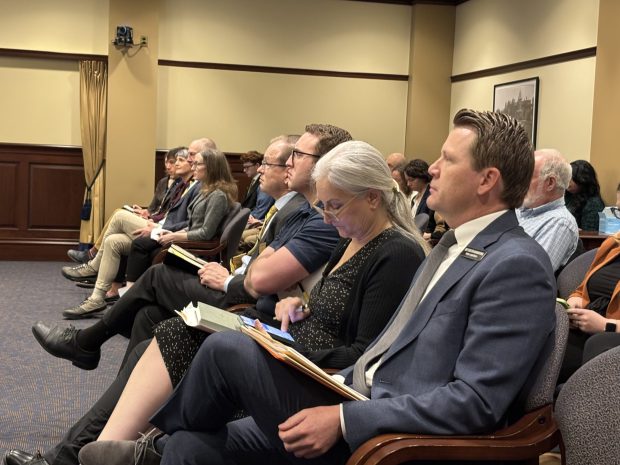
A divided House Education Committee passed House Bill 368, which would eliminate at least 10 state-subsidized seats at WWAMI — Idaho’s go-to medical education program since 1972.
“Idaho faces a critical need for more physicians,” said Rep. Dustin Manwaring, R-Pocatello, one of the bill’s sponsors. “WWAMI has not expanded when requested.”
HB 368 is the latest attempt to step away from WWAMI — a cooperative medical education program, named for the member states of Washington, Wyoming, Alaska, Montana and Idaho. Manwaring and other legislators say they have grown frustrated with WWAMI and its parent institution, the University of Washington’s medical school.
UW now takes 40 Idaho students each year, with the state spending about $7.5 million a year to reserve WWAMI seats. But the 2022 Legislature passed a resolution urging UW to add Idaho seats, and the university hasn’t responded.
Lawmakers have also criticized UW for balking at signing a statement asserting that it uses no Idaho tax dollars on abortion training. The UW signed this statement in February, the same day House Education considered an earlier bill that would have severed Idaho’s ties to the medical school entirely.
In presenting his bill, Manwaring accused UW of fighting for the “status quo,” and the $5 million he said the university collects from Idaho annually. “It is a great deal for the University of Washington.”
During an abbreviated public hearing Wednesday, House Education heard from an Idaho-based WWAMI associate dean. Mary Barinaga acknowledged that WWAMI “hasn’t always listened quickly” to legislators’ concerns.
However, Barinaga urged the committee to keep WWAMI whole — and preserve the Idaho clinical partnerships that the program has cultivated over a half century. “We are asking to be part of the solution.”
HB 368 would do three things. It would eliminate at least 10 WWAMI seats. It would call for creating 30 new medical school seats, outside WWAMI, over three years. And it would call for the State Board of Education to study Idaho’s medical education shortage.
The bill doesn’t spell out where, or how, Idaho would find the 30 new medical school seats. But House Education heard Wednesday from one would-be partner.
The University of Utah believes it can absorb Idaho’s needs for 30 new seats, said Benjamin Chan, the medical school’s associate dean of admissions and Idaho affairs. “We feel very confident.”
The University of Utah now takes 10 Idaho students per year, at a cost of about $2.9 million a year. About half of the Idaho students return to the state after graduation, Chan said. But Idaho also attracts a number of graduates from Utah, he said, meaning Idaho’s return on investment exceeds 100%.
The State Board is already forming a committee to look at the medical education issue, and the group has been meeting informally. The board supports this process, Executive Director Joshua Whitworth told the committee, but he said he believes the group will conclude that Idaho will need to tap into a variety of sources to address its physician shortage. “We need all partners on the stage.”
WWAMI has been one of the most discussed education topics of the session. Through a public records request, Idaho Education News received emails to several House Education members; these emails were overwhelmingly opposed to the first bill to sever WWAMI.
But on Wednesday, House Education heard from only three witnesses. Chairman Douglas Pickett limited the hearing to 45 minutes, saying committee members had time conflicts with other hearings. Twenty-nine people were signed up to testify Wednesday, and 26 were opposed.
The committee split on one piece of HB 368: the language requiring the state to drop at least 10 WWAMI seats.
Two motions — attempts to eliminate this wording — failed on identical 5-8 votes. The committee then voted 8-5 to send HB 368 to the House floor, intact.
Roll call
The House Education Committee’s 8-5 vote to send HB 368 to the House floor:
Yes: Reps. Douglas Pickett, R-Oakley; Dale Hawkins, R-Fernwood; Barbara Ehardt, R-Idaho Falls; Kyle Harris, R-Lewiston; Kent Marmon, R-Caldwell; Ron Mendive, R-Coeur d’Alene; Steve Tanner, R-Nampa; and Tony Wisniewski, R-Post Falls.
No: Reps. Monica Church, D-Boise; Dan Garner, R-Clifton; Chris Mathias, D-Boise; Jack Nelsen, R-Jerome; and Mark Sauter, R-Sandpoint.
Absent: Rep. Lance Clow, R-Twin Falls.
HB 368 now joins the second anti-WWAMI bill on the House floor. On Feb. 14, House Education passed House Bill 176, the bill to sever the WWAMI program within two years. That bill has sat on the House floor for three weeks, without a vote.
High-needs special education fund barely clears House
A bill to create a fund for high-needs special education students squeaked through the House on Wednesday.
State superintendent Debbie Critchfield is requesting $3 million for the program, which would cover most costs above $15,000 for high-needs students in public schools.
“We’re trying to help in those extraordinary cases, as a reimbursement, a last (resort) for these schools,” said sponsoring Rep. Ben Fuhriman, R-Shelley.
House Bill 291 passed 36-34, with a majority of Republicans opposed.
One of the “no” votes, Rep. John Vander Woude argued that spending could “blow up” to $80 million, referring to the statewide funding gap for special education. “This is a good way to grow government,” said Vander Woude, R-Nampa. “If this program is really needed, it should be within the state’s school budget.”
Supporters pointed to a recent study by the Idaho Office of Performance Evaluations that found the state’s public school funding formula only accounts for about half of the state’s special needs students.
Under the high-needs program, a district could apply for assistance from the state. If approved, the district would still be responsible for the first $15,000 of a student’s costs. The state would pick up the next $65,000, and 80% of costs beyond that.
The state must fund these students’ needs, per federal law — the Individuals with Disabilities Education Act (IDEA) — or face legal repercussions from parents, argued Rep. Monica Church. The Boise Democrat and public school teacher referenced a battery of court decisions that have affirmed this responsibility.
“We can either fund special education, or we can fund special education and lawsuits. Those are our two choices.”
Rep. Heather Scott applauded Church for the “best testimony I think I’ve heard on this floor in 11 years.” But Scott wasn’t persuaded to support the bill.
“I learned so much from what you just shared that I had no idea about,” said Scott, R-Blanchard. “That being said, I think we can find the funding from somewhere else. I’m not going to vote for this, but those are real problems that we’re going to deal with in our schools.”
HB 291 now heads to the Senate.
Senate approves outcomes-based funding bill
The Senate approved a bill that would pilot an outcomes-based funding component in the public schools budget. But the vote was far from unanimous.
Outcomes-based funding has been a priority of superintendent Critchfield’s in recent years. Sen. Dave Lent’s bill would earmark $35 million for student achievement in fifth- through eighth-grade math and college and career readiness.
“I’ve sat here on this floor many times and heard many of you talk about putting more money into public education and not seeing any results,” said Lent, R-Idaho Falls. “I think we’ve heard you, and here’s a chance for us now to make a difference.”
Hardline conservative opponents said they support tying state funds to outcomes, but not with additional money. “I would think that the $3.3 billion we’ve already appropriated (for public schools) could be directed to the outcomes,” said Sen. Tammy Nichols, R-Middleton.
The Senate approved the proposal 22-13. Senate Bill 1147 now heads to the House.
Senate reinstates staff-to-child ratios in child care deregulation bill
The Senate quietly reinstated staff-to-child ratio standards in a controversial bill to deregulate child care centers.
Last week, the Senate Health and Welfare Committee narrowly advanced House Bill 243 after a contentious public hearing. Opponents were particularly critical of a provision that would have allowed child care centers to set their own staff-to-child ratios.
The bill’s Senate sponsor, Sen. Carl Bjerke, R-Coeur d’Alene, moved to amend the bill Tuesday, and the Senate approved the changes Wednesday.
The new version would keep the current point system that determines how many staff members child care centers must have based on the number and ages of children they supervise — although the updated standards would be more lenient.
Child care centers would still need one staff member for every 12 points while the new formula would be:
- 2 points for children under 2 years old.
- 1.33 points for children between 2 and 3 (currently 1.5 points).
- .923 of a point for children between 3 and 5 (currently 1 point).
- .48 of a point for children between 5 and 13 (currently half a point).
The amended bill would still repeal a statute that allows local governments to set more stringent child care regulations.
HB 243 is now teed up for a full vote on the Senate floor.
Firearms bill won’t affect university, school policies, sponsors say
Legislation that would strengthen firearm rights on public property won’t affect existing school and university gun policies, the bill patrons said Wednesday.
The House State Affairs Committee voted along party lines to advance House Bill 376. It would ensure the right to carry concealed firearms on property that’s “normally and habitually” open to the public, even when private parties are renting the spaces.
During an introductory hearing last week, sponsoring Rep. Dale Hawkins said he was unsure how the bill would affect college and university firearms policies. Hawkins, R-Fernwood, and former Sen. Scott Herndon — who sued the city of Sandpoint in 2020 over firearms restrictions at a public event venue — had better answers Wednesday.
Herndon, a Republican from Sagle, said the bill wouldn’t affect an existing law that gives college and university trustees the authority to regulate firearms on campus. Additionally, existing policies on firearms in public schools would “remain intact,” Herndon said.
The bill now heads to the full House.
Charter school financing bill heads to Senate floor
A bill designed to continue a charter school building financing program is headed to the Senate floor.
The Senate Education Committee unanimously passed House Bill 331, which covers a charter school credit enhancement program established in 2023.
HB 331 would increase the cap on the state-backed program, and sponsors say this would allow more charter schools to enroll. Twenty-one charters have used the program, saving $11.8 per year in interest. Over 15 years, sponsors project the program will result in $112 million in savings.
HB 331 has already passed the House unanimously.
The House ends the day with a raucous dustup
The 66th day of the 2025 legislative session ended in disarray.
The dustup unfolded during a House floor debate on House Bill 378, a travel reporting requirement bill for legislators and legislative candidates.
As the heated exchanges unfolded, Rep. Kent Marmon, R-Caldwell, rose to debate. Noting that several lawmakers had left the floor, Marmon asked for a recess until all 70 House members were present.
Moments later, Rep. David Leavitt, R-Twin Falls, moved for a call of the House — a formal process that authorizes state troopers to locate absent lawmakers and bring them back into the chamber. The House recessed with no vote.
After the recess, House GOP leadership made a motion to adjourn for the day. This motion overrides a motion for a call of the House, said GOP Majority Leader Jason Monks, R-Meridian, who presided over the session.
The House held a voice vote to adjourn, with numerous lawmakers loudly voting no. Seconds later, Rep. Stephanie Mickelsen — an Idaho Falls Republican and the sponsor of HB 378 — made a motion for a roll call vote on adjournment. That vote didn’t happen, and afterwards, Monks told reporters that he wasn’t obligated to recognize Mickelsen’s motion.
As the session broke up, several lawmakers protested and booed.
The House will reconvene Thursday morning, with HB 378 still on the docket for a vote.

