
The 2026 Legislature will probably not change Idaho’s aging — and widely criticized — school funding formula.
So a key lawmaker wants to take a wait-‘til-next-year approach.
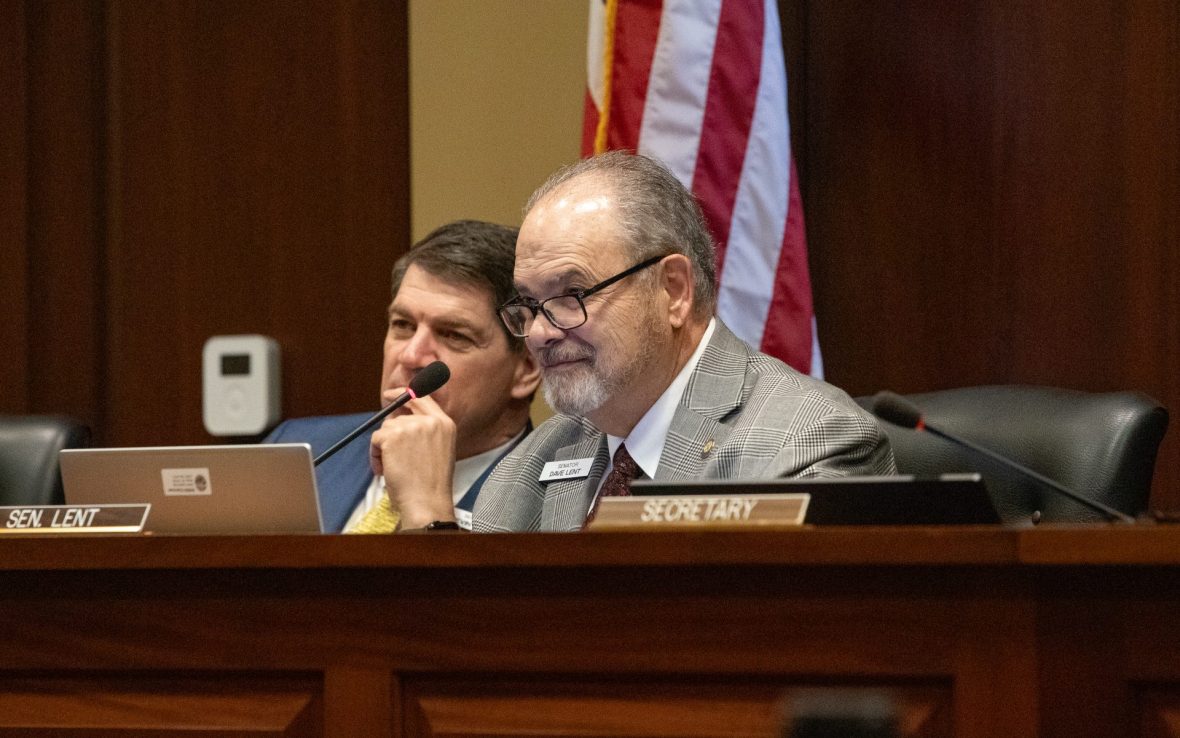
The Senate State Affairs Committee didn’t dive into the issue Wednesday morning but promptly printed the funding formula proposal. It was one of three late-session education proposals routed through the committee.
Here’s the rundown:
Funding formula. The latest foray into Idaho’s decade-long debate over the school funding formula comes from Senate Education Chairman Dave Lent.
He suggested directing state superintendent Debbie Critchfield to put together a stakeholder group to work on a rewrite. She would bring a draft to the Joint Finance-Appropriations Committee in the fall, with a goal of presenting a bill to the 2027 Legislature.
Idaho has not rewritten the formula since 1994, and many education leaders agree the formula doesn’t effectively parcel out Idaho’s $2.7 billion K-12 budget or properly support Idaho’s roughly 308,000 students.
The general goal of a rewrite is to work “weights” into the math — increasing funding for special education students, English language learners and other student groups that need added support.
However, state leaders have been discussing a funding formula rewrite since 2016. “This builds on the lessons learned,” Lent, R-Idaho Falls, said of his proposal.
With the committee’s unanimous support, it could go to Senate Education for a full hearing.
Strategic performance plans. Lent also wants to change the report card used to measure local schools — creating what he calls a “strategic performance plan.”
According to the bill’s statement of purpose, “Every school district and public charter school will be required to adopt a multi-year plan that sets measurable goals for student proficiency, academic growth, graduation rates, college and career readiness, and improved outcomes for at-risk and economically disadvantaged students.”
These documents would replace the continuous improvement plans, now required under state law.
Senate State Affairs introduced this bill, setting the stage for a hearing in Senate Education.
College athletics. Two Nampa Republicans want Congress to preserve the framework of college sports.
The nonbinding memorial urges the feds to move quickly — or risk “program reductions, escalating costs and competitive disparities” that could leave Idaho institutions, particularly Boise State University, on the sidelines.
“In the evolving collegiate athletics landscape shaped by name, image, and likeness (NIL), revenue sharing, and shifting conference dynamics, there is a compelling need for federal policy and funding frameworks to ensure fair competition, sustainable athletic programs, and continued economic and community benefits for states like Idaho,” the memorial reads, in part.
Sen. Ben Adams and Rep. Brent Crane are co-sponsoring the memorial.
Republicans advance bill restricting public funds for teachers’ union
GOP lawmakers Wednesday advanced a bill that would prohibit school districts from deducting union dues from payroll systems and from offering employees paid leave for union activities, among other things.
House Bill 745 cleared the House Commerce and Human Resources Committee by one vote after a public hearing that lasted about two and a half hours. It now goes to the full House.
“This bill just ensures that no tax dollars will be used for specific union activities,” said sponsoring Rep. Judy Boyle. The Midvale Republican sponsored similar proposals in past years. Last year’s bill passed the House but stalled in the Senate.
Under the latest bill, public school districts would be prohibited from:
- Deducting union dues from paychecks.
- Covering union dues in employee wages.
- Providing personal information about employees, including contact information, to the union.
- Requiring employees to meet with union representatives.
- Communicating on behalf of the union.
- Offering employees paid leave for union activities — although the union could still reimburse districts for paid leave, as it does now, or employees could use their own sick leave or paid time off.
While the restrictions apply to public-sector unions broadly, cities and counties are exempt. “Law enforcement and firefighters are not included here to make them happy,” Boyle said.
Representatives from half a dozen statewide, regional and national advocacy groups supported the bill Wednesday. These included Americans for Prosperity, National Right To Work Committee, Mountain States Policy Center, Idaho Family Policy Center and Idaho Republican Party.
Boyle’s bill was based on a study from the Washington-based Freedom Foundation that argued Idaho taxpayers are “subsidizing” political activities of teachers’ unions to the tune of over $1.1 million. The think tank is not affiliated with the Idaho Freedom Foundation.
“Teachers’ unions have followed the advice of the National Education Association and taken advantage of the collective bargaining process to shift the cost for union operations and advocacy to Idaho taxpayers,” said Maxford Nelsen, director of research and government affairs for the Freedom Foundation.
The Idaho Education Association disputed this claim.
“Let me be abundantly clear,” said Shane Reichert, general counsel for the statewide teachers’ union. “The Idaho Education Association and our local affiliates are completely funded by member dues. We do not, under any circumstances, receive taxpayer funding.”
Reichert also said the bill “intentionally does not regulate unions mutually” by excluding police and fire unions. These exemptions amount to “punishment for protected speech and association” from a single group, Reichert said, potentially in violation of the First Amendment.
Chris Cargill, president and CEO of the Mountain States Policy Center, said the restrictions should apply to all government unions “in a perfect world.” But there’s a “fundamental difference” when it comes to the teachers’ union. “The amount of political activity that comes from one group is quite different than the amount of political activity that comes from another group.”
Rep. Jon Weber disagreed: “As long as I’ve been in the House, every session, there’s lobby groups for emergency services, firefighters, teachers’ union. They’re all here.” Weber, R-Rexburg, was among four committee Republicans who opposed the bill along with two Democrats.
Rep. Ben Fuhriman also voted against it. The Shelley Republican said it doesn’t cost a school district for employees to “check a box” that says they want union dues deducted from their paychecks.
“We’re basically telling employees of the schools what they can and cannot do with their money once they get paid,” he said. “I have a fundamental problem with that.”
The Idaho State AFL-CIO, a regional chapter of the International Brotherhood of Electrical Workers, and the Bonneville School District’s superintendent also opposed the bill.
But eight committee Republicans supported it, including Rep. Lucas Cayler of Caldwell. Cayler said he used to be shop steward for a machinist and aerospace union in Hawaii, and he supports the right to collectively bargain. But his union didn’t conduct its activities on “company time.”
“This is a very good step in the right direction,” he said. “There’s probably some moves to be made in the future, with applying a very fair standard and equal application of this bill and this law to all future government employees who fall under a collective bargaining agreement.”
House Education advances civics diploma endorsement, introduces 3 new bills
A bill that would create a high school diploma endorsement recognizing achievement in civics is heading to the full House.
House Bill 712 creates a “State Seal of Excellence in Civics.” Students would qualify by obtaining a 3.25 grade point average or higher in social studies courses and by scoring 90% or higher on the state’s civics assessment. They would also have to complete a civics research project and participate in volunteering.
“This is a voluntary excellence endorsement for a graduation diploma,” said sponsoring Rep. Michael Veile, R-Soda Springs. “This certainly allows someone to put that on their diploma, which can be a credential that they use for college applications and things like this.”
The House Education Committee unanimously supported the bill.
The committee also introduced three new bills that deal with public school enrollment and sports eligibility. Each bill could return to the committee for a public hearing.
Parental consent for enrollment. Rep. Barbara Ehardt introduced a bill requiring public schools to obtain parental consent before counting a student toward their enrollment.
It’s “necessary” to ensure public school administrators “collect and report accurate student data for the purposes of funding,” says the bill’s statement of purpose.
“I am so sorry that we even have to bring this before us for a hearing, but unfortunately we do,” said Ehardt, R-Idaho Falls.
Rep. Jack Nelsen asked how the bill would affect separated parents in a custody battle. “I have no idea how that ties into here, but if we need to discuss that … we shall,” Ehardt said.
Sports eligibility. The committee also introduced separate proposals that would relax eligibility rules for nonpublic students to participate in public school sports teams.
One bill, also from Ehardt, would give private school and homeschool students a right to participate in “all nonacademic public school activities.”
Ehardt said some public schools are “militant” and charge “excessive” fees for homeschoolers to participate in sports. The bill says public schools may charge fees that “reflect the costs associated with participation in the activity.”
The other sports bill would allow athletes to play on any team within their school district, if their zoned school doesn’t offer the activity.
“This would be good for some homeschool, charter school students, people who are looking to have some flexibility on where they play sports,” said sponsoring Rep. Rob Beiswenger, R-Horseshoe Bend.
Beiswenger’s bill says it would not “limit the authority” of the Idaho High School Activities Association to “regulate the eligibility of students transferring between schools.”
Rep. Mark Sauter, R-Sandpoint, asked whether there’s a funding mechanism attached to districts being required to welcome additional athletes. Beiswenger said there is not. “I’ll probably have some questions” when the bill returns for public hearing, Sauter said.
School staff definition bill sails through House
A bipartisan bill that would clarify the definitions of public school employee roles easily cleared the House.
Sponsored by Reps. Monica Church, D-Boise, and Kyle Harris, R-Lewiston, House Bill 728 would update the definitions of public school employees for state funding purposes. Church said it would improve transparency and offer rural public schools more flexibility.
“This is what happens when we’re willing to break out of our shells and reach across the aisle and work with other people,” Harris said.
The Idaho Association of School Administrators opposed the bill during a public hearing last week. The advocacy group argued that the tightened definitions could hamstring local schools.
But the House unanimously approved the bill, sending it to the Senate.

