
Idaho’s version of the One Big Beautiful Bill is now law.
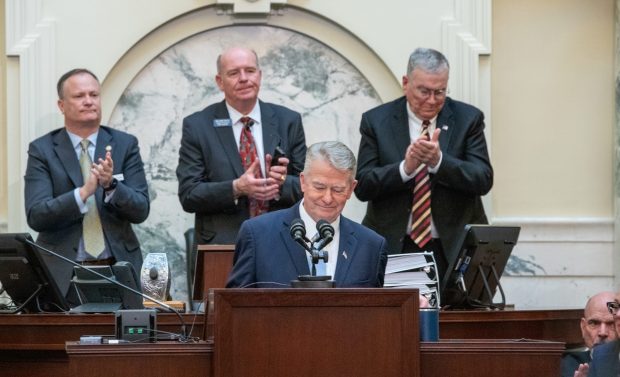
Gov. Brad Little Wednesday signed a bill to adopt most of the tax cuts in President Donald Trump’s omnibus policy law — and make the tax cuts retroactive to 2025.
Supporters of House Bill 559 pushed for an immediate rollout of the tax cuts. They argued that this would allow working Idahoans to take full advantage of the cuts, which will be in effect for only four years. They also pressed to pass the bill immediately to allow families and businesses to begin filing their tax returns.
But HB 559 puts added pressure on a tight state budget. The immediate tax cuts could reduce state revenues by a projected $155 million for the budget year ending June 30. Legislative leaders are banking on robust revenues to cover the tax cuts while maintaining a balanced budget.
Little had proposed delaying the tax cuts until July 1, saying it was unclear how the changes would affect this year’s budget. But HB 559 passed both houses nearly along party lines, with veto-proof two-thirds majorities.
Special education ‘high-needs’ bill unveiled
A much-anticipated special education bill made an expedited debut Thursday afternoon.
The Senate Education Committee introduced a bill that would create a $5 million fund to serve “high-needs” special education students.
The high-needs fund would cover only unusually expensive special education needs — such as a student’s full-time aide or American Sign Language interpreter — costs exceeding $30,000 per year per student.
“These expenses can cause significant budget gaps for the school districts and public charter schools incurring the expenses,” the bill’s statement of purpose reads, in part.
High-needs payments would be capped at $100,000 per student per year.
The money, for starters, would come from two existing Idaho Department of Education funds — the state’s driver training account and its career ready students fund.
State superintendent Debbie Critchfield has proposed the high-needs program, and the budget maneuvering, as a small step to address a much larger problem. School districts and charter schools face an estimated $100 million special education shortfall — the gap between federal and state funding and local costs.
Without discussion, Senate Education voted unanimously to print the bill, sponsored by Sen. Camille Blaylock, R-Caldwell. That vote sets the stage for a full, and undoubtedly longer, public hearing at a later date.
Recent history suggests the high-needs proposal will face resistance — again.
Last year, the House narrowly passed a $3 million high-needs bill, but it died on the Senate floor by a single vote.
Senate Ed speeds through bills on foreign athletes, homeschoolers, DOGE cleanup
It was, overall, a quick afternoon in the Senate Education Committee.
After introducing the special education high-needs bill, the committee quickly introduced three other bills, without debate. Here’s the rundown:
Foreign student-athletes. In 2025, Idaho’s public colleges and universities had about 250 foreign nationals competing on athletic teams. Sen. Doug Okuniewicz wants to limit scholarships for foreign athletes.
The bill would impose several limits:
- A 50% cap for any single men’s or women’s team at a college or university.
- A 5% cap for football teams.
- An overall 10% cap for a college or university’s athletic programs, across all sports.
Okuniewicz, R-Hayden, said he consulted with athletic directors and one community college president about his bill. And he recognized that there is a balance at play — between allowing Idaho teams to be competitive, while maximizing scholarships that can be used by students who can legally work in Idaho after graduation.
“I think it will make for an interesting conversation,” said Okuniewicz, referring to a possible hearing on the bill.
“PROM” for homeschoolers? Sen. Josh. Kohl, R-Twin Falls, wants homeschool students to be able to attend high school events, such as dances and college fairs. His bill — the “Participation in Recreation Outside of Matriculation Act” or “PROM Act” — would allow homeschoolers to buy a social access pass at a high school. The pass would cost up to $25, and homeschoolers would also have to pay the same event fees charged to other students.
DOGE cleanup bill. The committee printed a slightly rewritten bill to remove 14 sections of obsolete education law. The deletions involve programs the state never funded or put into effect.
The bill stems from the Legislature’s DOGE task force, which met last summer and fall.
Presidential search secrecy bill heads to governor
Gov. Brad Little will get the last word on a fast-track bill to place most of the higher ed presidential search process under wraps.
The House quickly passed a bill that would allow search committees to interview candidates in private — then release the name of only one finalist. The State Board of Education would then have to wait 10 business days before making a hire.
Current law allows a closed-door vetting process. However, the State Board must release a list of five finalists. Historically, those finalists have then come to campus for open meetings with students and staff.
State Board officials have said the current law has impeded the Boise State University president’s search, which began in March and has been on hold since October. They say would-be finalists have balked at being identified publicly because it would put their current jobs at risk.
The House passed Senate Bill 1225 on a 67-1 vote, with only Rep. John Gannon, D-Boise, in opposition. The Senate passed the bill unanimously on Feb. 2.
If SB 1225 becomes law, the State Board would apply the new guidelines to the stalled Boise State search.
Democrats propose ideas for solving budget crunch
Democratic leaders say they have ideas for addressing the state’s budget crunch in a way that wouldn’t cut services — but their bills have been blocked by committee chairs.
“The majority party will tell you…the only choice we have is to make excruciatingly deep cuts to everything, to care for the disabled, to public schools, to universities, to road and water projects,” said House Minority Leader Ilana Rubel of Boise, during a news conference Thursday at the Statehouse. “But it is simply not true. There is, as you can see here, a better way.”
The Legislature’s GOP-dominated budget committee is scheduled Friday to vote on taking 2% out of most state agencies’ “maintenance” budgets — excluding the K-12 public school support budget and a few other agencies — next fiscal year. The Joint Finance-Appropriations Committee voted last week to claw back 1% this fiscal year.
Heading into the Legislative session, budget-setting lawmakers faced a $555 million gap between agency spending requests and projected revenue.
Senate Minority Caucus Chair Janie Ward-Engelking said Thursday that JFAC’s vote on the 2% cuts is all but decided. But Democrats, with help from some Republicans, will try to block the cuts when they reach the full House and Senate, she said.
“We’re going to do what we can to stop them,” said Ward-Engelking, D-Boise.

In the meantime, minority leaders said they have several alternatives to widespread cuts, including:
- Tapping one-third of the state’s rainy-day funds, about $533 million,
- Pausing last year’s state income tax cut from House Bill 40, which reduced state revenue by about $240 million annually, and
- Eliminating the $50 million Parental Choice Tax Credit program.
The proposals would restore some of the lost state revenue tied to $1.1 billion in annual tax cuts and credits that lawmakers enacted over the last five years, said Senate Assistant Minority Leader James Ruchti of Pocatello.
“That is a revenue problem, not a spending problem,” Ruchti said. “The Idaho legislature blew it. It voluntarily reduced revenue year after year for five years.”
But Democrats say Republican committee chairs won’t allow their ideas to be heard. Chairs have discretion on whether bills get hearings in their committee.
“There are simple and obvious solutions to this crisis that we are simply not being allowed to talk about and not being allowed to vote on,” Rubel said.
Bill banning sexual orientation, gender identity instruction heads to House
A bill to ban public school instruction on sexual orientation and human sexuality is heading to the full House.
House Bill 516 would remove a provision in state law that allows sexual orientation and gender identity instruction that’s “age-appropriate or developmentally appropriate for students in accordance with state standards.”
“These two subjects we’re dealing with right here are not the business of educators in the public school system,” said sponsoring Rep. Dale Hawkins. “They are the business of parents.”
The House Education Committee voted to advance the bill — but not without spirited debate. Opponents argued that the bill conflicts with a parental rights law Republicans passed last year.

House Bill 239 required that parents opt in to public school instruction on human sexuality, including discussions of sexual orientation and gender identity. Rep. Barbara Ehardt, an Idaho Falls Republican who sponsored the opt-in bill, House Bill 239, said it’s not in conflict with the latest proposal.
But Jeff Carlson — a trustee at Future Public School, a charter in Garden City — disagreed. Carlson, who’s filling in at the Legislature for Rep. Chris Mathias, D-Boise, said the new bill would prohibit public school instruction that parents may have consented to.
“Does the state want me to follow this new law that says I should do what the state says versus what a parent may say?” Carlson asked.
Hawkins was indifferent toward the concerns. The Fernwood Republican has described HB 516 as a “cleanup” bill that removes a provision that was unintentionally left in the law when it was enacted in 2025.
Rep. Jack Nelsen, R-Jerome, asked Hawkins whether he could address a letter from the American Civil Liberties Union that raised the possibility of a court challenge to banning classroom discussions of sexual orientation and gender identity.
“I have no desire to do so,” Hawkins responded.
Amy Dundon, ACLU of Idaho’s legislative strategist, wrote to the committee that the bill could face a challenge if, in practice, it prohibits classroom discussion of homosexuality while heterosexuality “remains permissible.”
“Here, HB 516 could constitute outright viewpoint discrimination, making the bill legally fragile,” Dundon wrote.
In response to another question, from Rep. Soñia Galaviz, D-Boise, Hawkins appeared to suggest that discussions of heterosexuality are not implicated by the bill. When Galaviz noted that sexual orientation or gender identity “includes straight folks,” Hawkins responded, “I’m not sure where that’s supposed to be going.”
“Regular biology is not affected by this,” he said. “These are strict strikeouts of two subjects that are taught for a certain intention, and I think, everybody on the committee knows what those are.”
Digital curriculum funding bill will be reworked
A bill that would dish out state funding for digital curriculum on an as-needed basis — rather than first come, first served — will have to be reworked before it returns to the House Education Committee.
The panel voted Thursday to hold the bill until next week, after Republicans raised concerns that “as-needed” criteria wasn’t spelled out in the bill. “Who is defining that, and why can’t we be more specific?” said Rep. Douglas Pickett, R-Oakley.
Rep. Jerald Raymond’s bill would direct the Idaho Department of Education to establish “competitive, needs-based criteria” that governs which public school districts are prioritized when state funding for digital curriculum is limited. Raymond, R-Menan, previously compared the current process to “The Hunger Games.”
State superintendent Debbie Critchfield said the department is already working on criteria. She listed a few characteristics that would give districts priority — including digital initiatives linked to math, literacy and career readiness.
The committee was unconvinced. House Bill 599 will return to the committee Feb. 19.
Also Thursday, the House Education Committee introduced a bill would add foster children to the list of applicants that charter schools can prioritize in enrollment waitlists. Rep. David Leavitt, R-Twin Falls, is the sponsor.

