
The University of Idaho has closed several offices in order to comply with a DEI ban — but that doesn’t mean it will cut staff.
The U of I has shifted staffers, and is keeping at least one vacancy open, President C. Scott Green said Monday.

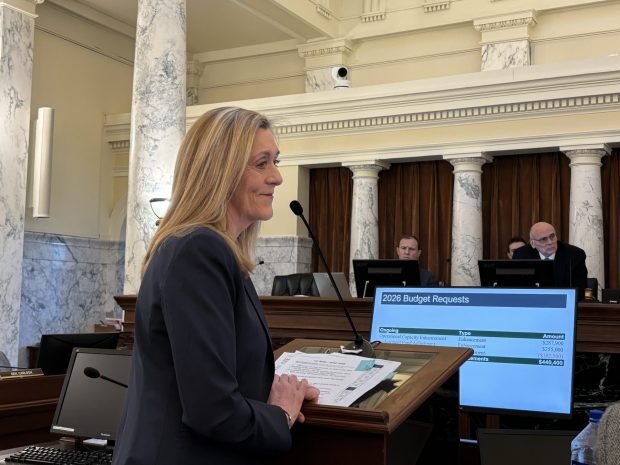
“The need for support services hasn’t changed,” Green told the Joint Finance-Appropriations Committee.
On Dec. 18, the State Board of Education ordered colleges and universities to close support centers geared toward specific student groups — as part of a crackdown on campus diversity, equity and inclusion programs. That same day, the U of I announced its plans to close all offices under its Equity and Diversity Unit, including its women’s center and centers geared toward serving Black students and LGBTQ+ students.
The U of I is moving staff into centers that are designed to serve all students, as the State Board has requested. And student support positions are evolving as well; one staffer left the LGBTQ center, and the U of I will “repurpose” that position. “Those job descriptions as they existed are no longer there.”
As he has at previous JFAC hearings, Rep. Josh Tanner clamored for using the DEI crackdown to save tax dollars. “How much can we actually revert back to the general fund?” said Tanner, R-Eagle.
The Legislature has already banned colleges and universities from using tax dollars for DEI programs. That means the U of I’s $1.2 million comes from student fees and corporate donations.
Green and Lewis-Clark State College President Cynthia Pemberton both addressed JFAC Monday, as budget-writers took their first close look at higher education spending requests. Boise State University President Marlene Tromp and Idaho State University President Robert Wagner are on JFAC’s schedule for Wednesday.
In other JFAC news from Monday:
University of Phoenix. Green said the U of I still hopes to acquire the University of Phoenix, but he said it’s up to the for-profit online giant to make the next move.
“We’re waiting to hear what they would like to do,” Green said.
If the Phoenix purchase moves forward, Green said, the Legislature will have to approve it. The 2024 Legislature blocked the $685 million purchase, throwing the proposal into a holding pattern since summer. The parties have a June 10 deadline to close a deal, and Phoenix has the right to pursue other buyers. But Phoenix has also agreed to pay up to $20 million in “breakup fees” if the U of I bid falls short.
The U of I has already received $5 million, using it to offset some of its consulting fees and due diligence work on the purchase. A $20 million payout would cover the U of I’s costs with perhaps $2 million to $3 million left over, Green said. “I think we’re well-protected.”
Pemberton: “I just want us to catch up a little bit.” Staff salaries remain a top priority at Lewis-Clark.
If the Legislature funds Lewis-Clark’s $288,000 request for discretionary dollars, the money will go into pay raises. But it would take $1.2 million for Lewis-Clark to bring its pay to median levels.
Lewis-Clark’s faculty pay continues to lag behind local K-12 salaries. “I just want us to catch up a little bit,” Pemberton said.
The four-year schools are seeking a total of $3.4 million in discretionary spending, known as “operational capacity enhancement.” This money would go toward salaries and benefits.
Critchfield shares ‘strategic goals’ for education department
State superintendent Debbie Critchfield spoke with the House Education Committee for more than an hour Monday, detailing the “strategic goals” guiding the Department of Education.
She named four:
Getting “back to basics” in teaching
Critchfield, a Republican in her first term, said the department is focusing on the “basics” in reading, math and civics instruction.
She emphasized the importance of phonics in early reading instruction. She also touted an 8% growth in literacy test scores over the last two years. Overall, nearly 60% of Idaho’s K-3 students were reading at grade level this fall. “We’re making great progress in our reading around the state, and we are asking our districts to prioritize this.”
Preparing students for their chosen career paths
Public schools should provide students with experiences relevant to their chosen career paths, Critchfield said. She lauded Career Ready Students, a state-funded program that incentivizes districts to expand career-technical education.
In New Plymouth, Career Ready Students grants funded a meat science class, Critchfield said. In Hagerman, students are learning culinary skills. And in Shelley, the program funded an agriculture drone technology grant.

“These are the things that we’re trying to connect our students with … and particularly in their own backyard.”
Preparing teachers with training they need in today’s classrooms
Critchfield said she and other State Board of Education members are crafting recommendations for universities that would “deepen or broaden” training for K-12 teachers. Teachers are calling for additional training on classroom management and dealing with behavior issues.
“We know that the teacher is the most important tool and element in the classroom. When we have a well-trained and well-supported teacher, we’re going to see results.”
Modernizing the public schools budget
Critchfield also teased her forthcoming proposal to amend a portion of the state’s school funding formula, which is meant to address school leaders’ persistent calls for more money.
“What I’m really hearing our school leaders say is that the money that is coming out is not coming out in the most useful way for the modern classroom.”
Critchfield has proposed distributing districts’ discretionary funding through a weighted formula that provides additional money for higher cost students, such as those with special needs. Critchfield has yet to introduce a bill to amend the formula.
Also on Monday, Critchfield answered several questions from the committee, including some that focused on President Donald Trump’s calls to eliminate the U.S. Department of Education.
Critchfield, who has previously supported the idea, said Idaho would be “just fine,” and the state department will update local school leaders on changes that would come with eliminating the federal agency.
“I’m in no way in a panic that if the Department of Education goes away that we’re going to be in trouble.”
Rep. Douglas Pickett, the committee’s chairman, asked Critchfield what role educators play in developing students’ value systems and whether school boards should prioritize constituent feedback over recommendations from Boise-based “associations.” Pickett didn’t name specific associations, but he said that these groups recommend to school trustees policies that “deal with a student’s moral values,” and the Legislature is asked to step in.
“You would recommend to them that they should listen more to their constituents and worry less about what they’re being told from Boise?” Pickett asked.
Elected officials’ decisions should “reflect the expectations of the community,” Critchfield said. But there is often a “disconnect” between local and state policymakers, even though they’re elected by the same constituents. She urged lawmakers to visit their local schools and meet with school board members.
“It would really cut down on legislation that’s brought forward too, to be honest, when it can be solved at the most local level.”
Mask mandate ban heads to House floor
Voting along party lines, a House committee endorsed a ban on mask mandates.
House Bill 32 would prohibit the state and local governments from requiring face masks “for the purpose of preventing or slowing the spread of a contagious or infectious disease.”
The House State Affairs Committee vote sends the bill to the House floor for a vote, which could occur in the next few days.
A similar bill passed the House last year, but stalled in the Senate.
HB 32 is co-sponsored by Sen. Brian Lenney, R-Nampa, and Rep. Rob Beiswenger, R-Horseshoe Bend.
Bullying reporting requirements clear committee
After little discussion and no public comments, the House Education Committee approved a bill requiring parents be notified of “serious” bullying.
Sponsored by Rep. Chris Mathias, House Bill 44 would direct school districts to implement a policy for notifying parents and guardians of bullying that results in suspension.
These policies would make parents and guardians “aware of the severity of the situation, so that they can do their part as parents and caregivers to make sure that these situations are being addressed,” said Mathias, D-Boise.
Committee members unanimously voted to advance the bill to the full House.
New bill directs school districts to enact cellphone restrictions
A new bill, introduced Monday, would direct public school districts to implement policies governing cellphones and other electronic devices.
The legislation would require that school districts adopt a policy emphasizing that “student use of electronic devices be as limited as possible…during school hours” and reducing distractions from electronic devices.
Many school boards across the state have already enacted cellphone restrictions in recent months and years. Sen. Treg Bernt, sponsor of the bill, said Monday that districts will have flexibility to craft policies specific to their needs.
“A cellphone policy in the West Ada School District looks a lot different than a cellphone policy may look like in Riggins,” Bernt, R-Meridian, told the Senate Education Committee, which voted to introduce the bill. “We want to exercise local control.”

